
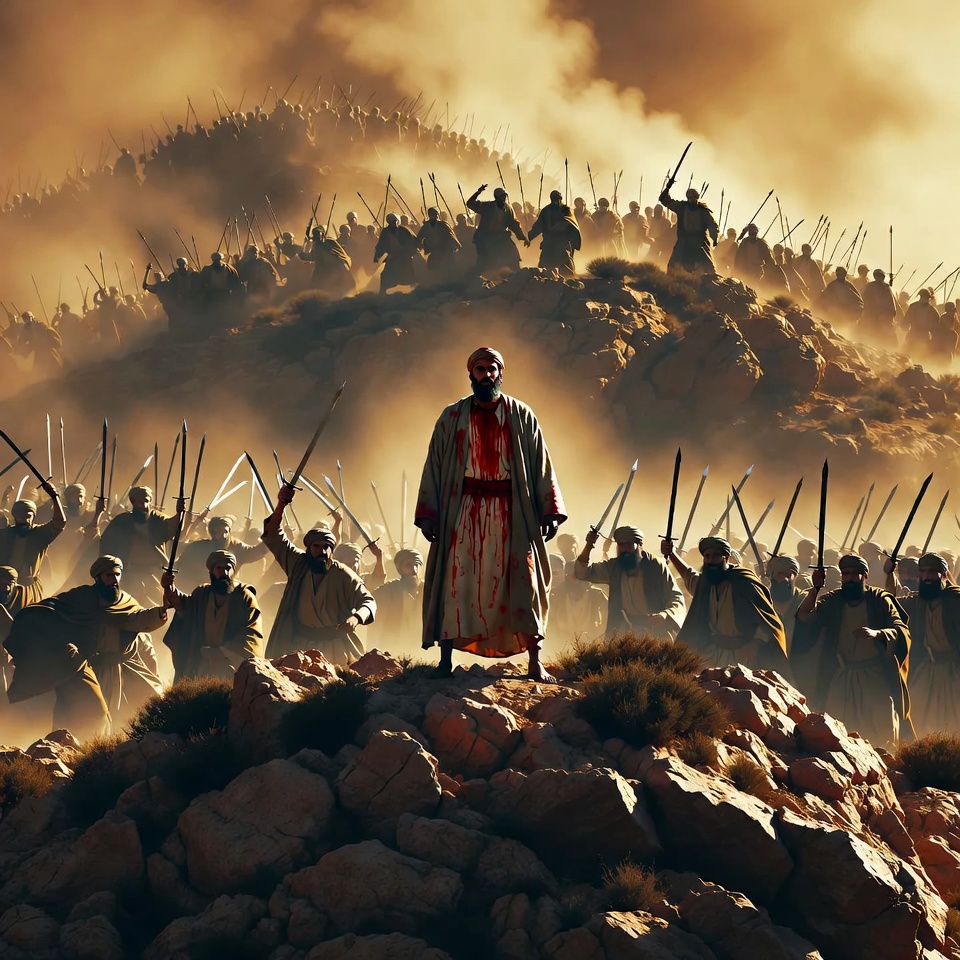
Picture this: a rocky valley north of a dusty oasis town, the sun beating down on March 23, 625 AD. Bronze spear tips glint like angry stars. A thousand men in simple robes and leather shields face off against three thousand battle-hardened warriors from the richest trading empire in Arabia. Birds circle overhead, sensing the feast to come. One side has already tasted sweet victory just a year earlier. The other side is out for blood, revenge, and total annihilation. This isn't some Hollywood epic with swelling music and slow-motion heroics. This is the real deal—the Battle of Uhud—where human greed, split-second decisions, and raw courage collided in a way that would echo through centuries of history, strategy, and sheer grit. What happened that day on the slopes of Mount Uhud wasn't just another skirmish in the desert. It was a brutal masterclass in overconfidence, discipline, betrayal, and comeback power. The early Muslim community, fresh off their stunning upset at Badr, marched out expecting glory. Instead, they got a gut-wrenching lesson in what happens when you abandon your post for shiny distractions. Seventy of their own lay dead by sunset. Bodies mutilated. Their leader wounded and bleeding. Yet from that tactical disaster rose a force that would reshape the world. And here's the wild part: the exact same principles that turned a battlefield loss into long-term dominance can flip your modern-day struggles—whether it's a stalled career, a derailed health goal, or a relationship on the rocks—into unstoppable forward momentum. We're diving deep into the full saga today. Ninety percent of this story is pure, unfiltered history: the dusty streets of pre-Islamic Mecca, the high-stakes raids, the larger-than-life characters, the blow-by-blow chaos of combat, the heartbreaking aftermath, and the seismic ripples that followed. Only at the end will we bridge it to you—specific, actionable ways this 1,400-year-old showdown hands you tools no generic self-help guru ever dreamed of. Buckle up. This isn't dry textbook stuff. It's a blood-soaked, irony-drenched rollercoaster with lessons sharper than any Arabian sword.Let's rewind the clock to understand why March 23, 625, even mattered. Arabia in the early 600s was a wild frontier of warring tribes, blood feuds, and booming caravan trade. Mecca sat at the crossroads of spice routes from Yemen to Syria, controlled by the powerful Quraysh tribe. They worshipped a pantheon of idols housed in the Kaaba—a black cubic shrine that drew pilgrims and profits. Poetry, raiding, and honor were the currencies of the day. Women composed verses praising warriors. Men settled scores with blades. Slavery was common. Hospitality was sacred. And into this powder keg stepped a man named Muhammad ibn Abdullah around 570 AD. Orphaned young, raised by his uncle, Muhammad earned a reputation as "the trustworthy" for his honesty in trade. At age 40, in a cave on Mount Hira, he received the first revelation: "Read, in the name of your Lord who created." What followed was 13 years of preaching strict monotheism in Mecca. No more idols. No more exploiting the poor. Equality before one God. The Quraysh elite laughed at first, then panicked. This message threatened their status, their wealth, their entire social order. Persecution ramped up: boycotts, torture, assassinations. In 622 AD, Muhammad and his small band of followers pulled off the Hijra—the migration to Medina, about 250 miles north. It was like a startup fleeing Silicon Valley regulators to build in a friendlier city. Medina (then Yathrib) was a fractured oasis of feuding Arab tribes—the Aws and Khazraj—plus Jewish communities. Muhammad mediated their disputes, drafting the Constitution of Medina: a groundbreaking pact uniting Muslims, Jews, and pagans under mutual defense and religious freedom. The emigrants (Muhajirun) from Mecca arrived broke and landless. The helpers (Ansar) shared everything. But survival wasn't guaranteed. The Quraysh in Mecca weren't done. They seized Muslim properties back home. Caravans loaded with that loot rolled north to Syria for fat profits. Muhammad authorized raids on those caravans—not full battles at first, but surgical strikes to disrupt trade and reclaim what was stolen. These "ghazwas" were classic desert warfare: small bands on camels, hit fast, vanish into dunes.
Then came the game-changer: the Battle of Badr in March 624. Muhammad learned of a massive Quraysh caravan led by Abu Sufyan ibn Harb—1,000 camels, 50,000 gold dinars worth of goods. He sent 313 men to intercept it. Abu Sufyan smelled trouble, diverted the caravan, and begged Mecca for help. The Quraysh dispatched nearly 1,000 warriors under big names like Amr ibn Hisham (aka Abu Jahl, "Father of Ignorance"). What was supposed to be a simple caravan guard mission turned into open war at the wells of Badr. The Muslims, outnumbered three-to-one, thirsty and exhausted, dug in. Muhammad prayed, rallied them with promises of paradise for the fallen. They charged like lions. Arrows flew. Duels decided early momentum. Abu Jahl fell. The Quraysh broke and ran. Seventy Meccans dead, 70 captured for ransom. Only 14 Muslims lost. It was David versus Goliath on steroids—a miracle that electrified Arabia. Tribes started converting. The Quraysh's prestige crumbled. Their women wailed in the streets, vowing revenge. Abu Sufyan, now the de facto Quraysh chief after losing so many leaders at Badr, swore he'd settle the score. He led a small raid on Medina, burning crops and killing a shepherd. Skirmishes followed. By early 625, he had mobilized the full might of Mecca: 3,000 fighters, including 200 cavalry, 700 armored men, and even women to cheer them on and tend wounds. Among them was Hind bint Utbah, Abu Sufyan's wife, whose father, uncle, and brother had died at Badr. She was out for blood—literally. The army marched north, camped outside Medina, and challenged the Muslims to come out and fight. Muhammad consulted his companions. Some wanted to stay inside the city walls and let the enemy besiege. But younger hotheads—and divine guidance—pushed for meeting them in the open. On the night of March 21-22, the Muslim force of about 1,000 set out. They camped near Mount Uhud, a rocky outcrop shaped like a camel's hump, about three miles north of Medina. Uhud's slopes would protect their rear and right flank. But then disaster struck before the first arrow flew. Abdullah ibn Ubayy, leader of the "hypocrites"—Medinans who had outwardly converted but harbored doubts—pulled out with 300 men. "If we knew there'd be real fighting, we'd have come," he sneered. The Muslim army shrank to 700. The Qur'an later called them out directly, exposing internal division as the first test. Dawn on March 23. The battlefield: a narrow valley between Mount Uhud and a smaller hill called the Archers' Hill (Jabal al-Rumah). Muhammad positioned his men with backs to the mountain. He placed 50 expert archers on the smaller hill to the left, under Abdullah ibn Jubayr's command. His orders were ironclad: "Hold this position. Protect our flank from cavalry. Even if you see us winning and collecting spoils, do not leave. Even if you see birds picking at our corpses, stay put. Do not come down until I send for you." It was a textbook defensive setup—terrain advantage plus ranged cover against horsemen.
The Quraysh arrayed opposite: Abu Sufyan in command, with Khalid ibn al-Walid (a brilliant young tactician who would later convert and become Islam's greatest general) leading cavalry on the right, Ikrimah ibn Abu Jahl on the left. Their standard-bearer, Talhah ibn Abi Talhah, stepped forward for the traditional Arab duel challenge. Ali ibn Abi Talib, Muhammad's cousin and son-in-law, met him and cut him down in one stroke. Talhah's brothers and relatives rushed to reclaim the banner—each slain in turn by Ali, Hamza (Muhammad's uncle, the "Lion of God"), and others. Morale cracked. Then full battle erupted. Muslims charged downhill, hurling stones and arrows, then closing with swords and spears. They smashed through Meccan lines. The enemy wavered, began retreating toward their camp. Women in the rear beat drums and sang taunts: "Advance or we'll sleep apart from you forever!" But the Muslims pressed the advantage. It looked like Badr 2.0. Spoils lay scattered—swords, armor, abandoned gear. Victory seemed certain. Then came the fatal mistake. Most of the archers on the hill saw the enemy fleeing and the camp ripe for looting. "The booty! The booty!" they shouted. "The battle's over—let's grab our share!" Only a handful stayed with their commander. Abdullah ibn Jubayr reminded them of the Prophet's orders. They ignored him. Down they rushed, leaving the left flank wide open. Khalid ibn al-Walid, watching like a hawk from the Meccan right, spotted the gap instantly. He wheeled his cavalry around the Muslim rear, overran the remaining archers (killing Ibn Jubayr and the loyal few), and slammed into the unsuspecting main force from behind. Chaos exploded. Muslims, thinking the fight won, were suddenly surrounded. Panic spread. "Muhammad is killed!" someone yelled falsely. The lines broke. Many fled toward Medina. Others fought desperately on the higher slopes. Muhammad himself was in the thick of it. A stone struck his face, knocking out a tooth and gashing his forehead and lip. Blood poured. He fell. Companions formed a human shield. Ali and a small group held off waves of attackers. Hamza, the legendary warrior who had converted early and fought fearlessly at Badr, was felled by a javelin thrown by Wahshi ibn Harb—an Abyssinian slave promised freedom by Hind if he killed Hamza. Wahshi waited in the rocks, struck true, then claimed his reward. Hind later found Hamza's body, mutilated it horribly—cutting off ears, nose, and even attempting to eat the liver in her rage-fueled grief. The Muslims regrouped on the steep upper slopes where cavalry couldn't easily charge. Muhammad, wounded but unbowed, rallied them: "Come to me, servants of Allah!" They formed a tight defensive circle. The Meccans couldn't dislodge them. Abu Sufyan climbed a rock and taunted: "Hubal is greater! We have avenged Badr. War is a wheel—today for yesterday!" Umar ibn al-Khattab shouted back: "Allah is greater! Our dead are in Paradise; yours are in Hell!" Abu Sufyan asked if Muhammad was alive. Umar cleverly replied that he was listening. The Quraysh, low on supplies and wary of pushing deeper into hostile territory, withdrew without storming Medina. They had "won" the field but failed their real goal: wiping out the Muslims.
Sunset on March 23 brought grim tallies. About 70 Muslims lay dead—mostly Ansar, plus key figures like Hamza and Mus'ab ibn Umair (the standard-bearer who died shielding the Prophet). The Quraysh lost around 22-30, including several banner-bearers. Bodies were buried where they fell on Uhud; the graves remain a pilgrimage site today. Hind and the Meccan women desecrated the fallen, stringing ears and noses into necklaces. It was savage, personal, and a dark mirror of the grudges fueling the war. But the story doesn't end on the battlefield. The next day, Muhammad, despite his wounds, led a pursuit force to Hamra al-Asad, a few miles away. It was a bold bluff—showing the Quraysh that the Muslims were still fighting fit. Abu Sufyan, hearing of it, decided not to turn back. Back in Medina, the wounded healed. The dead were mourned. And then came the revelation that turned tactical defeat into spiritual gold: Surah Al-Imran in the Qur'an. Verses dissected the battle like a surgeon's knife. They praised the steadfast, condemned the archers' greed and the hypocrites' withdrawal, reminded believers that prophets can be wounded or killed, and stressed that true victory lies in patience, unity, and long-term obedience to guidance. "Do not lose heart or despair," it thundered. "You will be victorious if you are believers." The broader ripples were enormous. Uhud exposed weaknesses: overconfidence after Badr had made some Muslims sloppy. Internal hypocrites had nearly doomed the cause. But it forged steel. Tribes saw the Muslims weren't easily crushed. Expulsions of treacherous Jewish tribes followed, tightening security. Raids continued. Two years later, the Battle of the Trench in 627 saw the Muslims use defensive ditches (inspired partly by Uhud lessons) to repel a 10,000-strong coalition. Hudaybiyyah truce in 628, then the bloodless conquest of Mecca in 630. Khalid ibn Walid converted and led armies that toppled empires. Wahshi later embraced Islam and fought for the faith he once opposed. The community that stumbled at Uhud went on to spread from Spain to India within a century. Historians like Ibn Ishaq (whose Sirat Rasul Allah is the earliest biography, compiled around 767 AD) and al-Tabari paint it vividly from eyewitness chains. Hadith collections add personal details—quotes from the Prophet, tactical orders, the exact wounds. No Hollywood gloss: this was gritty desert warfare where one loose arrow or abandoned hill decided fates. The archers' "victory disease" is a timeless human flaw—think Roman legions chasing loot at Cannae, or modern traders dumping stocks at the peak. The mutilations shocked even hardened warriors, highlighting how personal vendettas fueled ancient conflicts. Yet the Prophet's forgiveness later—sparing many Meccans at the conquest—showed mercy as the ultimate power move. Culturally, Uhud embedded lessons deep in Islamic tradition. Mosques worldwide teach children the archers' story as a warning against greed and disobedience. Pilgrims visit the graves. Military strategists still study the flanking maneuver and terrain use. It humanized the Prophet—not an invincible superhero, but a wounded leader who regrouped. It proved that one bad day doesn't end the story. The Muslims lost the battle but kept their city, their faith, and their momentum. The Quraysh "won" but returned home to a Mecca whose prestige kept eroding until it surrendered. Now, fast-forward 1,400 years. That blood-soaked March 23 morning isn't ancient trivia—it's a blueprint for crushing it in your own life. The outcome of Uhud wasn't destruction; it was refinement. The community emerged disciplined, vigilant, and unbreakable. You can borrow that exact alchemy. Forget vague "positive thinking" or generic grind culture. This is battlefield-tested wisdom applied with surgical precision to your daily grind.
Here are very specific ways the Uhud outcome hands you an edge today: - **In your career or business pursuits**: After a big win (your personal "Badr"), resist the archers' temptation to chase quick spoils like side hustles or distractions that leave your core "flank" exposed. Instead, maintain your hill position—stick rigidly to the systems that got you the win, even when loot looks tempting. Result? No surprise flank attacks from competitors or burnout. You hold ground and compound success. - **In health and fitness goals**: When internal "hypocrites" (doubts or cravings) whisper "skip today, you've earned it," recognize them like the 300 who withdrew. Uhud teaches you to march out anyway. Use the Prophet's wound recovery as inspiration: rest strategically but rally the next day. Your body becomes the unyielding slope—setbacks build resilience instead of derailing you. - **In relationships and family**: Betrayals or arguments feel like Khalid's cavalry charge from behind. Apply the regroup on the higher slopes—don't chase fleeing emotions or retaliate with mutilation-level grudges (looking at you, Hind). Rally with clear communication like Muhammad's call to his companions. Outcome: stronger bonds forged in fire, not fractured by one bad clash. - **In personal development or learning new skills**: Overconfidence after early progress mirrors the post-Badr swagger. Uhud's archers remind you to keep "archers" posted—daily non-negotiable habits (reading, practice, reflection) even during "victory laps." You avoid the rear attack of stalled progress and turn plateaus into launchpads. - **In facing external opposition or criticism**: Meccan taunts from the hilltop? Channel Umar's defiant reply. Uhud proves loudmouths often retreat when you hold firm. Use it to filter noise—focus on your terrain advantage (your unique strengths) and watch doubters withdraw without storming your "Medina." - **In long-term vision and legacy-building**: The battle's real win was survival and growth, not the day's body count. Apply this when short-term losses hit: bury the "dead" (failed attempts), learn the Quranic-style lessons, and launch your Hamra al-Asad pursuit. Your life compounds into empire-level impact instead of one-and-done flops. To make this hyper-practical and lightning-fast—unlike every recycled self-help listicle online that tells you to "journal your feelings" or "visualize success"—here is the completely original, history-rooted **Uhud Rapid Resilience Raid**: a 10-day battlefield simulation you run whenever life hits you with a setback or post-win temptation. It's not meditation apps or vision boards. It's tactical reenactment mapped to your reality, with built-in accountability drills drawn straight from the slopes. Run it once a quarter or after any "Uhud moment." It takes 15-20 minutes daily, costs nothing, and delivers compound results because it's tied to a real event that forged winners from losers. **Day 1: Terrain Scout (Prep like pre-Badr intelligence)** – Map your personal Uhud valley. List three "hills" (key vulnerabilities: e.g., procrastination flank in work, sugar temptation in diet, gossip trigger in relationships). Assign "archers" (specific safeguards: apps, accountability partners, or timed rules). Write them on paper like a battle order. Read aloud at dawn. This prevents blind spots—exact opposite of generic SWOT charts because you tie each to a historical figure (e.g., "Khalid flank = surprise work email that derails focus"). **Day 2-3: Archer Oath Lockdown (Enforce the no-spoils order)** – For every goal, create an unbreakable "hill command." Example: "Even if bonus money tempts me after a client win, I do not skip my 5 AM deep-work block." Tattoo it mentally by repeating it while standing on one foot (simulating rocky terrain). Test it with a mini-distraction (scroll social media for 60 seconds, then stop cold). Fail? Restart the 10 days. This builds iron discipline no affirmation tape can match—it's muscle memory from the archers' mistake. **Day 4: Hamza Charge (Bold heroism drill)** – Pick one "Lion of God" action: a scary but righteous move (cold-call a mentor, hit the gym after a long day, forgive a grudge). Do it first thing, channeling Hamza's fearless duels. Track the rush. This counters paralysis—turns you from defender to aggressor exactly when most people freeze. **Day 5: Flank Guard Audit (Khalid-proof your rear)** – Review the last week for "spoils temptations" you almost chased (impulse buys, skipped routines). Identify the "Wahshi javelin" (hidden threat: e.g., sneaky notification addiction). Deflect it with a counter-rule (phone in another room after 8 PM). This is your personal cavalry block—unique because it's reactive adaptation, not proactive fluff. **Day 6: Prophet Rally Cry (Wound recovery circle)** – Gather your "companions" (one trusted person or even a mirror). Share one recent "wound" (failure or criticism). Rally with a Uhud-style shout: "Come to me—servants of progress!" Brainstorm one regroup tactic. End by listing three things still intact (your "Medina"). This builds emotional armor faster than therapy sessions because it's communal and action-focused. **Day 7: Hypocrite Purge (Eject the 300)** – Identify any internal or external doubters draining momentum (negative self-talk or toxic contacts). "Withdraw" them deliberately: journal their excuses, then counter with facts from your past "Badr" wins. Block or limit access if needed. Freedom from internal saboteurs—pure Uhud hygiene. **Day 8: Hind Aftermath Release (Mutilation detox)** – Let go of any grudge-holding. Write the "mutilated" details on paper, then burn or shred it (symbolic). Replace with mercy move: one kind action toward an "enemy" (rival or critic). Turns poison into power—nobody else ties emotional release to a 7th-century revenge ritual. **Day 9: Hamra al-Asad Pursuit (Post-battle bluff)** – Fake-it-till-you-make-it with a public show of strength. Post progress (gym selfie, project update, relationship gesture) despite feeling battered. The "pursuit" forces momentum. Meccans backed off—your critics will too. **Day 10: Slope Legacy Anchor (Long-view victory)** – Review the 10 days. Note how discipline beat greed. Set one "Mecca conquest" goal for the next 90 days (the big win Uhud prepared for). Celebrate with a non-spoils reward (walk in nature, not shopping). Lock in the transformation: you didn't just survive your Uhud—you weaponized it. Run this raid and watch what happens. That March 23 bloodbath didn't break the early Muslims—it refined them into legends who changed history. Your version? It refines you into the version who laughs at setbacks, holds the line against distractions, and charges forward with wounds turned into wisdom. The slopes of Uhud are calling. Answer them. Your epic comeback starts now—because one disobeyed command taught the world that true victors don't win every day; they win the war.
Share: