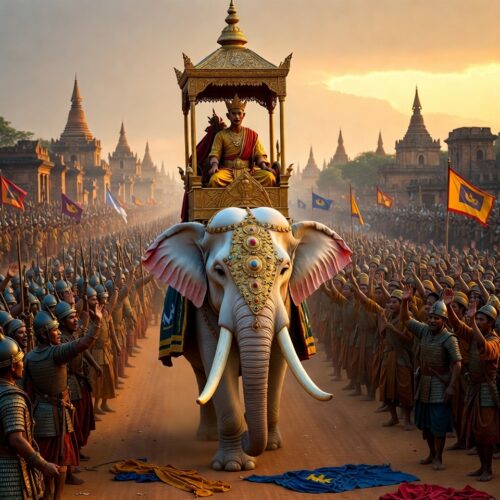

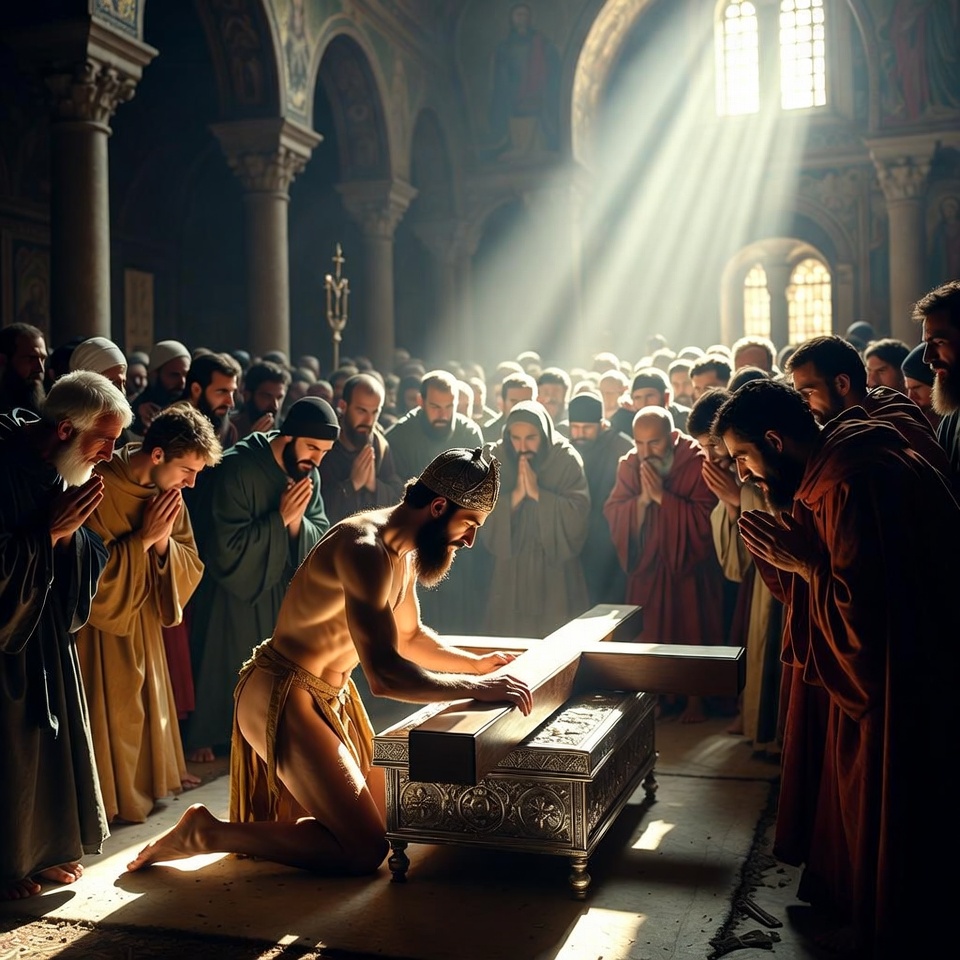
Picture this: It's March 21, 630 AD, and the sun beats down on the ancient streets of Jerusalem like a divine spotlight. Byzantine Emperor Heraclius—battle-scarred, weary from years of personal command on the front lines—approaches the gates of the Holy City in full imperial pomp. Golden robes shimmering, crown gleaming, mounted on a magnificent warhorse, the True Cross of Christ strapped securely to his saddle like the ultimate trophy from the greatest comeback in antiquity. This isn't just any parade. This is the climax of a 26-year war that nearly annihilated two superpowers, a holy relic snatched by fire-worshipping invaders, recovered through blood-soaked mountain campaigns, and now paraded home.But the gates won't budge. The horse balks. An invisible force—chroniclers call it divine intervention, an angel playing celestial traffic cop—stops the procession cold. Heraclius, the man who'd slain Persian generals in single combat and toppled an empire, gets the ultimate ego check. He dismounts, strips to simple garments, removes his crown, and hoists the heavy wooden relic onto his own shoulders. Suddenly, it feels light as a feather. The gates swing open unaided. Barefoot, humble, sweating under the weight of history's most sacred symbol, the emperor carries the True Cross into Jerusalem as crowds weep and cheer. No trumpets blaring his glory—just pure, unadorned triumph. This wasn't some footnote in dusty chronicles. On March 21, 630, Heraclius reversed one of the greatest "heists" in religious history and sealed the last great war of the ancient world. The True Cross—discovered by Empress Helena three centuries earlier, lost in the flames of Persian conquest, reclaimed after desperate reforms and lightning campaigns—symbolized everything: faith under fire, strategy over brute force, and the power of humility after victory. For over 90% of this story, we're diving deep into the raw, blood-and-iron details of how one emperor turned total collapse into holy reclamation. Then, we'll flip it to you: how this forgotten March 21 moment equips you with a razor-sharp, campaign-style plan that's nothing like the recycled "journal and affirm" fluff clogging the internet. No vision boards. No gratitude lists. This is your personal Byzantine reconquest—quick, dirty, and devastatingly effective. Let's rewind to the relic's origin story, because no March 21 triumph makes sense without it. Around 326-328 AD, Helena, mother of Constantine the Great (the guy who legalized Christianity and built an empire on it), trekked to the Holy Land on a relic-hunting mission. Jerusalem was a mess of pagan temples layered over Christian sites. Helena ordered the demolition of a temple to Venus built atop what locals swore was Jesus' tomb. Digging revealed the Holy Sepulchre—and three crosses buried nearby. Which one was the real deal, the one that held the Son of God? Legend says they tested them on the sick and dying. One cross healed a noblewoman instantly; the others did nothing. Boom: the True Cross identified. It was a mishmash of woods—cedar, pine, cypress, per Eastern tradition—wrapped in silver, housed in the gleaming Basilica of the Holy Sepulchre. Pilgrims like the nun Egeria in the 380s described the ritual: deacons guarded it fiercely (someone once bit off a chunk!), while the faithful kissed it reverently, foreheads pressed to the sacred wood. Fragments flew across the empire in golden reliquaries, healing the sick, inspiring armies. Cyril of Jerusalem boasted the "whole earth is full of the relics of the Cross." It wasn't just a stick; it was Christianity's ultimate power object, proof of resurrection amid Roman chaos.
Fast-forward three centuries, and that holy wood is in serious trouble. The year is 614, and the Sassanid Persian Empire under King Khosrow II (Chosroes to the Greeks) is on a rampage. This isn't some border skirmish. It's the explosive restart of the endless Roman-Persian grudge match, kicked off in 602 when Byzantine Emperor Maurice—Khosrow's old ally and "father-in-law" figure—was murdered in a bloody coup by the tyrannical general Phocas. Khosrow, feigning outrage to avenge his friend, invaded like a vengeful god. Persians swept through Mesopotamia, the Caucasus, Syria. By 613, they smashed the Byzantines at Antioch, looting the city and slaughtering the patriarch. Damascus fell next. Then came Jerusalem's nightmare: a three-week siege ending in massacre. Between 57,000 and 66,500 Christians dead. Churches torched, including the Holy Sepulchre. The True Cross? Ripped from its silver casket and hauled off to Persia as the ultimate trophy, paraded before Zoroastrian fire altars. Jews allegedly aided the Persians (chroniclers exaggerated the drama for propaganda), deportations hit 35,000, and Egypt tumbled soon after in 618. Persian armies camped at Chalcedon, staring across the water at Constantinople itself. The Byzantine Empire—once the rock of the Christian world—was hemorrhaging territory, grain, and hope. Phocas ruled like a psychotic middle manager: rapes, executions, zero strategy. The empire teetered. Enter Heraclius, the barefoot hero of our March 21 tale. Born around 575 in Cappadocia to a successful general (also named Heraclius, exarch of Africa), the younger Heraclius grew up in a military family of probable Armenian stock. In 608, his father launched a revolt against Phocas from Carthage. Cousin Nicetas secured Egypt by 609. Young Heraclius sailed east with a fleet, stopping in Sicily and Cyprus for recruits. By October 610, he reached Constantinople. The elite Excubitor guards—led by Phocas' own son-in-law Priscus—defected. Heraclius stormed in, captured the tyrant, and asked the classic question after Phocas sneered, "Will you rule any better?" Heraclius beheaded him on the spot. (Chroniclers added a gruesome flourish: Phocas' genitals were hacked off in revenge for his rapes.) Crowned October 5 in the Chapel of St. Stephen, Heraclius married Fabia Eudokia (who died in 612) and later his niece Martina in 622—a scandalous union that produced kids with disabilities, later blamed on divine punishment for incest.
Heraclius inherited a dumpster fire. Persians controlled the east, Avars and Slavs raided the Balkans, treasury empty, army shattered. He slashed spending, melted church plate for coin, halved officials' pay, debased currency—harsh but necessary. In 618, he nearly fled back to Carthage, but Patriarch Sergius and the people begged him to stay. He listened. Reforms began: drill the troops in Bithynia, promote Greek as the official language (shifting from Latin), adopt the title "Basileus" (king), and frame the fight as holy war. He carried an acheiropoietos (not-made-by-hands) icon of Christ as his battle standard. This wasn't just survival; it was reinvention. Heraclius personally led from the front—the first emperor to do so since the 4th century. The counteroffensive kicked off April 4, 622. Leaving infant son Heraclius Constantine as co-emperor under Sergius' watch, Heraclius sailed east. First stop: Armenia. He crushed a Persian-allied Arab chief, then routed General Shahrbaraz. Easter 624 in Nicomedia, then deep into the Caucasus. His armies torched the great Zoroastrian fire temple at Adur Gushnasp—psychological warfare at its finest. Victories piled up against Shahrbaraz, Shahin, and Shahraplakan. In 625, at the Sarus River, Heraclius charged across a bridge under arrow fire like a man possessed. Shahrbaraz, watching, quipped that the emperor feared arrows "no more than an anvil." Heraclius even ambushed Shahrbaraz's camp at Aliovit in February; the general fled naked, abandoning his harem and baggage. Drama! 626 brought the mother of all sieges: Avars and Slavs (80,000 strong) plus Shahrbaraz's Persians hit Constantinople from both sides. Heraclius was off campaigning, but the city held thanks to Patriarch Sergius parading Virgin Mary icons along the walls. Navy smashed Persian rafts. Theodore (Heraclius' brother) crushed Shahin elsewhere. Feigning jealousy letters from Khosrow, Heraclius tricked Shahrbaraz into defecting. Masterclass in psychological ops. By 627, Heraclius allied with the Göktürks under Ziebel—40,000 horse archers for a marriage pact and gifts. They ravaged Transcaucasia, besieging Tbilisi with traction trebuchets. Turks bailed late, but Heraclius pressed on alone with maybe 25,000-50,000 men. December 12, 627: Battle of Nineveh in the fog near the Tigris ruins. Persians under Rhahzadh (6,000 elite) charged. Heraclius feigned retreat, then counterattacked. He allegedly killed Rhahzadh in single combat—one thrust through the chest—while taking a lip wound himself. Persians broke. Heraclius sacked Khosrow's pleasure palace at Dastagird, destroyed bridges to Ctesiphon. Khosrow fled, only to be overthrown and executed by his son Kavad II (Siroes) in February 628. Arrows riddled the old king over five days in a dungeon. Kavad sued for peace: all territories returned, prisoners freed, indemnity paid, True Cross handed over. The relic's journey home was cinematic. Shahrbaraz (now allied) or Kavad sent it back via negotiator. Heraclius paraded it first in Constantinople's Hagia Sophia, then toured the empire. Finally, March 21, 630 (or 629 per some calendars), Jerusalem. That's where the humility miracle hits. Golden Legend and later accounts paint it vividly: Heraclius tries the grand entrance—horse, robes, crown. The cross weighs a ton; gates stick. Divine smackdown. He strips down, goes barefoot, shoulders the wood. It lightens. Gates fly open. Crowds roar. The "first crusader" (as Western chroniclers later hailed him) restores the Cross to its Sepulchre home. Symbolism? After two decades of Persian arrogance (Khosrow once demanded Heraclius grovel as "obedient son"), victory demanded humility. No chest-thumping parade—just an emperor carrying his own cross.
The war's toll was apocalyptic. Over 200,000 dead on both sides. Cities razed, economies wrecked. Heraclius' reforms—military "themes" (land grants for soldier-farmers), Greek administration—kept Byzantium alive. But both empires were exhausted. Arabs, freshly unified under Islam, struck almost immediately: raids in 629, full conquests by 636 at Yarmouk (Heraclius' brother Theodore defeated). Persians fell entirely; Byzantium lost the east but survived as a Greek Christian bulwark for centuries. Heraclius died February 11, 641, at 65, amid family drama (sons Heraclius Constantine and Heraclonas co-ruled under Martina's regency). His monothelitism compromise to unify churches flopped, but his military legacy endured. What a saga: from relic discovery under Helena, to Persian theft amid massacre, to Heraclius' phoenix rise, six-year personal crusade, Nineveh heroics, and that barefoot procession. March 21, 630, wasn't random—it was the emotional payoff after impossible odds. The emperor who nearly abandoned ship reclaimed not just wood, but the empire's soul. Now, here's where this distant thunderclap cracks open your life like a siege engine on a weak gate. The outcome of Heraclius' reconquest—strategic patience through chaos, bold strikes after reform, and humility locking in the win—translates directly to your daily grind. No vague "be resilient" platitudes. This is specific, battle-tested application that turns your personal "Persian invasions" (dead-end jobs, toxic relationships, stalled dreams) into reclaimed territory. **Specific ways this historical fact supercharges your individual life today:** - **Reclaim "stolen relics" like Heraclius did the Cross**: After 16 years of Persian control, he didn't whine—he audited resources, slashed waste, and launched targeted raids. In your life, that means identifying one core "sacred" thing you've lost (your health after burnout, a creative passion buried under bills, a relationship eroded by grudges) and treating its recovery as non-negotiable campaign objective. Result? You stop accepting half-measures and execute precise strikes instead of scattered complaints. - **Turn near-defeat into frontline command like the 622 launch**: Heraclius considered fleeing to Carthage amid Avar raids and empty coffers but stayed, reformed on the fly, and personally led. Apply this: when your "empire" (career, family stability) hits rock bottom—layoffs, health scares, betrayals—you ditch the escape fantasy, strip non-essentials, and charge personally. No delegating your growth; you become the emperor in the field, building unbreakable momentum from desperation. - **Forge unlikely alliances for the deep strike**: Heraclius' Gökturk pact (40,000 nomads for a marriage promise) flipped the Caucasus theater. Translate to today: instead of solo-grinding, you broker weird, high-leverage "pacts" with mentors, unlikely collaborators, or even rivals who share an enemy (procrastination, self-doubt). Outcome: exponential gains where solo efforts stalled, just like Turks ravaging Persian flanks while Heraclius hit Nineveh. - **Execute the Nineveh reversal after feints**: Foggy battlefield, outnumbered, feigned retreat then savage counter—Heraclius killed the enemy general himself. In practice: when life ambushes you (deadline doom, family crisis), don't panic-charge; feint (step back, reassess), then strike decisively on the weak point. You develop sniper-like focus, turning defense into offense and emerging with "battle scars" (a healed lip wound? Just a story now) that prove your command. - **Lock victories with barefoot humility**: The gate miracle wasn't showy triumph; it was ego surrender. Post-win (promotion, fitness goal crushed, relationship mended), you perform one anonymous act of service—no social media humblebrag. This prevents "Khosrow hubris" (paranoid overreach that got him killed) and sustains gains, keeping your personal empire stable against the next "Arab wave" of challenges.
These aren't abstract. They rewire how you operate: your "lost Jerusalem" (that big dream) gets stormed not by wishful thinking but by Heraclian logistics. **Your detailed, quick, ultra-unique Heraclian 21-Day Reconquest Protocol – nothing like online self-help** Forget 30-day challenges or morning routines. This is a military expedition blueprint, modeled exactly on Heraclius' arc but customized for your solo empire. It runs 21 days (nod to the date) in four campaign phases. You'll need: a notebook for "battle dispatches" (weekly field reports, not fluffy journaling—raw intel on terrain, enemy movements, supply lines), a wall "campaign map" (sketch provinces like Career Province, Health Frontier, Relationship Borderlands), and zero apps. The uniqueness? Every obstacle gets codenamed after Persian villains (your boss = "General Shahrbaraz the Deadline Dodger"; Netflix binges = "Avar Raider Hordes"). Victories end with a "humble entry ritual" (carry a literal small wooden cross or symbolic object barefoot around your block while listing three non-negotiable next strikes). No affirmations—just dispatches and levies. This crushes generic advice because it's tactical warfare on your life, not therapy-speak. **Days 1-5: The Phocas Purge (Internal Coup and Resource Reform)** Start like Heraclius in 610: execute the tyrant inside. List every "Phocas" draining you—toxic habits, energy vampires, outdated commitments. Behead them metaphorically (cancel subscriptions, ghost bad influences, cut one non-essential expense). Levy resources: audit time/money like church plate melting—reallocate 20% to your "army" (dedicated blocks for big goals). Dispatch 1: "Phocas fell today. Morale rising." Train basics in "Bithynia camp" (daily drills: 30-minute focused strike on one weakness). By day 5, your empire is lean, funded, and loyal. Funny twist: name your worst habit "Khosrow's Paranoia" and laugh as you purge it. **Days 6-10: The Caucasian Deep Strike (Alliances and Raids)** Channel 624 Armenia. Forge one "Gökturk pact"—reach out cold to someone powerful or random (old colleague, online expert in your field) with a specific mutual-win offer. No small talk; propose a raid. Launch three small strikes on big goals (e.g., apply to that dream job, schedule the scary doctor's visit, pitch the side hustle). Use feints: test waters without full commitment. Dispatch 2: "Allies secured. Shahrbaraz routed naked." Track on your map with arrows. This phase builds your cavalry—unexpected help multiplies force. **Days 11-15: The Constantinople Siege Defense and Nineveh Counter** 626 vibes: repel incoming hordes (procrastination raids, distractions). Procession your icon (print a motivational image or symbol, parade it mentally during walks). When the "siege" hits (real-life ambush like bad news), feint then counter hard—personal combat with your biggest enemy general (spend one full day annihilating it). Heraclius' lip wound? Accept minor setbacks as battle marks. Dispatch 3: "Fog lifted. Rhahzadh slain." End with a mock sack: destroy one symbolic "Dastagird palace" (delete a clutter folder or old grudge note). **Days 16-21: The March 21 Humble Triumphal Entry** The payoff. Parade your reclaimed "True Cross" (celebrate one major win publicly but end with barefoot ritual: walk a block carrying a stick or phone note of your goal, listing three future strikes while naming one anonymous good deed you'll do). Integrate gains across provinces—no overreach. Final dispatch: "Gates open. Cross restored. Empire secured." Review the map: what's next campaign? Repeat the protocol quarterly or when "Persians" return. It's quick (21 days to momentum), detailed (every phase has dispatches and rituals), and unique (military codenames + humble carry = zero overlap with yoga-and-vibes self-help). You'll emerge like Heraclius—scarred, victorious, ready for whatever Arabs ride in next. That March 21 procession wasn't just history. It was proof: after the longest war, the deepest reforms, and the bloodiest battles, humility seals the deal. You hold the same relic now—your life. Strip the pomp, shoulder the weight, and march through gates that once seemed barred forever. Your Nineveh awaits. Go reclaim it, emperor. The empire you build will outlast any Persian ghost.
Share: