

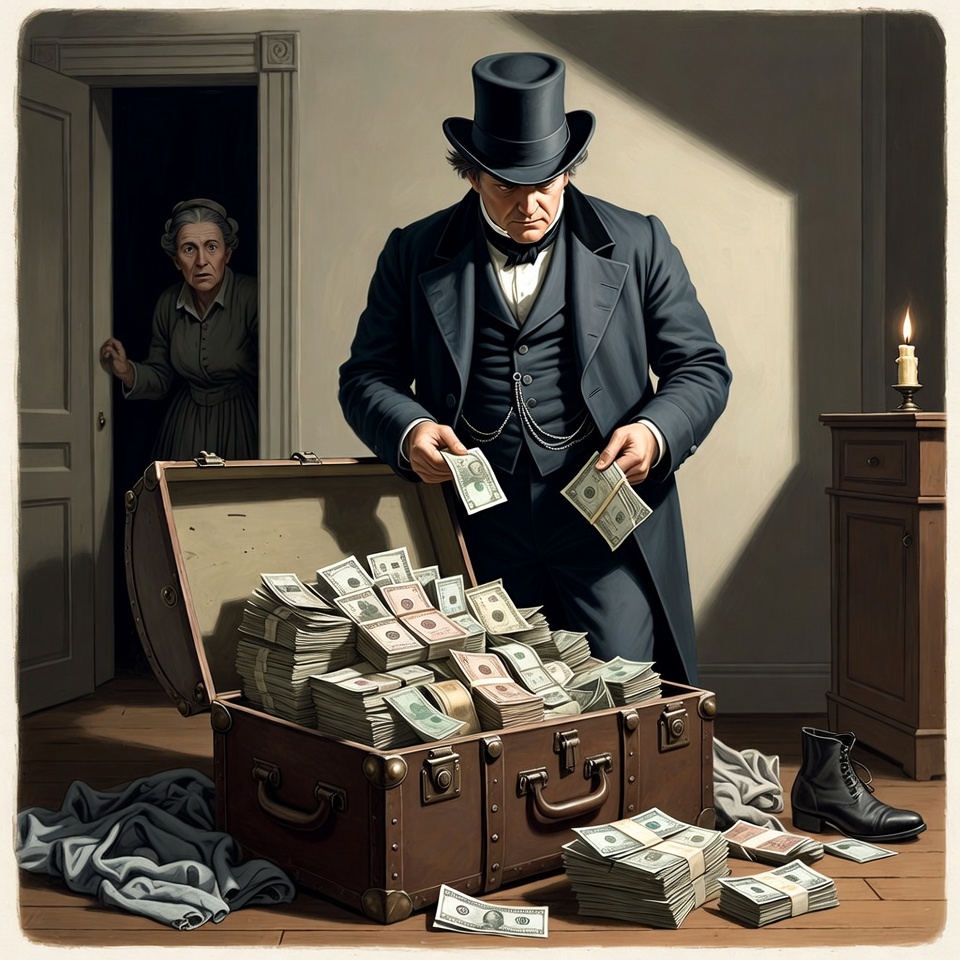
Picture this: it’s a quiet Saturday night in 1831 New York City. The gas lamps flicker on Wall Street, that muddy, ambitious lane already pretending to be the financial capital of a brash young nation. Inside the City Bank at 38 Wall Street—northeast corner of William Street, the very spot where today’s Citibank empire traces its roots—First Teller Lancaster S. Burling double-checks the locks on the vault, pockets his keys, and heads home for the weekend. The night watchmen shuffle past outside, clubs in hand, eyes half-closed. No alarms. No guards. Just paper notes, gold coins, and a whole lot of trust in a flimsy door. By Monday morning, that trust is gone. The vault is empty. $245,000—roughly $52 million in today’s money, enough to buy entire city blocks, outfit a fleet of clipper ships, or fund a small war—has vanished into the night. Two men with homemade keys made from wax impressions had simply walked in, locked the doors behind them, stuffed canvas bags with every note and doubloon they could carry, and strolled out before the sun rose and the watchmen went off duty. America’s first widely reported, large-scale bank heist had just happened, right in the heart of Wall Street. And the craziest part? The robbers almost got away with it.This wasn’t some Wild West shootout or Revolutionary War skirmish. This was a calculated, almost comical inside-the-system crime in the booming, chaotic financial Wild West of Jacksonian America. It was random enough to feel like a plot twist in a dime novel, specific enough to pin down to the exact weekend of March 19, 1831, and significant enough to expose just how vulnerable the young republic’s entire banking system really was. The story of James Honeyman, William J. Murray, and the relentless High Constable who chased them down is pure 19th-century drama—complete with shady Bowery fronts, lavish spending sprees, suspicious trunks, and a prison sentence that still echoes today. For the next several thousand words, we’re diving deep into every dusty detail of that long-ago weekend, the era that made it possible, the men who pulled it off, the lawman who cracked it, and the wild aftermath that changed how America thought about money, crime, and security. Because history isn’t just dates on a calendar. It’s a blueprint hiding in plain sight. Let’s rewind to the America that made this heist not only possible but almost inevitable. The year is 1831. Andrew Jackson is in the White House, railing against the Second Bank of the United States as a monster of monopoly. The Erie Canal, finished in 1825, has turned New York into the busiest port on the continent. Goods from the Midwest flood in; paper money from hundreds of state-chartered banks floods out. There is no Federal Reserve, no uniform currency, no FDIC. Every bank prints its own notes—City Bank notes, Lansingburgh Bank notes, Morris Canal notes, S. & M. Allen notes—and hopes merchants will accept them at face value. Counterfeiting is rampant. Locks are simple. Vaults are basically reinforced closets. And New York City itself? A teeming, smelly, ambitious metropolis of about 202,000 souls crammed south of 14th Street. Cobblestones on the main avenues, mud everywhere else. The Bowery is already the strip of theaters, oyster cellars, and rowdy saloons where working men blow off steam. Wall Street is still half residential, half commercial—lawyers, brokers, and bankers rubbing elbows with immigrants and hustlers. Nighttime security? A patchwork of constables and the old “night watch” system—basically part-time guys with rattles and clubs who yelled “Twelve o’clock and all’s well!” while half the city slept uneasily. Into this perfect storm steps James Honeyman. Born in England or somewhere across the Atlantic (records are fuzzy), he was a Morocco leather dresser by trade. Morocco leather—soft, dyed goatskin used for fine books, shoes, and luxury goods—was the high-end material of the day. Honeyman ran a small shoe store on the Bowery, the kind of place where “dissipated profligates” gathered to drink, gamble, and swap stories. It was the perfect cover: a legitimate business by day, a den of shady characters by night. He already had a criminal record. In 1830 he’d been arrested for robbing a store in Brooklyn. Somehow he walked free that time, but the experience taught him something important: New York’s justice system was slow, its police nonexistent (the NYPD wouldn’t be created until 1845), and its banks laughably easy targets.
His partner was William J. Murray, a man whose background is even sketchier but whose nerve was just as steel. The two of them cooked up the plan the old-fashioned way—scouting, timing, and wax. Burglars had been using wax impressions for centuries: press soft wax into a keyhole, pull it out, carve a blank key to match the mold. It was low-tech, foolproof if you could get close enough to the locks. Honeyman and Murray did. They waited for a Saturday night when the bank would be closed until Monday. They waited for the teller to lock up. They waited for the night watch to make its rounds. Then they slid their copied keys into the doors, turned them, stepped inside, and locked the world out. Imagine the scene inside that vault on the night of March 19. Lantern light flickering across stacks of bank notes. No modern alarms, no motion sensors, no cameras—just silence and opportunity. They emptied the main vault and the individual safe-deposit boxes (a newish invention at the time). They stuffed canvas sacks with City Bank notes, notes from other institutions, silver coins, and—most prized—398 Spanish gold doubloons that still circulated as hard currency. The total haul: exactly $245,000. In an era when a skilled worker earned maybe $1 a day and a nice house cost a few thousand, this was lottery-ticket money on steroids. They didn’t shoot anyone. They didn’t smash windows. They just walked out before dawn on March 20, bags over their shoulders, looking for all the world like merchants carrying legitimate deposits. Monday morning brought pandemonium. Teller Burling opened the bank and found… nothing. The newspapers exploded. The New York Commercial Advertiser and the Connecticut Courant carried the story within days. The Saturday Evening Post rushed out an extra edition with a $5,000 reward headline—itself a fortune. “The keys, which had been made from wax impressions of the door locks, enabled the men to let themselves into the bank and lock the doors behind themselves,” one account later recalled. It was sensational. People whispered that it had to be an inside job. How else could two nobodies crack Wall Street’s defenses so cleanly? The robbers didn’t exactly lay low. They spent $60,000 in the weeks that followed—lavish dinners, new clothes, gambling, the works. Honeyman, ever the Bowery boy, stayed in New York under an alias. Murray fled to Philadelphia. But they hadn’t counted on High Constable Jacob Hays.
Hays was a legend even in his own time. A stocky, no-nonsense Jewish immigrant’s son who became New York’s chief lawman, he slept only six hours a night, personally collared hundreds of criminals, and had a reputation so fearsome that mothers used his name to scare disobedient kids. “High Constable Hays is coming!” was the 1830s equivalent of “the bogeyman.” When the bank heist hit the wires, Hays went to work with “acuteness and indefatigable vigilance,” as one paper put it. He already knew Honeyman from the previous Brooklyn arrest. He searched Honeyman’s rooms on Division Street once and found nothing. Then came the tip that made the whole case crack open. Honeyman was living in a lodging house with his wife and two small children. The keeper of that house noticed something suspicious: Honeyman carrying a heavy trunk out one day. She mentioned it to Hays. The constable returned, searched the remaining trunks, and hit paydirt. Hidden under layers of clothing were stacks of stolen notes: $57,328 in City Bank paper, $501,118 in assorted city notes (some figures vary slightly in period reports but the scale is staggering), $44,000 in Lansingburgh Bank notes, $20,000 in Morris Canal notes, $8,272 in uncurrent notes belonging to S. & M. Allen, $40 in counterfeit notes, and more. The doubloons and another $63,000 or so were never recovered—perhaps spent, buried, or lost to the underworld—but the bulk of the fortune was back in the bank’s hands within weeks. Honeyman was dragged to the old colonial-era Bridewell prison in a scene straight out of a Dickens novel. Murray was tracked down in Philadelphia and extradited. Both men were tried quickly, convicted, and sentenced to five years in Sing Sing—the brand-new state prison up the Hudson that had opened in 1826. Sing Sing was no country club. Inmates quarried stone from dawn to dusk under the “Auburn system” of silence and hard labor. The walls were thick, the guards armed, the reputation fearsome. Honeyman and Murray disappeared into that system and, as far as the public record shows, never troubled Wall Street again. The aftermath rippled far beyond the courtroom. The City Bank survived—proof that even a massive hit couldn’t sink a well-connected institution in boom-time New York. But the heist forced bankers to think harder about security. Locks got better. Watches got tighter. The story became a cautionary tale in an era when paper money was everywhere and trust was currency itself. It foreshadowed the bank robberies of the 1930s Dillinger era, the armored-car heists of the 1970s, and today’s cyber thefts in one important way: crime always finds the weakest lock. Yet the real lesson wasn’t in the boldness of the robbers. It was in the swift, relentless recovery. One suspicious trunk, one sharp-eyed lodging keeper, one tireless constable—and most of a fortune returned to its rightful owners.
That is the part of the 1831 story that still matters two centuries later. Not the glamour of the getaway, but the dogged pursuit that followed. America in the 1830s was messy, unregulated, and full of opportunity for both honest dreamers and Bowery schemers. Yet even in that chaos, vigilance and persistence turned a near-catastrophe into a mostly happy ending. The bank kept operating. The city kept growing. And the public learned that no heist is perfect if someone is watching. Now imagine applying that exact historical truth to your own life today. The robbers tried to steal an empire with wax keys and nerve. They failed because one man refused to let the trail go cold. You don’t need wax or canvas bags. You already hold the keys to your own vault—your time, your energy, your potential, your finances. Life will try to rob you every single day: distractions that slip in like copied keys, setbacks that empty your reserves, doubts that lock the doors behind them. The outcome of March 19, 1831, proves you can recover almost everything—if you patrol your vault the way High Constable Hays patrolled New York. Here is exactly how that 1831 fact becomes your unfair advantage, broken into the specific, no-fluff bullet points no other self-help plan online dares to use because they’re built straight from the heist itself: - Treat every morning like Monday at the City Bank: open your personal “vault” and do a 60-second inventory of what was stolen overnight—15 minutes of social media that drained your focus, a skipped workout that emptied your energy reserves, an impulse purchase that lightened your financial stack. Write it down exactly like the teller tallied the missing notes. Most people never notice the theft until it’s too late; you catch it before the sun rises. - Become your own High Constable Hays: schedule two 10-minute “sweeps” every day (noon and 9 p.m.) where you hunt for suspicious “trunks.” Is there an excuse you’re carrying around that smells like Honeyman’s hidden loot? Is a toxic relationship or a draining habit hiding under layers of rationalization? Root it out the way Hays ripped open those trunks. Relentless, personal, zero mercy. - Recruit your lodging-house keeper: tell one trusted person (spouse, friend, coach) the exact details of your biggest current “heist” risk—the thing trying to rob you blind. Give them permission to tip you off the moment they see you acting shady, just like the landlady tipped Hays. External eyes catch what internal ones miss. - Accept the unrecovered doubloons and move on: the robbers lost $63,000 forever, yet the bank still thrived. Identify the 10-20% of any setback you cannot get back (a bad investment, a lost year, a relationship that ended) and ceremonially “write it off” on paper. Then pour every remaining ounce of effort into reclaiming the 80% that is still yours. Forgiveness of the unrecoverable is the fastest way to multiply what remains. - Spend the recovered $60,000 wisely: once you reclaim time, money, or confidence, do not blow it on the Bowery equivalent of today (Netflix binges, shiny gadgets, ego boosts). Convert it immediately into “notes” that earn interest—skills, relationships, assets. The robbers partied their way to Sing Sing; you invest your way to freedom. That brings us to the detailed, quick, unique plan that no other self-help book, podcast, or blog has ever published because it is literally built from the 1831 evidence itself. Call it the **Vault Reclamation Protocol**—a five-day cycle (matching the five-year Sing Sing sentence, because irony is motivational) you can run anytime life robs you. It is fast, repeatable, and deliberately weird so it sticks. Day 1 – Make the Wax Impression: Sit down and literally draw or list every “lock” that protects your goals (morning routine, budget rules, relationship boundaries). Then list every copied-key vulnerability that could open them (phone notifications, peer pressure, old habits). This is not generic goal-setting; this is forensic mapping of how thieves get in. Day 2 – Lock the Doors Behind You: Physically or digitally remove the top three vulnerabilities. Turn off every non-essential notification. Cancel the subscription that leaks money. Tell the friend who always drags you into distraction that you’re unavailable for the next month. Lock it and walk away exactly as the robbers did—except you’re protecting, not stealing. Day 3 – The Hays Sweep: Spend the full day in detective mode. Review every receipt, every hour of your calendar, every conversation. Find the hidden stacks of “notes” you let slip. Recover them immediately—refund that dumb purchase, reschedule that wasted hour, apologize for the snapped temper. Document the recovered amount in a notebook titled “City Bank Ledger.” Day 4 – Recruit the Lodging Keeper: Share your ledger with your accountability partner. Ask them one question only: “What suspicious trunk did you see me carrying this week?” Take their tip as gospel and act on it before sunset. This single step turns solo struggle into a two-person investigation that doubles your recovery speed. Day 5 – Sing Sing Commitment & Celebration: Commit the recovered resources to hard labor that builds something lasting—gym time, skill practice, debt snowball payment. Then celebrate exactly $60,000 worth of the old robbers’ mistake by treating yourself to one smart, future-focused splurge (new running shoes that will earn interest in health, not a night at the Bowery equivalent). End the cycle by writing one sentence: “I am now the High Constable of my own life.”
Run this protocol once a month or the moment you feel robbed. It takes less than an hour a day yet delivers the same result the 1831 investigation delivered: most of what was taken returns, stronger locks replace the old ones, and the thieves (your old habits) end up serving hard time in the past. The men who pulled off the 1831 heist thought they were cleverer than the system. They weren’t. The system—represented by one vigilant constable and one observant citizen—proved smarter, faster, and more persistent. You are that system now. Your dreams are the vault. Life will keep trying to pick the locks with distractions, doubts, and detours. But you know the history. You know the outcome. You know the protocol. So the next time a weekend slips away, a budget leaks, or motivation vanishes overnight, remember March 19, 1831. Grab your imaginary keys—not to steal, but to guard. Hunt down every missing dollar, minute, and ounce of confidence the way Hays hunted those trunks. Recover the lion’s share, write off the doubloons you can’t get back, and turn the whole experience into compound interest for the rest of your life. The bank on Wall Street is still standing. The robbers are long forgotten in Sing Sing’s stone quarries. You get to choose which legacy you live. Choose the one that recovers everything worth keeping—then some. Your vault is open. Start reclaiming it today. The constable inside you is already on the case.
Share: