
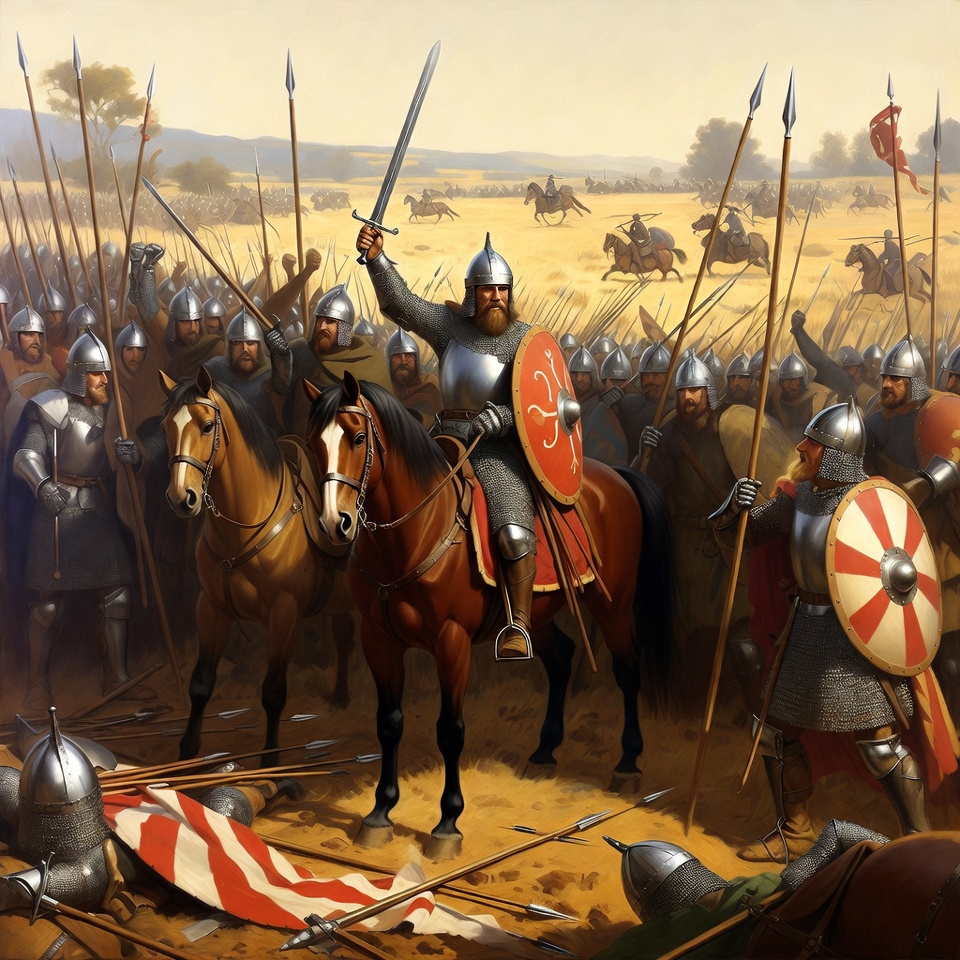
Picture this: It’s dawn on March 15, 933, in the misty riverlands of northern Thuringia along the Unstrut. A Saxon king nicknamed for his love of bird snares stands at the head of a ragtag but determined army drawn from every corner of a fractured realm. Opposite him? A swarm of lightning-fast Magyar horsemen, bows drawn, arrows notched, fresh off another terror raid. They expect easy pickings. What they get instead is a thunderous counter-charge that sends them fleeing for miles, their decades-long reign of fear shattered in a single morning. This wasn’t some Hollywood epic. This was the Battle of Riade (also called the Battle of Merseburg), and it changed the course of Europe forever.Henry I, “the Fowler,” wasn’t born to wear a crown in the glamorous way later emperors did. Born around 876 in Memleben, he came from the tough Liudolfing line of Saxon dukes. His father Otto the Elder had built a strong power base in Saxony, but East Francia after Charlemagne’s empire splintered was a mess of rival stem duchies—Saxony, Franconia, Bavaria, Swabia, and the contested Lotharingia—constantly squabbling while external raiders picked the bones clean. The Magyars were the worst. These nomadic warriors from the Eurasian steppes had settled in the Carpathian Basin (modern Hungary) around 895 and turned raiding into an art form. Think Huns 2.0: expert horse archers who could loose arrows at full gallop, strike a village at dawn, burn it by noon, and vanish with captives and loot before defenders could organize. They’d already crushed Great Moravia in 906, wiped out a Bavarian army at Pressburg in 907, and terrorized Italy and France. In East Francia, their raids were relentless—devastating countryside, enslaving peasants, forcing tribute payments that bled kingdoms dry. Henry’s path to the throne started messy. He succeeded as Duke of Saxony in 912. He rebelled against King Conrad I over Thuringian lands but patched things up. When Conrad lay dying in 918, the Frankish king did something smart: he recommended Henry as his successor, calling him the only man tough enough to hold the realm together against internal rebels and those Magyar hordes. On May 24, 919, at the Imperial Diet in Fritzlar, the nobles of Franconia and Saxony elected Henry king. Other dukes stayed away at first, but Henry played it cool. Archbishop Heriger offered to anoint him with holy oil—the usual Carolingian pomp. Henry refused. He wanted to be king by the acclaim of his people, not church ritual. No fancy coronation, just raw legitimacy. That set the tone: he ruled as *primus inter pares*—first among equals—keeping the stem dukes happy with autonomy while slowly welding them into something stronger. Then came the nickname that still makes historians chuckle. Legend has it messengers arrived to tell Henry he’d been elected king while he was out in the fields or woods, completely absorbed in setting up bird snares for fowling—nets for finches, traps for whatever flew by. He didn’t drop everything dramatically. He supposedly finished what he was doing or shrugged it off with Saxon practicality. Later chroniclers and even a 16th-century monument called the Finkenherd (finch trap) at Quedlinburg immortalized the spot. Imagine: Europe’s next great dynasty founder, mid-net repair, birds chirping, when suddenly—boom—crown offered. It humanizes him. Henry wasn’t some aloof warrior-poet; he was a guy who loved simple Saxon pursuits like hunting and hawking. That grounded him. His second marriage to Matilda of Ringelheim (a saintly figure who founded Quedlinburg Abbey, where they’re both buried) produced the real powerhouse line: sons Otto (future emperor), Henry (Duke of Bavaria), Bruno (archbishop and regent), and daughters who married into French and Lotharingian royalty. Early reign was survival mode. In 919, the Magyars smashed his forces at the Battle of Püchen; Henry barely escaped. But he learned fast. In 924 another Magyar army invaded Saxony. This time Henry’s men captured an Árpád prince (probably Zoltán) near Pfalz Werla. Henry used the hostage to negotiate a nine-year truce—expensive annual tribute, but it bought breathing room. During that truce (roughly 926–932), Henry went full fortress-builder. This is where the Burgenordnung system shines as one of medieval Europe’s smartest military reforms. At an assembly in 926 he ordered the construction of new castles and refuges across the land. Garrison duty got reorganized into groups of nine *agrarii milites*—farmer-soldiers. One man stood guard at the castle while the other eight worked the fields. In case of invasion, all nine (plus families and supplies) retreated inside the burh (fortified settlement) and defended it. No more helpless peasants slaughtered in open country. These weren’t fancy stone keeps yet; many started as earth-and-timber ring forts, but they worked. Henry also trained mobile heavy cavalry—armored horsemen with lances and shields who could deliver shock charges instead of the Magyars’ hit-and-run archery. He subdued Polabian Slavs too: seized Brandenburg in a winter campaign against the Hevelli, won at Lenzen in 929 against the Redarii, built Meissen fortress, forced Bohemian Duke Wenceslaus to submit. He even grabbed Lotharingia through war and marriage alliances. By the early 930s East Francia felt less like a crumbling Frankish leftover and more like a proto-German kingdom.
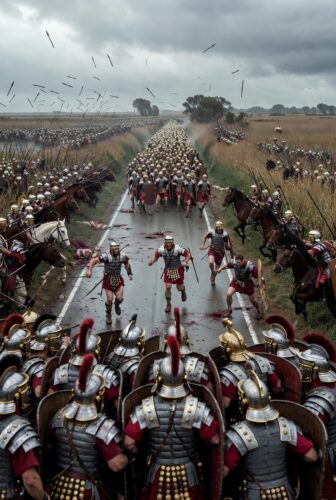
The turning point came in 932. At the Synod of Erfurt, Henry and the nobles decided enough was enough—no more tribute. Chroniclers say the Magyar envoys got a “diplomatic gift” that screamed defiance: a dead (or sometimes described as fat and rotting) dog thrown at their feet. Imagine the envoys’ faces. It was medieval middle finger—war declared. The Magyars, insulted and sensing weakness, launched another raid in early 933, targeting Thuringia and Saxony. Henry was ready. He mustered mounted contingents from every stem duchy—Saxons, Franconians, Bavarians, Thuringians. Chronicler Widukind of Corvey (our main source) describes the Thuringian levy as *inermes*—poorly armed locals used as a screen. Henry’s elite Saxon and other heavy cavalry stayed in reserve, armored and disciplined. The Magyars besieged some unlucky town but spotted Henry’s camp at Riade (the name actually refers to the camp itself; the exact battlefield spot is still debated—candidates include Kalbsrieth or the Hunnenfeld near Riethgen). They tried sneaking away at night. Henry sent a small mixed force of foot soldiers and a few riders to lure them. The Magyars, seeing what looked like easy prey, charged with their usual arrow storms. Here’s where Henry’s prep paid off. He’d drilled his men: first volley of arrows? Raise shields, stand firm. Don’t panic, don’t chase individually. Then—charge! One account (echoed in later traditions) has Henry ordering his troops to weather the initial hail, then rush in close before the enemy could reload. “Cover yourselves with your shields against the first flight of arrows, then charge at full speed with swords before they can shoot again.” No glory-hogging on faster horses; disciplined massed attack. The Magyar light cavalry, expecting flight or scatter, suddenly faced armored lances thundering at them. They broke. They fled for miles. German casualties were minor; the psychological blow was massive. On the field, the victorious troops hailed Henry as emperor—*imperator*—right there, a spontaneous coronation that boosted his authority without papal fuss. The victory was decisive. During Henry’s remaining years the Magyars never raided East Francia again. It bought 21 years of peace from that front (they tried again in 954 during a later rebellion and got crushed by Henry’s son Otto at Lechfeld in 955). Henry used the breathing room to keep expanding: conquered more Slavic lands, forced Danish submission in Schleswig in 934, saw West Frankish and Burgundian kings acknowledge his overlordship in 935. He died in 936 at Memleben, age about 60, buried at Quedlinburg. His son Otto I took over, built on the foundations—centralized more power, controlled the Church better, conquered Italy, and in 962 received the imperial crown from the pope, officially launching the Holy Roman Empire. Historians credit Henry’s Riade win and reforms with forging the first real sense of German nationhood. The stem duchies stopped tearing each other apart quite so viciously. The Ottonian Renaissance in art, learning, and administration followed. East Francia didn’t collapse like West Francia under its own Viking pressures. One morning’s charge on March 15, 933, helped birth medieval Germany and the imperial idea that shaped Europe for centuries.
Widukind of Corvey, writing decades later, captured the awe: the Magyars “readily fled at the coming of Henry’s horsemen.” Flodoard of Reims noted the Bavarian contingents. Later illustrations in the Sächsische Weltchronik (around 1270) show Henry personally fighting the invaders. The battle wasn’t a massacre—minor casualties on both sides—but its strategic impact was enormous. It proved heavy cavalry and fortified refuges could neutralize the era’s deadliest mobile threat. It showed that patient preparation during a “truce” (those nine years of tribute) could flip the script from victim to victor. It demonstrated that uniting fractious duchies under one pragmatic leader could create something greater than the sum of its parts. And it turned a bird-loving Saxon duke into the founder of a dynasty that dominated the heart of Europe. Think about the 10th-century world for a moment to appreciate the scale. After Charlemagne’s death in 814, his empire fractured into East, West, and Middle kingdoms. Internal wars, Viking raids in the north, Saracen pirates in the south, and now these Magyar super-raiders from the east. Villages lived in terror—scouts watching horizons for dust clouds signaling horsemen. Peasants abandoned fields at the first warning. Kings paid protection money like mob bosses. Henry flipped the script with engineering and discipline. His burhs weren’t just walls; they were community strongholds where farmers became part-time soldiers. His cavalry training emphasized teamwork over individual heroics—exactly the opposite of the Magyars’ freewheeling style. The dead-dog insult? Pure psychological warfare—humiliating the enemy before battle even started. It’s the medieval equivalent of trash-talking before the big game, but with actual dead animals. The battle also highlights Henry’s personality: practical, not flashy. He refused the anointing because he valued popular election over divine-right theater. He kept dukes happy with autonomy rather than crushing them. He married strategically and raised capable sons. Matilda’s piety complemented his military focus—she founded abbeys while he built forts. Their partnership symbolized the blend of secular power and Church support that defined the Ottonian age. When Henry died, Otto inherited a stabilized realm ready for greatness. Without Riade’s proof of concept, the Holy Roman Empire might never have coalesced the same way. Fast-forward over a thousand years. That single decisive morning on March 15, 933, wasn’t just about stopping arrows. It was about refusing to keep paying tribute to bullies, investing “truce” time in unbreakable defenses, training superior forces, uniting scattered strengths, and delivering one disciplined charge when the moment was right. The outcome? A fractured land became the seed of an empire that lasted centuries. Personal resilience scaled up to national identity. So what does a long-dead Saxon king’s triumph mean for you in 2026? The same principles that turned Henry from a tribute-paying duke into a nation-forging emperor can turn your daily chaos into a personal empire of calm, productivity, and lasting wins. Life throws Magyar-style raiders at all of us: sudden crises that drain time and energy, bad habits that exact endless “tribute,” distractions that hit fast and vanish with your focus, toxic commitments that burn villages of progress. Henry’s story proves you don’t have to stay on the defensive forever. Prepare patiently, refuse payment, build fortresses, train shock troops, muster allies, and charge decisively—and you’ll rout those raiders for decades.
Here are the specific ways the outcome of Riade directly benefits your individual life today when you apply it:
-
Refusing tribute like the dead-dog insult frees up massive resources: every time you stop “paying” a draining commitment (whether it’s a subscription silently bleeding your bank account or a relationship siphoning your energy), you redirect that gold straight into building your own burhs—creating breathing room that compounds like Henry’s nine-year truce turning into permanent peace.
-
The Burgenordnung system teaches rotatable defense that prevents burnout: instead of trying to guard every life area at once, you rotate focus the way those nine farmer-soldiers did—one guards while others “farm” progress—ensuring nothing falls while you still advance on multiple fronts without exhaustion.
-
Heavy cavalry training turns weaknesses into shock weapons: Henry’s men learned disciplined charges after years of light-cavalry defeats; you gain the same edge by drilling one high-impact skill (public speaking, budgeting mastery, or boundary-setting) until it becomes an armored lance that routs unexpected attacks like surprise deadlines or negotiations.
-
Uniting stem duchies creates unbreakable alliances: Henry pulled fractious regions together for one fight; applying this merges your scattered life domains (work, health, relationships, finances) into a coordinated force, so when raiders hit one area the others reinforce instead of crumbling.
-
The decisive charge after patient prep delivers outsized victories with minimal casualties: Henry waited for the perfect lure and then struck once; you learn to weather the first “arrow volley” of a crisis calmly, then execute one prepared counter-move that ends the threat for good rather than endless skirmishing.
These aren’t vague inspirations—they’re tactical blueprints proven on a real battlefield that reshaped history. Now here’s the detailed, quick, unique plan that makes this actionable and utterly unlike anything else online. Forget vision boards, daily affirmations, or hustle-culture checklists. This is the **Riade Resilience Rotation**—a 9-day launch cycle (one day per *agrarii milites* farmer-soldier) you can start this weekend and run forever as a rotating system. It’s engineered like Henry’s burhs: practical fortifications, rotatable duty, heavy-cavalry drills, dead-dog diplomacy for rejection, and one disciplined charge. No fluff. No generic “mindset shifts.” Just medieval tactics fused with modern life for rapid empire-building. **Day 1 – The Fowler’s Net (Scout & Trap):** Spend exactly 30 minutes listing your top three current “Magyar raiders” (specific threats like doomscrolling stealing 90 minutes nightly, recurring late fees as silent tribute, or a toxic commitment draining two evenings weekly). Write them on paper like Henry setting snares—then “trap” one immediately by deleting the app or canceling the auto-payment. This mirrors the bird-net legend: catch opportunities while others panic. **Day 2 – Dead-Dog Diplomacy (Refuse Tribute):** Identify one draining “envoy” (a bad habit, subscription, or people-pleasing task) and reject it permanently with a symbolic “dead dog” action—email the cancellation, block the number, or literally throw away the offending item while saying out loud “take this instead.” Redirect the saved time/money into a new “garrison fund” account that grows untouched for 30 days. This ends the tribute cycle cold. **Days 3–4 – Erect the Burhs (Build Fortresses):** Create two specific personal castles. Burh One (physical): reorganize one high-traffic area of your home or digital space (desk or phone home screen) into a defended zone with strict rules—no devices after 9 p.m. except for emergencies. Burh Two (mental): set up a 20-minute daily “refuge routine” using a physical notebook for planning tomorrow’s priorities before bed. Stock both with supplies (prepped meals or quick-reference notes) so any raid gets absorbed without panic. **Days 5–6 – Rotate the Milites (Farmer-Soldier Duty):** Assign rotating guard shifts to your life domains like Henry’s nine-man teams. Pick three domains (e.g., health, career, relationships). Day 5: one domain gets full focus (e.g., 45-minute workout while others rest). Day 6: switch—career domain gets the guard shift (deep work block) while health “farms” lightly. Repeat rotation weekly so nothing gets neglected and you defend the whole kingdom without burnout. **Day 7 – Train Heavy Cavalry (Skill Shock Drills):** Choose one high-impact skill that counters your weakest raider (budget tracking if finances raid you, or assertive scripting if people drain you). Do two 25-minute targeted drills: first “shield cover” (prepare responses or spreadsheets), then “charge” (apply it in a real low-stakes scenario like negotiating one bill or practicing one conversation). Do this weekly forever—your armored horsemen ready for any volley. **Day 8 – Muster the Duchies (Unite Allies):** Hold one 15-minute “Imperial Diet” with yourself or a trusted accountability partner. Align all life areas around one shared goal for the next 30 days (e.g., “build 10% emergency buffer while advancing one career project”). Assign each domain a supporting role exactly like Henry pulling duchies together—no solo heroes. **Day 9 – The Riade Charge (Decisive Strike):** Weather any small “arrow volley” that hits today, then execute one prepared counter-action from your earlier traps or drills (e.g., finally tackle that postponed project with your new cavalry skill or enforce the burh rules during a distraction). Celebrate the rout by proclaiming your own “emperor” status—treat yourself to something symbolic (a walk in nature like Henry’s fowling grounds) and note the victory in your notebook. Then rotate the whole 9-day cycle again, forever.Launch the full rotation this weekend. By Day 9 you’ll have concrete fortifications, rejected tributes, trained forces, and one decisive win under your belt. Run it as a perpetual rotation and those life raiders stay routed for years—just like Henry’s 21 years of peace. This isn’t another self-help fad; it’s tactical engineering drawn straight from a battlefield that built an empire. Patient preparation during calm periods, refusal of endless payments, rotatable defenses, disciplined training, united fronts, and one well-timed charge. Henry the Fowler started with bird nets and ended with a dynasty. You start with a 9-day cycle and end with your own unbreakable personal empire. The morning of March 15, 933, proved one thing above all: when you stop paying raiders and start building like a Saxon king, the hordes don’t stand a chance. Your charge awaits. Go build those burhs, train that cavalry, and rout your own Magyars. The field is yours—proclaim victory and watch your kingdom rise.
Share: