
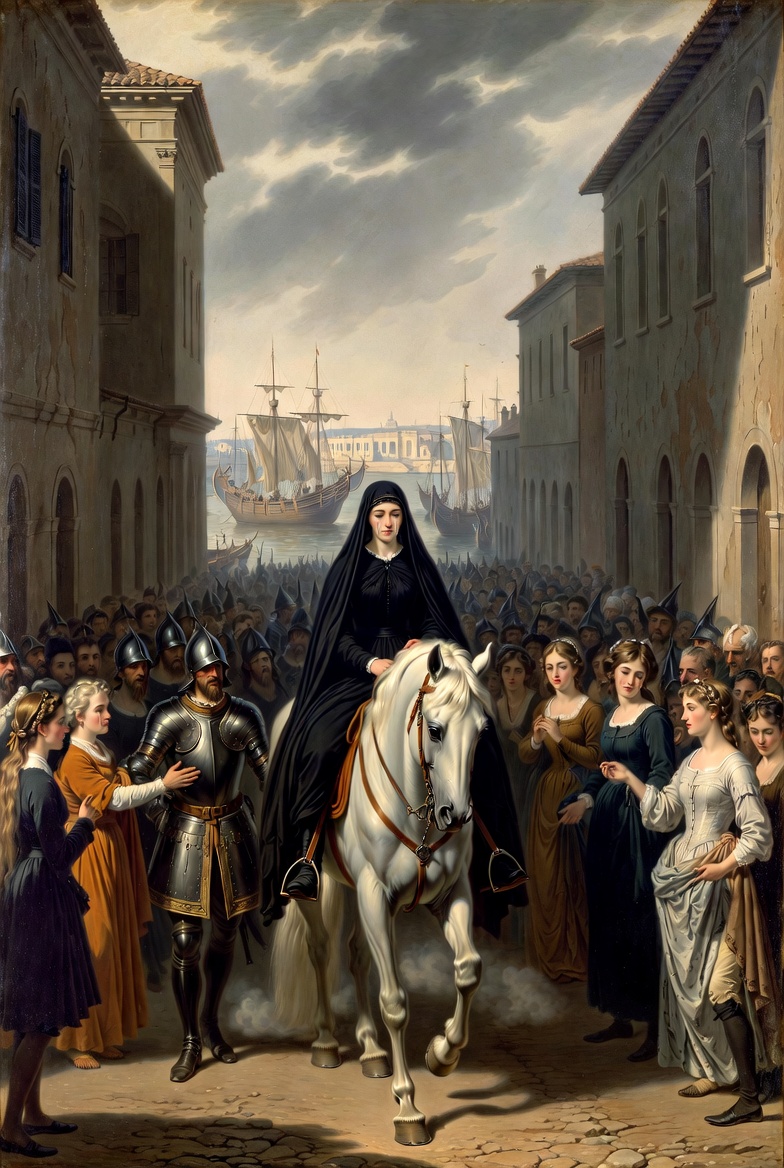
Picture this: a 34-year-old Venetian noblewoman in a flowing black silk cloak, riding out of Nicosia on a February morning in 1489, her eyes streaming tears that refused to stop. The knights and ladies trailing behind her wept too. The common folk lining the roads joined in. Chronicler Georgios Boustronios captured it perfectly: “Her eyes, moreover did not cease to shed tears throughout the procession. The people likewise shed many tears.” She wasn’t fleeing plague or war. She was handing over an entire island kingdom – Cyprus, the last Crusader stronghold in the eastern Mediterranean – to the calculating merchants of Venice. The formal cession sealed on March 14, 1489. No swords clashed. No armies marched. Just a quiet, dignified exit that ended three centuries of Lusignan rule and rewrote the map of the Renaissance Mediterranean.This wasn’t defeat. It was one of the smartest power pivots in distant history. Caterina Cornaro didn’t cling to a crumbling crown until Ottoman cannons or Neapolitan plotters finished her off. She ceded control, sailed home, and built something far more enduring: a literary salon in the hills of Asolo that inspired poetry, paintings, and even operas centuries later. Her story is packed with medieval soap-opera drama, trade empire scheming, poison rumors, and Renaissance elegance – the perfect 15th-century tale most history buffs gloss over while fixating on bigger battles or kings with flashier nicknames. Yet the outcome whispers a truth that still echoes louder than any battlefield roar: sometimes the bravest move is selling the island before it sinks you. Let’s rewind to understand why this March 14 moment mattered so much – and why it still does for anyone tired of clutching a “kingdom” that’s quietly draining them. Cyprus had been a glittering prize since the Third Crusade. In 1191, England’s Richard the Lionheart – that red-bearded rock star of medieval warfare – showed up with his fleet scattered by a storm. His sister Joan and fiancée Berengaria washed up near Limassol. The local Byzantine ruler, Isaac Komnenos (who styled himself emperor), imprisoned them and demanded ransom. Richard, never one for patience, stormed ashore with archers and knights. Isaac fled, but not before Richard slapped on a 50% capital levy, confiscated rebel lands, and issued the delightfully petty order that every Cypriot man shave his beard as a mark of submission. When the locals rebelled on Easter 1192, the Templars (to whom Richard briefly sold the island for 100,000 bezants) barely survived a massacre attempt in Nicosia. The Templars begged Richard to take it back. He did – then immediately offloaded it to Guy of Lusignan, the ousted former king of Jerusalem, basically to get the guy out of his hair. Guy and his brother Aimery founded the Lusignan dynasty in 1192. For nearly 300 years, Cyprus became the ultimate Crusader retirement home: a feudal paradise of sugar plantations, wine exports, and pilgrim traffic. The kings built Gothic cathedrals in Nicosia and Famagusta that still stand like stone ghosts. Famagusta’s harbor turned into the Mediterranean’s busiest entrepôt – Italian merchants, Syrian traders, and Greek peasants all jostled under Lusignan banners. The economy boomed on sugar cane (labor-intensive, slave-market-fueled, and insanely profitable – the Cornaro family itself ran mills in Episkopi). Wheat, oil, carobs, textiles, and pottery flowed out. The Haute Cour (high court) kept nobles in line, though regencies for child kings became the norm. Hugh I, Henry “the Fat,” Hugh III “the Great,” Peter I (who actually captured Alexandria in 1365), Peter II “the Fat,” James I, Janus (captured by Mamluks in 1426 and forced to pay tribute), John II – the line stretched on, claiming titles to Jerusalem and Armenia long after the mainland Crusader states fell.
By the mid-1400s, the kingdom was a beautiful but brittle shell. Mamluk tribute payments after Janus’s humiliating 1426 capture drained the treasury. The Black Death had wiped out a third of the population in 1348 and never fully recovered. Genoa squeezed Famagusta for decades. The island’s multi-ethnic stew – Greek Orthodox peasants (the majority, speaking their own dialect and running local courts), Catholic nobles, Italian bankers, Armenian artisans, Syrian Maronites – worked well enough until succession crises hit. Orthodox churches kept autonomy, which was rare and smart, but the kings remained a tiny French-speaking Catholic elite ruling from Nicosia and Famagusta. Enter John II, who died in 1458. His legitimate daughter Charlotte took the throne with her husband Louis of Savoy. But John’s illegitimate son James – the “Bastard” – had other ideas. Appointed archbishop at 16, James murdered the royal chamberlain in 1457, fled to Rhodes, got pardoned, then in 1460 used Mamluk troops to besiege Charlotte in Kyrenia Castle for three years. Charlotte fled to Rome; James crowned himself in 1464. He rewarded his Catalan buddy Juan Tafures lavishly and kept one eye on Venice for protection against everyone else. James needed cash and allies. He turned to the Cornaro family – Venetian patricians who already owned Cypriot sugar mills and had produced four Doges. In 1468, 14-year-old Caterina (born November 25, 1454, to Marco Cornaro and the Greek-descended Fiorenza Crispo) was betrothed. Proxy marriage in Venice that July; she sailed over in November 1472 and wed James in person at Famagusta. The deal was pure Venetian real-estate genius: commercial privileges in exchange for a royal bride who could anchor their influence.
James died suspiciously in Famagusta just months later – July 10, 1473 – probably dysentery, though whispers of poison by Caterina’s uncles or Venetian agents never died. His will named pregnant Caterina regent for their unborn son. She gave birth to James III, but the moment the Venetian fleet sailed home, a Catalan-Neapolitan plot tried to oust the infant in favor of Charlotte. Caterina was briefly imprisoned until Venice sent ships and restored order. Then, in August 1474, baby James III died at barely one year old – illness again, or more poison rumors aimed at Venetian or Charlotte partisans. Caterina became queen regnant in her own right, titled Queen of Cyprus, Jerusalem, and Armenia. For fifteen years she ruled a kingdom that was already a Venetian shadow state. Merchants from the Republic ran the sugar trade, collected taxes, and installed their own officials. Plots swirled: in 1488, someone tried to marry her off to Alfonso II of Naples, which would have dragged Cyprus into anti-Venetian alliances and invited Sultan Bayezid II’s Ottoman wrath. Venice, ever pragmatic, decided enough was enough. They couldn’t risk losing their lucrative colony to Naples or the Turks. Caterina’s own brother Giorgio Cornaro – the family’s “Padre della Patria” – was dispatched to persuade her. The pressure worked. In February 1489 the Senate convinced her to cede her rights to the Doge. The emotional exit from Nicosia happened around mid-February: black cloak, tearful procession to Famagusta, crowds weeping alongside her. The formal handover – the moment Cyprus officially became Venetian property – was sealed on March 14, 1489. No grand battle. Just a signed transfer of administration. Caterina kept the courtesy title of queen and sailed for Venice, arriving in June to a hero’s welcome aboard the Bucentaur with the Doge himself. In return, Venice granted her the fiefdom of Asolo, a charming hill town in the Veneto. There, Caterina reinvented herself. She reformed local justice, opened a pawnshop for the poor, improved agriculture, and relieved famine. Most famously, she turned her court into a Renaissance salon. Pietro Bembo set his platonic dialogues *Gli Asolani* (1505) right there, debating ideal love among her courtiers. Painters flocked: Gentile Bellini, Albrecht Dürer, Giorgione, and later Titian (who did a posthumous portrait as Saint Catherine). The story inspired operas – Halévy’s *La reine de Chypre*, Donizetti’s *Caterina Cornaro*, Lachner’s version. Even after the League of Cambrai sacked Asolo in 1509, forcing her back to Venice, she lived until July 10, 1510, buried in San Salvador church with a monument that still draws visitors.
That’s the raw historical meat: a 300-year Crusader kingdom born from Richard’s storm-tossed temper and beard-shaving edict, propped up by sugar wealth and Mamluk tribute, torn by bastard kings and infant deaths, finally sold off in a tearful but brilliant exit on March 14, 1489. Caterina didn’t lose. She traded a vulnerable island throne – threatened by Ottomans, Naples, plots, and endless Venetian meddling – for safety, creative freedom, and a legacy that outlived the Lusignans by centuries. Cyprus stayed prosperous under Venice until the Ottomans finally took it in 1571. Caterina lived another 21 years as cultural patron instead of political pawn. Now, apply that outcome to your own life and the payoff is massive. Strategic cession – the deliberate, dignified handover of something you’ve outgrown – doesn’t weaken you. It frees you to build influence that actually lasts. Holding on to a “kingdom” (that toxic job, draining relationship, perfectionist habit, or micromanaged project) just invites the medieval equivalent of Ottoman cannons or Neapolitan plots: burnout, betrayal, or slow erosion. Caterina walked away with her head high, tears and all, and created a salon that shaped Renaissance thought. You can do the same on a personal scale. Here’s exactly how that historical fact benefits you today, broken into very specific, actionable bullets that tie straight back to her story: - Spot the unsustainable “tributary” burden early, like Cyprus’s Mamluk payments after 1426. If your current role (career ladder rung, side hustle, or family dynamic) demands constant tribute in energy or money while delivering diminishing returns, calculate the hidden cost the way Venetian accountants did – and prepare the exit before external forces force it. - Recruit your own “Giorgio Cornaro” advisor – a trusted sibling, mentor, or neutral expert who has your long-term interests at heart, not short-term drama. Caterina’s brother convinced her without public humiliation; use yours to negotiate the handover terms privately so you retain dignity and some ongoing title (consulting gig, advisory role, or friendly co-parenting arrangement). - Perform the tearful but public procession. Caterina didn’t sneak out at midnight; she rode out visibly, letting people see the emotion. In your life, announce the cession openly on social media, in a team meeting, or family letter – the honesty disarms critics and rallies support instead of breeding conspiracy theories. - Sail to your personal Asolo immediately. Caterina received a hill-town fief and turned it into a creative haven. Designate a literal or metaphorical space (home office corner, weekend cabin, or digital “salon” group) the day after ceding control. Stock it with tools for your new passion – sketchbooks if you’re artistic, books if you’re mentoring – and start small reforms like she did with Asolo’s pawnshop and farms. - Convene the salon and let dialogue create legacy. Her court hosted Bembo’s love debates; host your own weekly virtual or in-person gatherings where you share knowledge, mentor others, or discuss ideas in your new domain. This shifts you from ruler (controlling everything) to patron (influencing without owning), exactly as Caterina’s cultural impact outlived her queenship. Those bullets aren’t generic “let go and manifest” fluff you’ll find on every self-help site. They’re rooted in the precise mechanics of Caterina’s March 14, 1489 pivot: economic calculation, family diplomacy, public grace, immediate new-base creation, and dialogue-driven legacy.
To make it dead simple and lightning-fast, here’s the detailed, quick, unique plan I call **The Cornaro Cession Protocol** – a five-day ritual that no other online self-help guru is running because it borrows the exact Venetian-Renaissance playbook instead of crystals or vision boards. Do this once for any “kingdom” you’re ready to release (over-managed business, codependent relationship, perfectionist fitness obsession, whatever), and watch the freedom compound like Venetian trade profits. **Day 1: Crown Inventory (The Richard Levy Audit)** List every asset and liability of your current “kingdom” on paper exactly as Venetian merchants tallied Cypriot sugar mills. Revenue in energy/time/money? Expenses in stress? External threats (burnout, competitors, health risks)? Be brutally specific – “this job pays X but costs Y sleep and Z creative hours.” This mirrors the economic realism that made Venice push for the cession. Takes one focused evening; no fluff journaling. **Day 2: Recruit Your Giorgio (The Brotherly Persuasion Meeting)** Identify and schedule a 30-minute call or coffee with one trusted advisor who benefits from your success, not your struggle. Share the inventory. Ask: “What terms would make this handover clean?” Caterina’s brother handled the negotiation; yours drafts the exit script – resignation letter, breakup text framework, or habit-break contract. Their outside perspective prevents emotional sabotage. **Day 3: The Tearful Procession Announcement (Public Dignified Exit)** Write and deliver the announcement exactly as Caterina rode out visibly. Post it, email it, or say it aloud. Include the emotion (“This has been meaningful but I’m choosing peace and new growth”) without blame. The public nature, like her procession with weeping crowds, rallies allies and shuts down rumor mills. Do it before noon so momentum builds. **Day 4: Voyage to Asolo (Establish the Creative Refuge)** Physically or digitally set up your new base that same day. Book the weekend cabin, clear the spare room, or create a private Slack channel labeled “Asolo Salon.” Stock it with one symbolic item from her world – a notebook for dialogues, art supplies, or even a small sugar bowl as reminder of the old economy. Schedule your first reform: one small improvement (meal-prep system, mentoring call, or hobby block) that echoes her Asolo justice and agriculture tweaks. This locks in the pivot before doubt creeps in. **Day 5: Convene the Salon (Launch the Legacy Dialogues)** Host the first gathering – Zoom coffee with three friends, in-person walk-and-talk, or even a solo voice-note series you share later. Pose one open question inspired by *Gli Asolani*: “What does balanced influence look like now?” Record insights. Caterina’s salon produced literature that still gets read; yours will produce ideas, connections, or projects that outlive the old kingdom. Repeat weekly. Within a month you’ll feel the same shift she did: from burdened ruler to liberated patron. This protocol is deliberately quick (five days, not 30 or 90), ritualistic (tied to real historical steps), and anti-generic. No affirmations, no gratitude lists, no “universe has your back” vagueness. It’s pragmatic Venetian calculation plus Renaissance creative rebirth – exactly what turned a tearful queen into an eternal icon. Run it once, and the next time life hands you an unsustainable island, you’ll cession it like Caterina on March 14, 1489: head high, eyes clear, future wide open. That single historical act on today’s date didn’t just change the Mediterranean. It proves that graceful surrender isn’t weakness – it’s the ultimate power move. Caterina lost a crown and gained immortality through influence. You can lose the weight of whatever you’re gripping and gain the same lightness, creativity, and lasting impact. The island is for sale. The salon doors are open. Step aboard and sail.
Share: