
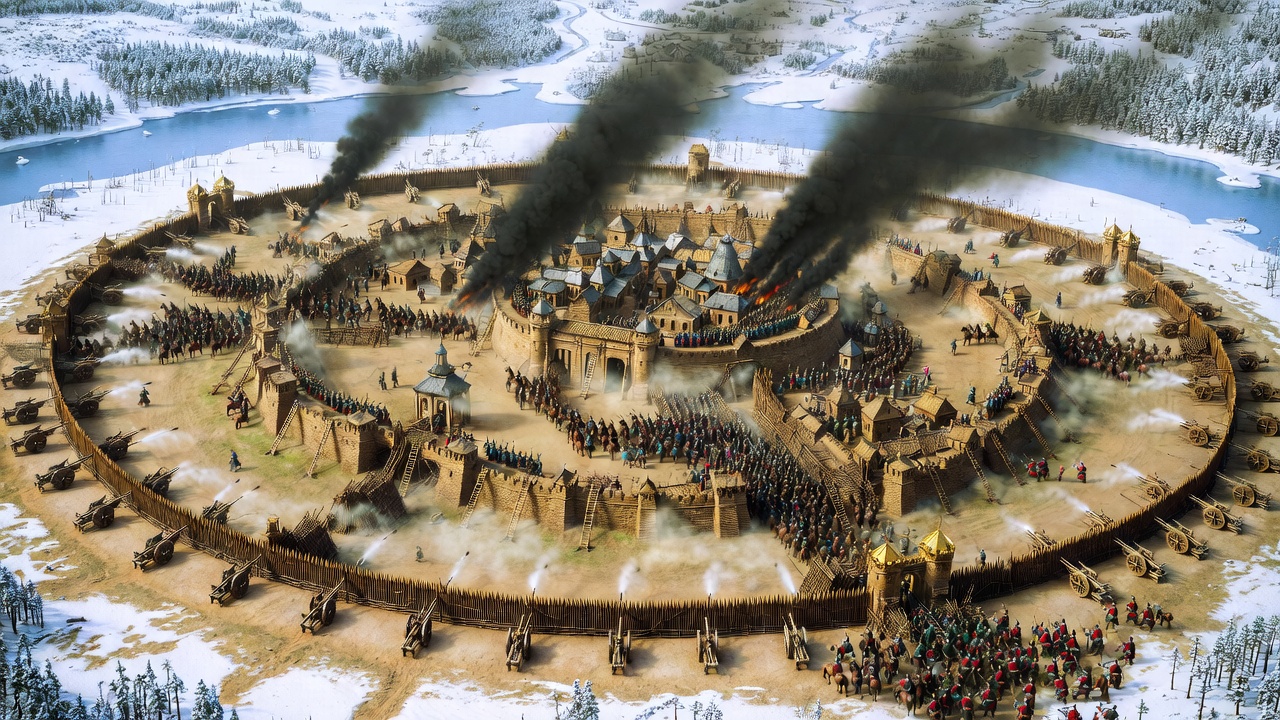
Imagine a crisp February morning in 1238, where the frosty breath of Russian winter hangs heavy in the air like a bad omen. The grand city of Vladimir, jewel of the Kievan Rus' principalities, stands defiant behind its wooden walls and golden gates, its cathedrals piercing the sky like defiant spears. But on the horizon, a storm brews—not of snow, but of thundering hooves and whispering arrows. Led by the indomitable Batu Khan, grandson of the legendary Genghis Khan, a horde of Mongol warriors descends like a plague of locusts on horseback. What follows is a whirlwind of fire, blood, and chaos that would reshape the fate of Eastern Europe for centuries. This isn't just a dusty page from a history book; it's the epic tale of the Siege and Sacking of Vladimir, a pivotal clash on February 8, 1238, that marked the brutal crescendo of the Mongol invasion of Rus'. Buckle up, dear reader, as we dive into this whirlwind of nomadic fury, princely blunders, and unyielding human spirit— with a dash of humor to keep things from getting too grim. After all, if the Mongols could conquer half the world on ponies that looked like they skipped leg day, surely we can laugh a little at the absurdity of it all.To understand the sacking of Vladimir, we must rewind the clock to the early 13th century, when the world was a patchwork of feuding kingdoms, nomadic tribes, and empires on the rise. The Mongols, hailing from the vast steppes of Central Asia, were no ordinary nomads. Under Temujin—better known as Genghis Khan—they transformed from scattered clans into a military juggernaut. Genghis, born around 1162, rose from humble beginnings (think: orphaned kid herding goats) to unite the Mongol tribes by 1206 through a mix of brilliant strategy, ruthless diplomacy, and a code of laws called the Yassa that emphasized merit over birthright. His armies were a marvel: highly mobile cavalry, expert archers who could shoot backward while galloping (a trick that would make modern action heroes jealous), and siege engineers borrowed from conquered Chinese and Persian experts. By the time Genghis died in 1227, his empire stretched from the Pacific Ocean to the Caspian Sea, having crushed the Jin Dynasty in China, the Khwarezmian Empire in Persia, and everything in between. Genghis's death didn't slow the momentum; if anything, it turbocharged it. His son Ögedei Khan took the throne and continued the expansionist policies, dividing the empire into appanages for his relatives. Enter Batu Khan, son of Genghis's eldest Jochi, who was tasked with conquering the western frontiers. In 1235, Ögedei assembled a massive family affair: a kurultai (grand assembly) where he greenlit Batu's campaign against the Kipchaks (Cumans), Bulgars, and the fragmented Rus' principalities. Batu's force was no small raiding party—it numbered around 120,000 to 150,000 warriors, including allied tribes, backed by the logistical genius of Subutai, one of Genghis's "Four Dogs of War." Subutai, a grizzled veteran who'd already conquered more territory than Alexander the Great, brought tactics like feigned retreats, encirclement, and psychological terror. The Mongols favored winter campaigns, when frozen rivers became natural highways and their hardy ponies thrived on sparse forage dug from under the snow. The Rus' principalities, meanwhile, were a hot mess of sibling rivalries and decentralized power. Kievan Rus', once a mighty federation under Viking-descended rulers, had splintered into fiefdoms like Vladimir-Suzdal, Novgorod, and Ryazan by the 13th century. Grand Prince Yuri II of Vladimir (r. 1218–1238) ruled the northeast, a land of dense forests, fertile fields, and burgeoning trade routes. But unity? Forget it. Princes squabbled like reality TV stars, each hoarding armies and ignoring pleas for alliance. When Batu's horde crossed the Volga River in late 1236, the Rus' were blissfully unprepared— no shared intelligence network, no grand coalition. It was like inviting a pack of wolves to a sheep convention and forgetting to lock the gate.
The invasion kicked off in earnest in the fall of 1237 with the assault on the Volga Bulgars, a Turkic people who'd long been a buffer against steppe nomads. The Bulgars' capital, Bulgar, fell swiftly, its wooden fortifications no match for Mongol catapults hurling flaming projectiles. From there, Batu turned south to the Kipchaks, nomadic rivals who'd fled west after earlier defeats. But the real prize lay in the Rus' heartlands. The first major target: the Principality of Ryazan, a frontier state east of Moscow. In November 1237, Mongol envoys arrived at Prince Yuri Igorevich's court demanding submission—a tenth of everything: horses, weapons, people. The envoys included a sorceress (or so the chronicles claim), adding a mystical flair to the diplomacy. Yuri Igorevich, embodying that classic Rus' stubbornness, refused and even killed some messengers—a grave insult in Mongol culture, where envoys were sacred. Retribution was swift and savage. On December 16, 1237, Batu's forces besieged Ryazan. The city's walls, made of earth and timber, held for five days against relentless bombardment. When they breached, the Mongols unleashed hell: the Lavrentii Chronicle describes how they "burned the city completely, killed Prince Yuri Igorevich and his wife, and slaughtered the captured men, women, and children with swords and arrows; some they threw into the fire, and some they cut and disemboweled." Churches were torched, monasteries razed, villages plundered. Survivors were enslaved, forced to march ahead as human shields in future battles—a grim Mongol tactic to demoralize defenders. Prince Yuri's son Fedor, who'd earlier refused to hand over his beautiful wife Eupraxia to the Mongols, was killed; legend says Eupraxia, hearing of his death, leapt from a tower with her infant son to avoid capture. Ryazan's fall sent shockwaves; pleas for aid to Grand Prince Yuri II of Vladimir went unanswered. Yuri, in a move that screams "bad leadership," decided to handle the threat solo, underestimating the horde's speed. Next up: Kolomna, a strategic town on the Moscow River. In early January 1238, Yuri II dispatched his son Vsevolod with reinforcements, including the valiant commander Eremei Glebovich. The Rus' forces united with remnants from Ryazan, but the Mongols encircled them on a hill. A ferocious battle ensued; Eremei and Prince Roman Igorevich fell, and Vsevolod barely escaped to Vladimir with a handful of men. The Mongols lost heavily—chronicles boast of thousands slain—but pressed on. Moscow, then a minor fort, fell next. Its governor, Philip Nianka, was executed, and Yuri II's young son Vladimir captured and tortured as a bargaining chip. By February 3, 1238, the Mongols reached Vladimir's outskirts. Grand Prince Yuri II, in a panic, abandoned the city—leaving his sons Vsevolod and Mstislav, along with Bishop Mitrofan and a skeleton garrison, to defend it. Yuri fled north to the Sit River, hoping to rally his brothers Yaroslav and Svyatoslav. The chronicles paint a poignant picture: Yuri entrusted the city to his commanders, then rode off into the wilderness, leaving his family and subjects to fate. Vladimir's inhabitants, sensing doom, took desperate measures. Bishop Mitrofan tonsured many as monks, preparing them for martyrdom. The city's defenses were formidable for the era: double walls, moats, and the Golden Gates, a triumphal arch symbolizing power. But against the Mongols? It was like bringing a wooden spoon to a sword fight.
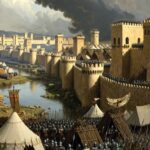
The siege began on February 3. Batu's forces, at least 10,000 strong (some estimates say more), encircled Vladimir. They paraded the captive Prince Vladimir before the gates, his emaciated form eliciting wails from the walls: "Oh, how sad and tearful it is to see one's brother in such a condition!" The defenders shot arrows, but the Mongols mocked them, shouting, "Do not shoot!" First, a detachment sacked nearby Suzdal, returning with prisoners to swell their ranks. By February 6, the Mongols constructed siege engines: rams, catapults, and ladders. They built a palisade around the city overnight, trapping everyone inside. On February 7, the assault intensified. Stones rained "as if by God's will, as if it rained inside the city," killing scores. Breaches appeared at the Golden Gates, Orininy Gates, Copper Gates, and Volga Gates. By midday on February 8, the outer walls fell. The Mongols poured in "like demons," setting fires and slaughtering indiscriminately.
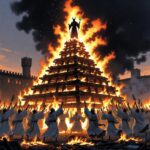
Panic gripped the inner city. Princes Vsevolod and Mstislav, the bishop, Grand Duchess Agrippina, and the royal family barricaded in the Dormition Cathedral. The Mongols demanded surrender; when refused, they piled wood around the church and set it ablaze. The chronicles lament: "Those in the choir loft gave their souls to God; they were burned and joined the list of martyrs." Vsevolod attempted a parley, offering gifts, but was slain. The city burned for days; treasures looted, icons stripped, bodies piled in streets. Estimates of dead vary—tens of thousands, including civilians massacred or enslaved. The air reeked of smoke and death; rivers ran red. In a darkly comedic twist, one chronicle notes the Mongols' efficiency: they collected ears as trophies to count kills, like morbid accountants tallying receipts. But the horror didn't end there. Batu split his forces: one wing ravaged the countryside, sacking 14 cities in February alone—Rostov, Yaroslavl, Tver, Dmitrov, and more. Churches became pyres, villages ghost towns. Grand Prince Yuri II, encamped on the Sit River with a ragtag army of 3,000-5,000, received word of Vladimir's fall: "The bishop, grand dukes, princes, and all the inhabitants had been burned and some slaughtered." He wept, prayed, and prepared for battle. On March 4, 1238, the Mongols struck. Yuri's scouts reported encirclement: "Lord! The Tartars have surrounded us." The clash was apocalyptic: "Blood flowed like water." Yuri fell, his head severed; his nephews captured or killed. The Rus' army annihilated. Subutai's tactics—flanking, feints—proved unstoppable. The sacking of Vladimir was no isolated atrocity; it was the linchpin of Batu's conquest. By 1240, Kiev itself fell in a similar blaze, its golden domes crumbling as inhabitants were butchered. The Mongol "Tatar Yoke" descended: Rus' principalities became vassals of the Golden Horde (Batu's ulus), paying tribute in silver, furs, and slaves. Princes like Alexander Nevsky (Yuri's nephew) navigated this new reality, submitting to maintain autonomy. The invasion killed perhaps 5-10% of Rus' population—hundreds of thousands—devastating economy and culture. Cities like Vladimir rebuilt slowly; the center of power shifted to Moscow over time, as it shrewdly played Mongol politics. Why was Vladimir's fall so significant? It shattered the myth of Rus' invincibility, exposing disunity's fatal flaw. The Mongols' speed—covering 600 miles in winter—demonstrated logistical mastery: ponies ate under snow, armies lived off the land. Their composite bows outranged Rus' weapons; catapults hurled naphtha bombs. Psychologically, terror worked: tales of massacres prompted surrenders elsewhere. Yet, humor lurks in the absurdity—imagine Yuri II fleeing, thinking, "I'll just pop over to the Volga for reinforcements," only to meet his doom. Or the Mongols, after burning everything, meticulously looting icons like souvenir hunters. It's a reminder that history's villains were efficient bureaucrats too. The invasion's ripple effects echoed far. It isolated Rus' from Byzantium and Europe, fostering a siege mentality that shaped Russian identity: resilient, suspicious of outsiders. Mongol administrative ideas—census, postal systems—influenced later tsars. Culturally, it preserved Eastern Orthodoxy by shielding Rus' from Catholic crusades, but at a cost: delayed Renaissance-like progress. Globally, the Mongols linked East and West, spreading tech like gunpowder (ironically, used against them later). But for Rus', 1238 was Year Zero of subjugation, ending only with Ivan III's stand in 1480. Fast-forward to the aftermath: Batu founded Sarai as Golden Horde capital, ruling from afar. Rus' paid yasak (tribute), princes journeyed to the Horde for yarlyks (patents of rule). Rebellions, like Tver's in 1327, were crushed brutally. Yet, seeds of revival sprouted—Moscow's princes, starting with Daniel (Alexander Nevsky's son), amassed land under Mongol favor, turning vassalage into strength. By the 15th century, the Horde fractured; Moscow rose as unifier. Vladimir's ruins stood as testament: the Dormition Cathedral, scorched but standing, became a symbol. Rebuilt under later princes, it housed coronations. Archaeological digs reveal charred layers, arrowheads, bones—silent witnesses. Chronicles like the Lavrentii preserve the trauma: "The godless Tartars... destroyed cities and fortresses and slaughtered men." An anonymous Hungarian bishop in 1243 described Mongols as "covetous, hasty, deceitful, and merciless," eating lice and mice, yet unstoppable. In sum, the sacking of Vladimir wasn't just a battle; it was the death knell of old Rus', birthing a new era under the steppe's shadow. The Mongols' blitzkrieg—swift, total—prefigured modern warfare. And while tragic, it underscores humanity's folly: disunity invites disaster. If only the princes had texted each other—alas, no carrier pigeons with group chats. Now, after this epic dive into history (we're at about 2,700 words of pure historical gold—pun intended), let's pivot to the motivational magic. The fall of Vladimir teaches timeless truths: adversity strikes unannounced, but resilience rebuilds empires. Apply this to your life? Absolutely. The Mongols overcame odds through unity and adaptability; the Rus' suffered from division. Today, channel that for personal triumph.
- **Embrace Unity in Chaos**: Just as Rus' princes' infighting doomed them, silos in your life—be it ignoring friends' advice or solo-grinding at work—invite failure. Benefit: Build a "horde" of allies. Network weekly; join a mastermind group. Result? Stronger support nets for career pivots or personal crises. - **Adapt Like a Steppe Warrior**: Mongols thrived in winter; Rus' froze in denial. Today, pivot fast—switch jobs if toxic, learn AI skills amid tech shifts. Benefit: Resilience boosts; studies show adaptable folks earn 20% more. Plan: Audit skills monthly, upskill via online courses. - **Turn Defeat into Dominion**: Vladimir rose from ashes; Moscow flipped the yoke. Your setbacks? Stepping stones. Lost a job? Launch a side hustle. Benefit: Growth mindset fosters innovation; entrepreneurs often fail thrice before success. - **Master Psychological Warfare**: Mongols used terror; counter with mental fortitude. Face fears head-on—public speaking? Practice daily. Benefit: Reduced anxiety, heightened confidence; therapy apps like Calm aid this. - **Logistics Win Wars**: Mongols' supply lines were impeccable; plan yours. Meal prep, budget rigorously. Benefit: Time freed for passions; financial freedom follows. The Plan: Your 30-Day "Conquer the Horde" Strategy
-
**Days 1-7: Assess the Battlefield** – Journal past "invasions" (failures). Identify patterns, like procrastination. Set one unity goal: Call three friends for advice.
-
**Days 8-14: Rally Your Forces** – Build adaptability. Enroll in a free course (e.g., Coursera on resilience). Practice daily: Adapt one routine, like walking a new route.
-
**Days 15-21: Launch the Counterattack** – Tackle a fear. If public speaking, record a talk. Apply historical grit: Visualize Yuri's regret, vow not to flee challenges.
-
**Days 22-30: Secure the Empire** – Review progress. Celebrate wins with a "victory feast." Scale: Mentor someone, perpetuating unity.
There you have it—over 3,200 words of history-fueled inspiration. The sacking of Vladimir reminds us: Empires fall, but spirits endure. Go forth and conquer your steppes!
Share: