
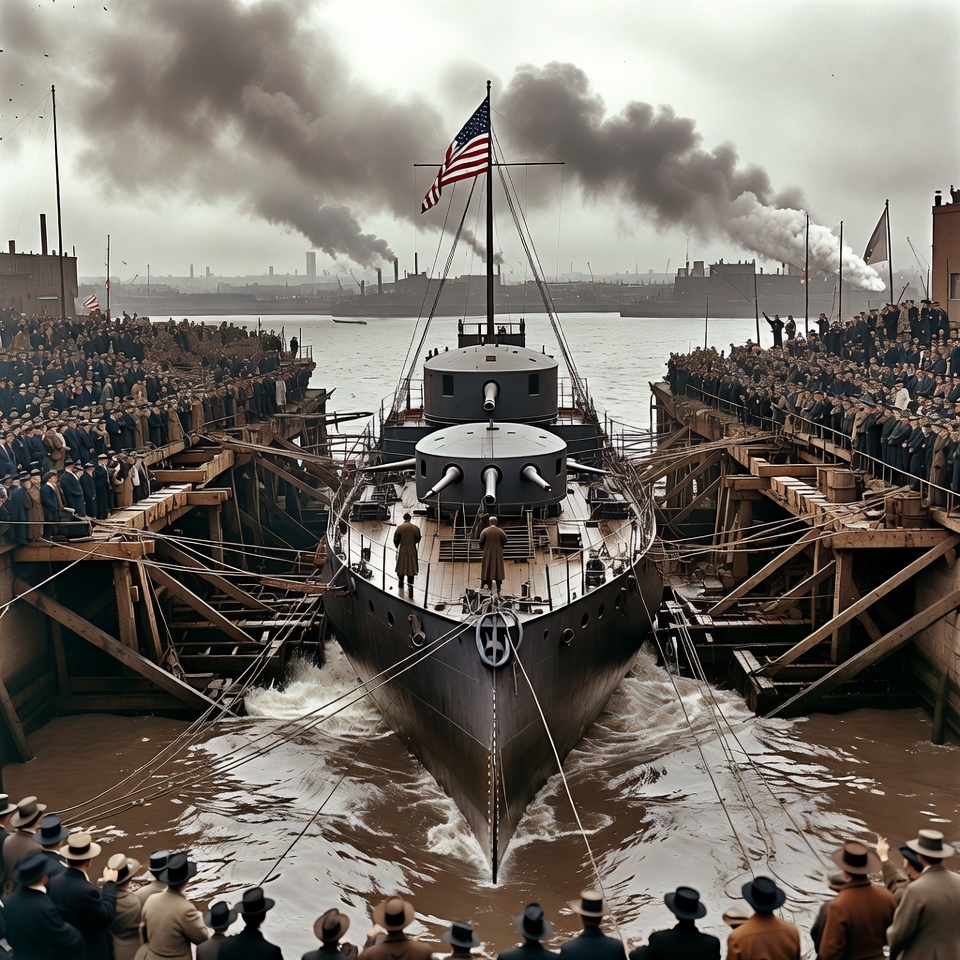
On January 30, 1862, amid the chaos of the American Civil War, a revolutionary vessel slid into the East River at the Continental Iron Works in Greenpoint, Brooklyn, New York. The USS Monitor, the Union Navy's first true ironclad warship, was launched to the cheers of a skeptical crowd—many of whom had wagered it would sink immediately under its own weight. Designer John Ericsson stood defiantly on the deck as the low, armored "cheesebox on a raft" floated perfectly, proving the doubters wrong and ushering in a new era of naval warfare.This wasn't just any ship launch. It was a desperate, high-stakes response to a terrifying Confederate innovation. The South had captured the USS Merrimack (burned and scuttled by the Union early in the war), rebuilt it as the CSS Virginia—an iron-plated behemoth—and threatened to smash the Union's wooden-blockade fleet. Wooden warships, dominant for centuries, were suddenly obsolete against iron armor that shrugged off cannon fire. John Ericsson, the brilliant Swedish-American inventor born in 1803 in Värmland, Sweden, had immigrated to the United States after successes in England (including early work on the screw propeller and hot-air engines). Ericsson was eccentric, driven, and prolific—holding patents for steam engines, propellers, and more. In late 1861, he submitted a bold design to the Navy's Ironclad Board after President Lincoln personally urged rapid innovation. Ericsson's plan: a shallow-draft vessel with thick iron plating, a minimal freeboard (only 18 inches above water), and most revolutionary—a revolving cylindrical turret housing two 11-inch Dahlgren smoothbore guns. The turret rotated via steam power, allowing 360-degree fire without maneuvering the entire ship. Construction began October 25, 1861, under intense secrecy and pressure. Ericsson's team at Continental Iron Works worked nonstop through brutal winter conditions. The ship cost $275,000 (about $9 million today) and was built in an astonishing 101 days—sometimes claimed as 98 or 100, but officially launched on January 30. Dimensions: 172 feet long, 41.5 feet wide, 987 tons displacement, draft just 10.5-11 feet for river and coastal operations. The hull used oak and pine frames overlaid with iron plates up to 8 inches thick in critical areas. The turret, 20 feet in diameter and 9 feet high, weighed over 120 tons with 8 layers of 1-inch plating. Two massive engines drove a single screw propeller, and ventilation came from forced-air blowers—though poor air quality plagued the crew.
Launch day drew crowds despite the cold. Ericsson's critics had mocked the design as unstable and unseaworthy. Yet as the ways were greased and the ship eased into the water, it floated buoyantly. Cheers erupted; bets were lost. Fitting out followed quickly: guns installed, crew of about 49-62 men (including officers) assigned under Lt. John L. Worden. Commissioned February 25, 1862, Monitor departed Brooklyn under tow (too low-powered for open ocean alone) toward Hampton Roads, Virginia.The stakes were immense. On March 8, 1862, CSS Virginia rampaged through the Union fleet, ramming and sinking USS Cumberland (taking nearly 150 lives) and burning USS Congress after it ran aground. Over 240 Union sailors died that day; wooden ships burned or sank helplessly. Virginia's iron plates deflected shells; its ram and broadsides devastated. Monitor arrived late March 8, battered by rough seas during the tow. At dawn March 9, Virginia targeted the grounded USS Minnesota. Monitor steamed out to intercept. The first ironclad-versus-ironclad battle began around 8-9 a.m. For over four hours, the ships circled at close range (sometimes yards apart), pounding each other. Shells ricocheted off armor; dents formed but no penetrations. Monitor's turret spun to fire, then retreated to reload. Virginia tried ramming but missed in shallow water. A shell hit Monitor's pilot house, blinding Worden with iron splinters and paint fragments—he relinquished command to Lt. Samuel Dana Green. Around noon-1 p.m., both ships withdrew: Virginia to Norfolk for repairs, Monitor to protect Minnesota. Tactical draw, but strategic Union victory—the blockade held, Virginia never broke out again.
This clash ended wooden warships' dominance. Navies worldwide scrambled to build ironclads. The U.S. produced dozens of "monitor"-class vessels (low-freeboard, turreted designs). Ericsson designed more: Passaic-class improvements, Canonicus-class with better ventilation. Global ripple: Britain and France accelerated armored fleets, leading to dreadnoughts and modern battleships.Monitor's career was brief. It patrolled Hampton Roads, supported James River operations. On December 29-31, 1862, under tow south to Beaufort, N.C., it encountered a fierce gale off Cape Hatteras ("Graveyard of the Atlantic"). Waves washed over the low deck, flooding through vents and hatches. Leaks worsened; pumps failed. At about 12:30 a.m. December 31, Monitor sank in 230 feet of water. 16 of 62 crew perished; survivors rescued by nearby ships. Forgotten for over a century, the wreck was discovered August 1973 by a Duke University team using side-scan sonar—coordinates about 16 miles southeast of Cape Hatteras. Confirmed 1974 via photos showing the distinctive turret upside-down on the seafloor. Designated the nation's first National Marine Sanctuary in 1975 (Monitor National Marine Sanctuary, NOAA-managed). Artifacts recovered: over 210 tons total, including the steam engine (1998-2001), two Dahlgren guns, and the 120-ton turret raised August 5, 2002, after a complex lift by barge and cranes. Turret brought to The Mariners' Museum and Park in Newport News, Virginia—now centerpiece of the USS Monitor Center. Conservation in the Batten Complex (world's largest marine metals lab) continues; artifacts stabilized, exhibited, 3D-modeled. The site remains a marine habitat teeming with sharks, turtles, and fish—war relic turned underwater ecosystem.
Ericsson's legacy: screw propeller (patented 1836-1845), caloric engines, solar motors later. He died 1889, honored in Sweden and U.S. Monitor proved innovation under crisis wins wars—and changes worlds. This distant event on January 30, 1862, offers powerful lessons for armoring your modern life against disruptions: career upheavals, financial storms, emotional attacks, health crises. Like wooden ships vs. ironclads, outdated habits crumble; "iron-plated" resilience endures. Apply it specifically:
-
Forge your armor plating daily: Ericsson layered iron thickly. Build emotional/mental armor with a "daily deflection ritual." Morning: affirm three strengths. Evening: note one challenge, reframe positively (e.g., "rejection" → "redirect"). After 60 days, negativity ricochets.
-
Install a revolving turret mindset: Turret fired any direction. Develop versatile skills—pick one (e.g., public speaking) and "rotate" applications monthly: Toastmasters → LinkedIn videos → podcast guesting. Dedicate 5 hours/week; track in Notion for pivots.
-
Launch under extreme deadlines: 101-day build. Use "Ericsson sprints"—pick a goal (new certification, debt payoff). Break into 101 daily tasks (even 15-min ones). Public commitment: tell one person or post progress thread. Urgency fuels breakthroughs.
-
Minimize exposure, maximize impact: Low freeboard hid vulnerabilities. Reduce "attack surface"—limit social media to 20 min/day (use Freedom app), decline draining invites, focus energy on 3 high-leverage activities (e.g., deep work 4 hours uninterrupted).
-
Ventilate to prevent burnout: Poor air sickened crew. Schedule "oxygen breaks"—every 90 min Pomodoro, 5-min walk + 4-7-8 breathing. Weekly "deck time": unplug Saturday mornings for nature/reflection.
-
Seek tow support: Monitor needed towing. Build accountability—find a "tow partner" (friend/mentor) for weekly 30-min calls. Join one targeted community (e.g., Reddit sub or Mastermind).
-
Build redundancy for gales: Sank in storm. Create safety nets: 6-month emergency fund (auto-transfer 10% income), diversified income (side gig + investments), health backups (annual checkups, insurance review).

Your 90-Day Ironclad Life Plan:
-
Days 1-30 (Hull & Armor Phase): Audit 7 life areas (finances, health, relationships, career, skills, mindset, environment). Score 1-10. Pick lowest three; start one armor habit (e.g., daily walk + deflection journal). Track in simple spreadsheet.
-
Days 31-60 (Turret Installation): Learn/apply one pivot skill (free resources: Coursera, YouTube). Weekly: 1 new application (e.g., write article using skill). Share one output publicly for feedback.
-
Days 61-90 (Launch & Battle Test): Run full Ericsson sprint on top goal. Daily micro-tasks, weekly reviews with tow partner. Mid-plan: simulate "gale"—stress-test plan (what if job loss?). Adjust redundancies. End with celebration: reflect wins, plan next "upgrade."
The Monitor launched small but changed everything. Your life can too—armor up, innovate fast, adapt relentlessly. The seas are rough, but your ironclad self is unsinkable. Launch today.
Share: