
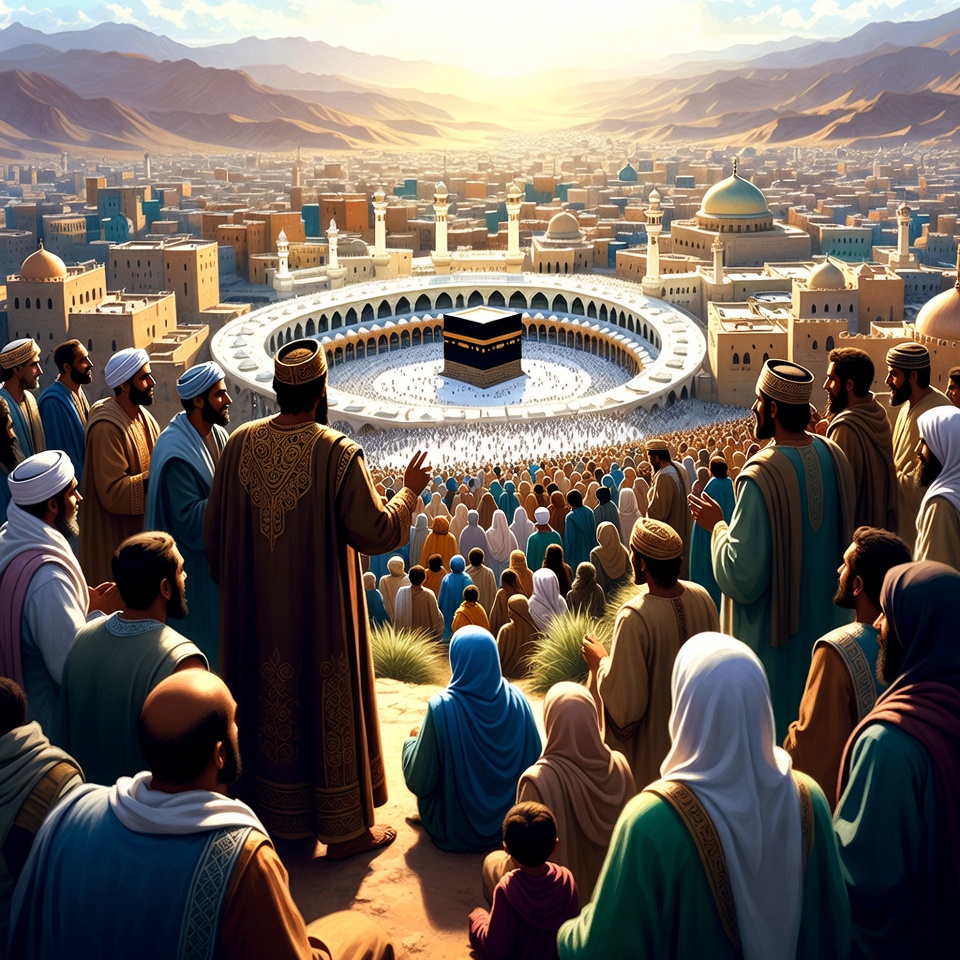
Imagine a vast army of 10,000 warriors, their footsteps echoing across the arid sands of the Arabian Peninsula, converging on a city that had long been a bastion of opposition and idolatry. No epic clash of swords, no rivers of blood—just a swift, almost surreal surrender that reshaped the course of history. This is the story of the Conquest of Mecca in 630 CE, an event that unfolded around January 11 of that year, marking a pivotal moment in the rise of Islam and the transformation of a fractured society into a unified force. It's a tale brimming with intrigue, strategic brilliance, acts of mercy, and profound cultural shifts, all set against the backdrop of ancient tribal rivalries and divine aspirations. But beyond the dusty pages of history, this conquest offers timeless blueprints for anyone seeking to overcome personal obstacles today—turning adversity into triumph through calculated moves, forgiveness, and unyielding resolve. Dive in with me as we unpack this remarkable episode, blending the grit of the past with sparks of inspiration for your own life. Let's start by setting the scene in the harsh, unforgiving landscape of 7th-century Arabia. The Arabian Peninsula was a mosaic of tribes, each fiercely independent, bound by blood ties, ancient grudges, and a polytheistic faith centered around the Kaaba in Mecca—a cube-shaped shrine housing hundreds of idols representing various gods and goddesses. Mecca wasn't just a religious hub; it was an economic powerhouse, drawing pilgrims and traders from across the region, enriching the powerful Quraysh tribe that controlled the city. The Quraysh were merchants, warriors, and custodians of the Kaaba, wielding influence that extended far beyond their sandy domain. Enter Muhammad, born around 570 CE in Mecca itself, a member of the Quraysh's Banu Hashim clan. Orphaned young and raised by his grandfather and uncle, Muhammad grew into a man known for his honesty and wisdom, earning the nickname "Al-Amin" (the trustworthy). In 610 CE, at age 40, he received his first revelation in a cave on Mount Hira, where the angel Gabriel commanded him to "Recite!" This marked the beginning of Islam, a monotheistic faith emphasizing submission to one God (Allah) and rejecting the idols of old. Muhammad's message challenged the status quo: it denounced polytheism, called for social justice, protected the weak, and promoted equality among believers—ideas that threatened the Quraysh's economic and social dominance. For years, Muhammad and his small band of followers faced persecution in Mecca. They were boycotted, starved, and attacked. In 622 CE, in an event known as the Hijra, Muhammad and his companions fled to Medina (then called Yathrib), about 280 miles north, where they found allies among local tribes. This migration marks year one of the Islamic calendar. In Medina, Muhammad built a community based on the revelations compiled into the Qur'an, forging alliances and defending against Quraysh incursions. Battles like Badr (624 CE), where 313 Muslims defeated a much larger Quraysh force, and Uhud (625 CE), a setback where Muhammad was wounded, highlighted the growing tension. The turning point came in 628 CE with the Treaty of Hudaybiyyah. Muhammad led 1,400 followers toward Mecca for pilgrimage, but the Quraysh blocked them at Hudaybiyyah, a site outside the city. After tense negotiations, a 10-year truce was signed: Muslims could not enter Mecca that year but could the next; no warfare between the sides; and tribes could ally with either party. It seemed like a concession—many Muslims grumbled—but Muhammad saw it as a strategic pause. The treaty allowed Islam to spread peacefully, with conversions surging as the faith's message resonated across Arabia. But peace was fragile. In late 629 CE, the treaty shattered. The Banu Bakr tribe, allied with the Quraysh, attacked the Banu Khuza'ah, who were aligned with the Muslims. This wasn't a minor skirmish; it was a brutal assault at Al-Wateer, a watering place near Mecca, where the Banu Bakr, egged on by Quraysh leaders like Safwan ibn Umayya, Ikrima ibn Amr (son of the infamous Abu Jahl), and Suhayl ibn Amr, slaughtered about 20 Khuza'ah members. Worse, some killings occurred inside the Holy Sanctuary of Mecca, violating sacred customs that forbade violence there. The Banu Khuza'ah, desperate, barricaded themselves in the house of Budayl ibn Warqa and sent a 40-man delegation led by 'Amr bin Salim Al-Khuza'i to Medina, pleading for Muhammad's help. Muhammad, now a seasoned leader with a burgeoning army, responded decisively. He demanded the Quraysh pay blood money for the slain, dissolve their alliance with the Banu Bakr, or declare the treaty null. The Quraysh, sensing their blunder, sent Abu Sufyan ibn Harb—the shrewd, aristocratic leader of Mecca—to Medina to renegotiate. Abu Sufyan, a veteran of battles against Muhammad, arrived humbly but was met with silence: Muhammad avoided him, as did key companions like Abu Bakr, Umar ibn al-Khattab, and Ali ibn Abi Talib. Abu Sufyan returned empty-handed, the treaty effectively broken. What followed was a masterclass in preparation and secrecy. Muhammad imposed a communications blackout in Medina three days before the Khuza'ah news even arrived officially— a move to prevent leaks. He sent Abu Qatadah ibn Rabi'ah with a detachment to Idam, creating a diversion. Meanwhile, a potential betrayal emerged: Hatib ibn Abi Balta'ah, a Muslim who had family in Mecca, sent a warning letter via a woman from the Banu Abdul Muttalib. Muhammad, informed by revelation, dispatched Ali and Al-Miqdad ibn Amr to intercept her at Ar-Rawda. The letter was found hidden in her hair; Hatib confessed it was to protect his kin, and Muhammad pardoned him, showcasing early mercy. By 10 Ramadan, 8 AH (corresponding to late December 629 or early January 630 CE), Muhammad mobilized an unprecedented force: 10,000 fighters from Medina and allied tribes like the Banu Sulaym, Ghifar, and Aslam. He appointed Abu Ruhm al-Ghifari as governor of Medina in his absence. The army marched under strict discipline, observing the Ramadan fast until they reached Al-Qadeed, where Muhammad broke his fast with a drink of milk, signaling others to do the same for strength. As they advanced, key encounters added drama. At Al-Juhfa, Muhammad's uncle Al-'Abbas ibn Abdul Muttalib joined with his family, converting to Islam. At Al-Abwa', Muhammad forgave his cousins Abu Sufyan bin Al-Harith and Abdullah bin Abi Umayyah, who had previously mocked him, after their tearful repentance—another act of clemency that would pay dividends.To intimidate without surprise, Muhammad ordered 10,000 fires lit at Marr az-Zahran, a valley near Mecca, illuminating the night sky and revealing the army's size to Quraysh scouts. Abu Sufyan, accompanied by Hakim bin Hizam and Budayl bin Warqa, ventured out to assess the threat. Captured by Muslim patrols, Abu Sufyan was brought before Muhammad. Al-'Abbas intervened, urging conversion. Abu Sufyan, impressed by the army's discipline, professed the Shahada (declaration of faith) and was granted amnesty. Muhammad bestowed privileges: anyone entering Abu Sufyan's house, the mosque, or closing their door would be safe. Abu Sufyan returned to Mecca, proclaiming, "O Quraysh, Muhammad has come with a force you cannot resist. Submit and you will be safe." The Quraysh panicked. Many dispersed to their homes or the Kaaba, seeking sanctuary. A faction, led by Ikrima, Safwan, and Suhayl, gathered at Khandamah hill to resist, arming with whatever they could muster. But resistance was futile. On approximately 17-20 Ramadan (around January 11, 630 CE), the Muslim army entered Mecca in a coordinated assault designed for minimal bloodshed. Muhammad divided his forces: Khalid ibn al-Walid commanded the right flank, entering through the lower avenues with tribes like Aslam, Sulaym, Ghifar, Muzaynah, and Juhaynah; Zubayr ibn al-Awwam led the left flank through the upper paths, tasked with planting Muhammad's banner at Al-Hajun upon reaching the Kaaba; Abu 'Ubaidah ibn al-Jarrah headed the infantry through a side valley; and Sa'd ibn Ubada initially carried the banner but was replaced by his son Qays after boasting, with Muhammad declaring, "Today is a day of mercy."
Orders were clear: no fighting unless attacked, no harming women, children, or non-combatants, no uprooting trees or killing animals except for food. Khalid's flank met brief opposition from Ikrima's group, resulting in 12 Quraysh deaths and 2 Muslim martyrs before the resistors fled. Safwan threw his lance and escaped; Ikrima and Suhayl sought refuge. Overall, the conquest was bloodless compared to typical sieges—no mass slaughter, no pillaging. Muhammad entered Mecca triumphantly yet humbly, riding his camel Al-Qaswa, his head bowed so low his beard nearly touched the saddle, reciting Surah Al-Fath (Qur'an 48) in gratitude. He proceeded to the Kaaba, where he touched the Black Stone with his staff and proclaimed "Allahu Akbar" (God is Greatest), echoed by the army. Using his bow, he toppled 360 idols, reciting Qur'an 17:81: "Truth has come, and falsehood has vanished. Indeed, falsehood is ever bound to vanish." Idols like Hubal, the chief deity, crashed to the ground, symbolizing the end of polytheism.
Inside the Kaaba, Muhammad ordered pagan images removed but spared a depiction of Mary and Jesus, according to some accounts. He performed prayer, then addressed the assembled Quraysh from Safa hill: "There is no god but Allah alone; He has no partner. He has fulfilled His promise, helped His servant, and defeated the confederates alone." He emphasized human equality: "O people, indeed We have created you from male and female and made you peoples and tribes that you may know one another. Indeed, the most noble of you in the sight of Allah is the most righteous" (Qur'an 49:13). He abolished blood feuds, usury, and privileges of nobility, declaring all Muslims brothers. Amnesty was broad, but justice targeted: four arch-criminals were executed. Abdullah ibn Khatal, an apostate who killed a Muslim and satirized Muhammad, was slain clinging to the Kaaba's curtains. His singing girls, who mocked the Prophet, met similar fates—one killed, one pardoned. Miqyas bin Sababa was executed for murdering a Muslim in revenge. Others, like Hind bint Utba (who mutilated Hamza's body at Uhud), her son Ikrima, Wahshi (Hamza's killer), and even Safwan and Suhayl, were forgiven after seeking pardon. Hind destroyed her idols and converted, exemplifying transformation. Bilal ibn Rabah, a former slave and the first muezzin, climbed the Kaaba to call the adhan (prayer call), a poignant symbol of equality—once tortured for his faith, now heralding Islam's victory. Muhammad stayed in Mecca for 19 days, educating the people, destroying surrounding idols, and dispatching envoys. Khalid was sent to demolish Al-Uzza's temple at Nakhla, Amr ibn al-As to Suwa' at Hudhayl, and Sa'd bin Zaid to Manat at Mushallal. An incident arose when Khalid's force mistakenly killed Banu Jadhimah tribesmen who surrendered but were misheard; Muhammad disavowed it, paying blood money and declaring, "O Allah, I am innocent of what Khalid has done."
The aftermath rippled across Arabia. Mecca became Islam's spiritual center, with the Kaaba rededicated to monotheism. Muhammad retained Uthman ibn Talha as key-bearer, honoring pre-Islamic roles in a new context. Conversions flooded in; tribes pledged allegiance, renouncing idolatry, theft, adultery, infanticide, and slander. The conquest ended the Muslim-Quraysh wars, paving the way for unification. Muhammad reassured anxious Medinans he wouldn't abandon them, returning soon after. This event's significance can't be overstated. It fulfilled prophecies in the Qur'an, like Surah An-Nasr (110): "When the victory of Allah has come and the conquest, and you see the people entering into the religion of Allah in multitudes." It shifted power dynamics, accelerating Islam's spread—within two years, most of Arabia converted. Culturally, it abolished Jahiliyyah (age of ignorance) practices, promoting ethics, justice, and community. Mecca's sanctity was elevated: no bloodshed, no hunting, no cutting green trees—rules still observed. Historians debate exact dates due to calendar conversions—Hijri to Gregorian—but the core narrative endures in sources like Ibn Ishaq's Sirah, Al-Waqidi's Maghazi, and the Qur'an itself. It's depicted in art, literature, and films like Anthony Quinn's "The Message" (1976), capturing the drama without showing Muhammad, per Islamic tradition. The Conquest of Mecca wasn't just military; it was psychological and spiritual. Muhammad's army, diverse and disciplined, contrasted the Quraysh's disarray. Strategies like the fires, amnesty, and targeted justice minimized resistance, maximizing conversion. It's a study in leadership: blending firmness with compassion, vision with pragmatism.
Now, shifting gears to the motivational spark—while the history stands tall, let's distill how this ancient triumph can fuel your personal growth today. The conquest teaches that true victory often comes not from brute force but from strategic patience, forgiveness, and unity. Imagine applying these to your life: conquering "personal Meccas" like bad habits, career roadblocks, or strained relationships. Here's how you benefit, with specific bullet points on lessons drawn directly from the event: - **Embrace Strategic Patience for Long-Term Wins**: Muhammad waited two years after Hudaybiyyah, using the truce to build strength. Today, delay gratification in pursuits like fitness or savings—avoid quick fixes, build habits steadily for enduring results. - **Turn Betrayals into Opportunities**: The treaty breach could have sparked rage, but Muhammad used it to rally allies. In your life, view setbacks like job loss or friendship rifts as catalysts; reassess alliances and pivot toward growth. - **Practice Radical Forgiveness to Lighten Your Load**: Pardoning enemies like Hind and Wahshi freed Muhammad from grudges. Forgive past hurts—whether from family or colleagues—to reduce stress, improve mental health, and open doors to new collaborations. - **Build Diverse Alliances for Strength**: The 10,000-strong army included former foes. Diversify your network: join varied groups, learn from different perspectives, enhancing career resilience and personal enrichment. - **Communicate with Actions, Not Just Words**: The 10,000 fires signaled power without aggression. Demonstrate your value through deeds—like consistent work ethic or kind gestures—rather than boasts, earning respect organically. - **Prioritize Mercy in Conflicts**: Limited executions focused on justice, not revenge. In arguments, seek resolution over victory; this fosters healthier relationships and reduces regret. - **Symbolically Destroy Your "Idols"**: Smashing Kaaba idols ended old ways. Identify and eliminate personal vices—social media addiction or negative self-talk—replacing them with empowering routines. - **Celebrate Equality to Boost Empathy**: Muhammad's address on human equality dismantled hierarchies. Apply this by treating everyone fairly, enhancing leadership skills and building inclusive communities. - **Prepare Meticulously for Challenges**: The communications blackout and diversions ensured success. Plan your goals with backups—whether prepping for a presentation or emergency fund—to navigate uncertainties. - **Transform Defeat into Legacy**: From persecuted prophet to conqueror, Muhammad's journey shows resilience. Use failures as stepping stones, turning them into stories that inspire others. To make this actionable, here's a 30-day plan inspired by the conquest's phases—adapt it to your "personal conquest," like overcoming procrastination or advancing your career:
-
**Days 1-5: Assess and Prepare (Background Phase)**: Reflect on your obstacle. Journal causes, like the treaty breach. Gather "allies"—books, apps, or mentors. Impose a "blackout" on distractions, focusing inward.
-
**Days 6-10: Mobilize Resources (Mobilization Phase)**: Build your "army." Set specific goals, e.g., exercise 30 minutes daily. Track progress in a notebook, drawing strength from small wins, like Muhammad's alliances.
-
**Days 11-15: Advance with Strategy (March Phase)**: Take calculated steps. Use "fires" to signal commitment—share goals publicly for accountability. Forgive past self-sabotage, pardoning like Muhammad did Hatib.
-
**Days 16-20: Confront and Conquer (Entry Phase)**: Tackle the core issue head-on. Break it into flanks: address one aspect daily, e.g., declutter one room if conquering disorganization. Minimize "bloodshed"—avoid burnout with rest.
-
**Days 21-25: Secure and Cleanse (Surrender Phase)**: Celebrate victories. Destroy "idols"—delete tempting apps or habits. Address the crowd: share learnings with friends for reinforcement.
-
**Days 26-30: Sustain and Expand (Aftermath Phase)**: Educate yourself ongoing, like Muhammad's teachings. Send "envoys"—help others with your insights. Review progress, adjust, and pledge long-term allegiance to your new self.
This plan isn't rigid; tweak it for fun—add rewards like a favorite treat after milestones. Remember, Muhammad's conquest wasn't about domination but liberation. Yours can be too—freeing you from limitations, one strategic step at a time. History isn't just dates; it's a playbook for the bold. Go forth and conquer!
Share: