
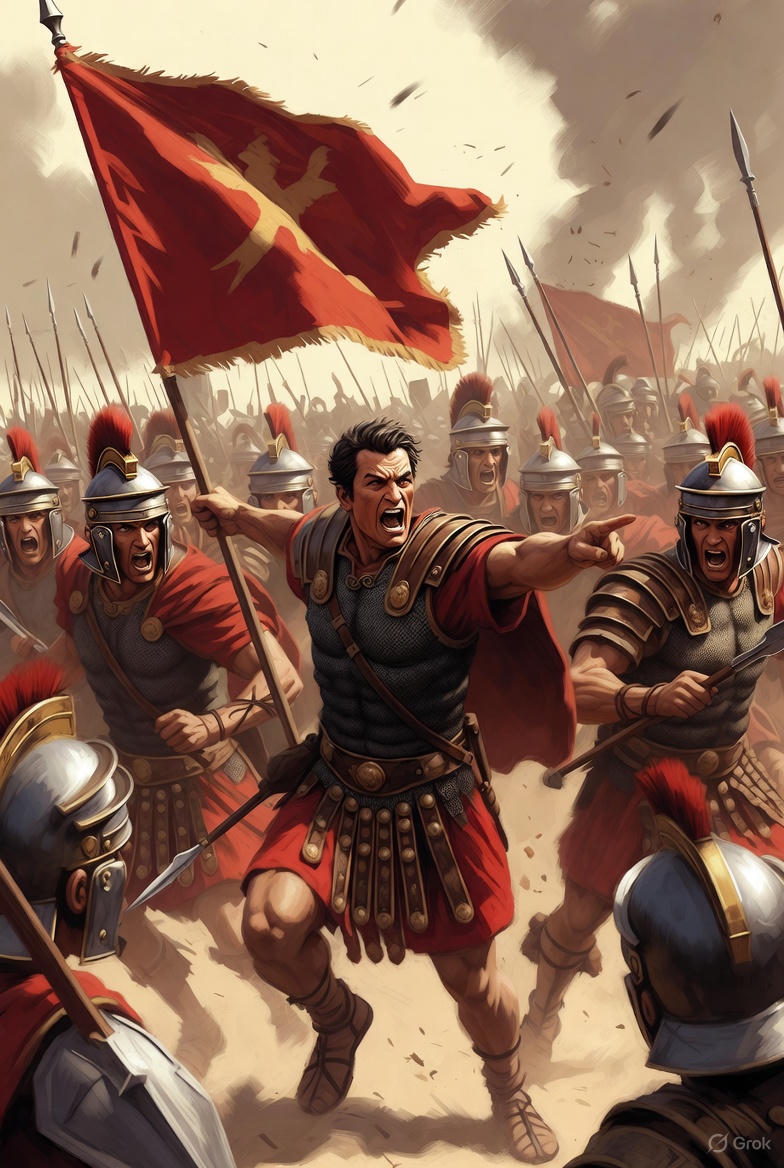
Imagine a blistering North African sun beating down on parched sands, where the fate of an empire teeters on the edge of a single, chaotic skirmish. It's January 4, 46 BC, and Julius Caesar, the legendary conqueror of Gaul, finds himself in a desperate pinch far from the marble halls of Rome. His legions, outnumbered and encircled by a swarm of nimble Numidian horsemen and dart-throwing skirmishers, face what looks like certain annihilation. Yet, through sheer grit, clever maneuvering, and a dash of audacious leadership, Caesar turns the tide—or at least lives to fight another day. This is the story of the Battle of Ruspina, a pivotal yet often overshadowed clash in Caesar's Civil War that showcased the raw unpredictability of ancient warfare. It's a tale packed with betrayal, tactical brilliance, and the unyielding human spirit, reminding us how history's underdogs can rewrite the script.Distant history often feels like a dusty tome, but the Battle of Ruspina bursts with the energy of a high-stakes thriller. Set against the backdrop of Rome's brutal civil strife, this engagement wasn't just a footnote in Caesar's campaigns; it was a make-or-break moment that tested the limits of Roman military prowess and set the stage for the Republic's final gasp. We'll dive deep into the historical nitty-gritty— the who, what, where, and why—with vivid details drawn from ancient sources like Caesar's own writings in *The Civil War*. But fear not; this isn't a dry lecture. Think of it as a front-row seat to antiquity's greatest showdowns, complete with heroic taunts, flying javelins, and the clash of iron. And yes, we'll wrap it up with some punchy, motivational takeaways on how this ancient dust-up can supercharge your modern life. After all, if Caesar could rally his troops from the brink, imagine what you could do with a Monday morning crisis. ### The Storm Brewing: Roots of Caesar's Civil War To grasp the drama at Ruspina, we must rewind the clock a few years to the crumbling foundations of the Roman Republic. By the mid-1st century BC, Rome wasn't the harmonious powerhouse of legend; it was a powder keg of ambition, corruption, and class warfare. The Senate, dominated by the conservative Optimates faction, clung to traditional power structures, while populist leaders like Julius Caesar pushed for reforms that favored the common folk—and, conveniently, their own rise to dominance. Caesar's star had ascended spectacularly during the Gallic Wars (58–50 BC), where he subdued vast swaths of modern-day France, Belgium, and beyond. His legions adored him for his generosity, sharing spoils and granting citizenship to allies. But back in Rome, envy festered. Figures like Cato the Younger and Pompey the Great saw Caesar as a threat to the Republic's delicate balance. Pompey, once Caesar's ally in the First Triumvirate (alongside Crassus), had shifted sides, aligning with the Senate. The spark ignited in 49 BC when the Senate demanded Caesar disband his army and return to Rome as a private citizen—essentially stripping him of protection against prosecution for alleged crimes during his consulship. Caesar, ever the gambler, crossed the Rubicon River with his troops, uttering the famous "Alea iacta est" ("The die is cast"). Civil war erupted. Caesar's forces swept through Italy, forcing Pompey to flee to Greece. The decisive Battle of Pharsalus in 48 BC shattered Pompey's army, and Pompey himself was assassinated in Egypt shortly after. But the war wasn't over. Pompey's supporters, the Optimates, regrouped in the Roman province of Africa (roughly modern Tunisia), a fertile breadbasket loyal to the Republican cause. Led by figures like Metellus Scipio, Cato, and Titus Labienus—Caesar's former right-hand man from the Gallic campaigns—they amassed a formidable force, bolstered by alliances with local Numidian kings like Juba I. Juba's kingdom provided thousands of swift cavalry and light infantry, experts in hit-and-run tactics honed in the desert. Caesar, after mopping up resistance in Spain and the East, turned his gaze to Africa. He knew defeating the Optimates there would end the civil war and solidify his dictatorship. But logistics were a nightmare. Shipping was scarce in winter, intelligence spotty, and the African coast hostile. Ancient historians like Appian and Dio Cassius paint a picture of Caesar's impatience: he set sail from Lilybaeum in Sicily on December 25, 47 BC (by the Julian calendar; the battle date adjusts to January 4, 46 BC after calendar reforms), with a fleet carrying six legions and 2,000 cavalry—but storms scattered them. ### Arrival in Africa: A Rocky Start Caesar's landing was anything but smooth. He aimed for a spot near the Optimate stronghold of Utica but washed up near Hadrumetum (modern Sousse) with only about 3,500 veteran legionaries and 150 cavalry. Supplies were minimal; his men carried just enough grain for a few days. The city's garrison, loyal to the Optimates, slammed the gates shut. Undeterred, Caesar pitched camp at Ruspina, a nearby promontory offering some natural defense. Reinforcements trickled in. On January 1, elements of the Fifth and Tenth Legions arrived at Leptis Parva (modern Lamta), a town friendly to Caesar. He marched there, secured the area with six cohorts as a garrison, and returned to Ruspina bolstered by more troops. By January 3, his force had grown, but food was running low. Foraging parties scoured the countryside, clashing with Numidian scouts. The Optimates weren't idle. Titus Labienus, the defector whose betrayal stung Caesar personally, shadowed his movements. Labienus commanded a hybrid army: Roman veterans mixed with 9,600 Numidian horsemen, 1,600 Gallic and Germanic cavalry (elite shock troops), and swarms of light infantry armed with javelins. These Numidians were masters of guerrilla warfare—fast, elusive, and deadly at range. Ancient accounts describe them as "infinitely swift," able to hurl darts while retreating on horseback.
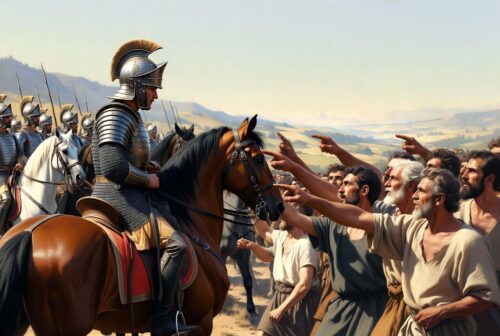
Caesar, in his *Commentarii de Bello Civili* (Civil War Commentaries), downplays his vulnerabilities, but the reality was grim. His men were seasoned from Gaul, but they lacked the cavalry to counter Labienus's mobility. Still, Caesar pressed on. On the morning of January 4, he led 30 cohorts (about 9,000-12,000 men, since cohorts were understrength) out for forage, accompanied by 400 cavalry and 150 archers. It was meant to be routine, but scouts reported enemy sightings. Caesar recalled his foragers and prepared for contact. ### The Clash Unfolds: Encirclement and Desperation As the sun climbed, Labienus struck. His cavalry charged from concealment, overwhelming Caesar's outnumbered horsemen and driving them back. The Numidians then enveloped the Roman flanks, forming a loose ring around the legions. In the center, light infantry peppered the Romans with javelins, dodging counter-throws with ease. Caesar's heavy infantry, clad in chain mail and wielding short swords (gladii) and heavy javelins (pila), were ill-suited for this skirmishing. Pila were designed for close-range volleys, not chasing fleet-footed foes. Sensing panic, Caesar adapted brilliantly. He ordered his line to extend thinly to prevent full encirclement, placing archers forward and cavalry on the wings. But the noose tightened. The Romans formed a defensive circle—a "orbis" formation—shields interlocked to face threats from all sides. Missiles rained down; wounds mounted. Morale wavered as men realized they were trapped miles from camp.
Enter the human element, which makes this battle so gripping. Labienus, riding boldly to the front, taunted Caesar's troops, calling them "raw recruits" and mocking their leader. A grizzled veteran from the Tenth Legion—Caesar's favorites from Gaul—stepped forward. Recognizing Labienus, he hurled his pilum, striking the traitor's horse and bellowing, "That'll teach you, Labienus, that a soldier of the Tenth is attacking you!" The blow wounded Labienus (though he survived), and the act shamed him before his men. It was a moment of pure defiance, echoing the personal vendettas that fueled the civil war. But the crisis deepened. One aquilifer (eagle-bearer), symbol of the legion's honor, tried to flee. Caesar himself grabbed the man, spun him around, and roared, "The enemy is over there!" Such leadership galvanized the troops. Drawing on his Gallic experience, Caesar innovated: he split his cohorts, having every other one face rearward. Half the army now confronted the cavalry behind, the other the infantry ahead. At his signal, they charged in both directions, unleashing pila volleys that shattered the Numidian lines. The enemy scattered, allowing a brief pursuit. Caesar's men inflicted casualties, but exhaustion set in. Then, reinforcements arrived for the Optimates: Marcus Petreius and Gnaeus Piso with 1,600 fresh Numidian cavalry and more infantry. They harassed the retreating Romans, forcing another stand. Caesar reformed his lines, charged again, and drove them off. Petreius was wounded in the melee. By dusk, the Caesarians limped back to Ruspina, battered but unbroken. Casualties are debated—ancient sources like Caesar minimize his losses (perhaps a few hundred), while claiming heavy tolls on the enemy (thousands, per some accounts). But the truth likely lies in between; the battle was more a costly draw than a victory.
### Aftermath: Turning the Tide in Africa Ruspina wasn't a smashing success for Caesar—he failed to secure supplies immediately—but it preserved his army and morale. He fortified Ruspina, arming sailors as makeshift light infantry and crafting more projectiles. Messengers sailed for reinforcements and grain from Sicily and Sardinia. Meanwhile, the Optimates consolidated: Metellus Scipio linked with Labienus and Petreius, camping nearby but wary of Caesar's veterans. The campaign dragged on. Caesar's full strength grew to eight legions, allowing offensives. Key allies like King Bogud of Mauretania defected to him, bolstering cavalry. The war culminated at Thapsus in April 46 BC, where Caesar routed the Optimates. Scipio fled and drowned; Cato committed suicide at Utica, becoming a martyr for Republican ideals. Labienus escaped to Spain, only to die at Munda in 45 BC. Ruspina's legacy? It highlighted Caesar's adaptability—traits that defined his career. His commentaries frame it as a moral win, emphasizing Roman discipline over "barbarian" hordes. Historians like Suetonius and Plutarch laud his calm under fire, noting how he inspired loyalty. The battle also underscored Africa's role in Roman history: Numidian tactics influenced later reforms, like those under Marius.
Zooming out, Ruspina was part of the Republic's death throes. Caesar's victory paved the way for his dictatorship, calendar reforms (hence the "Julian" date), and eventual assassination in 44 BC. It sparked the rise of Octavian (Augustus), birthing the Empire. Culturally, it fed into legends of Caesar as a military genius, inspiring countless leaders from Napoleon to modern strategists. But let's not forget the human cost. Thousands perished in the sands, from Roman legionaries to Numidian tribesmen. The civil war ravaged provinces, displacing populations and straining economies. Yet, amid the carnage, stories of individual heroism—like that Tenth Legion veteran—humanize the epic. ### Beyond the Battlefield: Echoes in Archaeology and Legacy Modern interest in Ruspina has unearthed fascinating artifacts. Excavations near Monastir (ancient Ruspina) reveal Roman campsites, with pottery shards and weapon fragments corroborating accounts. Numidian javelins, with their distinctive barbs, have been found in similar sites, illustrating the tech gap. Scholars debate the exact battlefield location, but satellite imagery suggests a coastal plain fitting the descriptions. In literature, Ruspina appears in Lucan's *Pharsalia*, an epic poem romanticizing the civil war. Shakespeare nods to Caesar's campaigns in *Julius Caesar*, though not this battle specifically. Today, it's studied in military academies for lessons in asymmetric warfare—how heavy infantry can counter mobile forces. Fun fact: Caesar's African campaign introduced exotic animals to Rome. After Thapsus, he paraded giraffes and elephants in triumphs, wowing crowds. Ruspina's skirmishers might have inspired later Roman adoption of auxiliary troops. ### Applying Ruspina's Lessons: Forging Your Own Victory Today While the sands of Ruspina have long settled, the battle's core lessons—resilience, adaptation, and bold leadership—remain razor-sharp tools for navigating life's ambushes. Caesar didn't just survive; he thrived by reframing chaos into opportunity. Here's how you can channel that ancient energy into your daily grind, with a practical plan to build unshakeable habits. - **Embrace the Circle Formation in Overwhelming Situations**: When problems hit from all sides—like work deadlines, family demands, and health hiccups—don't scatter. Instead, prioritize and defend your core. For instance, if you're juggling a career pivot, list your top three goals (e.g., skill-building, networking, resume update) and allocate specific time blocks each day to "face" them head-on, ignoring distractions. - **Turn Betrayal into Fuel, Like the Tenth Legion Veteran**: Labienus's defection hurt, but Caesar's men used personal grudges to fight fiercer. If a colleague undermines you or a friend ghosts, channel that energy productively. Write a "revenge journal" entry outlining what you'll achieve despite them—say, landing a promotion by upskilling via online courses three evenings a week. - **Intervene Decisively to Halt Panic**: Caesar grabbed the fleeing standard-bearer; you can do the same with self-doubt. When anxiety spikes during a big presentation, pause, breathe deeply for 30 seconds, and affirm, "The challenge is ahead, not behind." Practice this daily: set a phone reminder for a midday "morale check" where you review wins and adjust course. - **Split Your Forces for Dual Threats**: Caesar reversed cohorts to battle front and rear. Apply this to multitasking: if balancing fitness and finances, dedicate mornings to workouts (e.g., 30-minute runs) and evenings to budgeting reviews (e.g., tracking expenses in an app). This prevents one area from overwhelming the other. - **Pursue Briefly, Then Regroup**: After scattering foes, Caesar didn't overextend. In goal-setting, celebrate small wins but consolidate. After completing a project milestone, take a 24-hour "fortification break"—relax with a hobby—before pushing further. Now, a step-by-step plan to integrate these into your life over the next 30 days:
-
**Day 1-3: Assess Your Battlefield**: Journal current challenges. Identify "enemies" (obstacles) and "allies" (strengths/resources). Mirror Caesar's reconnaissance by mapping them out.
-
**Day 4-10: Build Your Defensive Circle**: Create a daily routine with non-negotiable core activities (e.g., 7 AM meditation, 8 PM wind-down). Use apps like Habitica to track.
-
**Day 11-20: Practice Adaptation Drills**: Simulate crises—e.g., change your workout if tired, or pivot plans if a meeting runs long. Reflect nightly on what worked.
-
**Day 21-30: Lead Your Charge**: Tackle a big goal, like a side hustle launch. When setbacks hit, use the veteran’s taunt mindset: affirm your capability and push through. End with a review: What Ruspina-style wins did you score?
By weaving these threads from 46 BC into your fabric, you'll not only honor history's grit but craft a life of purposeful conquest. Ruspina proves that even surrounded, victory starts with one defiant step. So, what's your next move?
Share: