
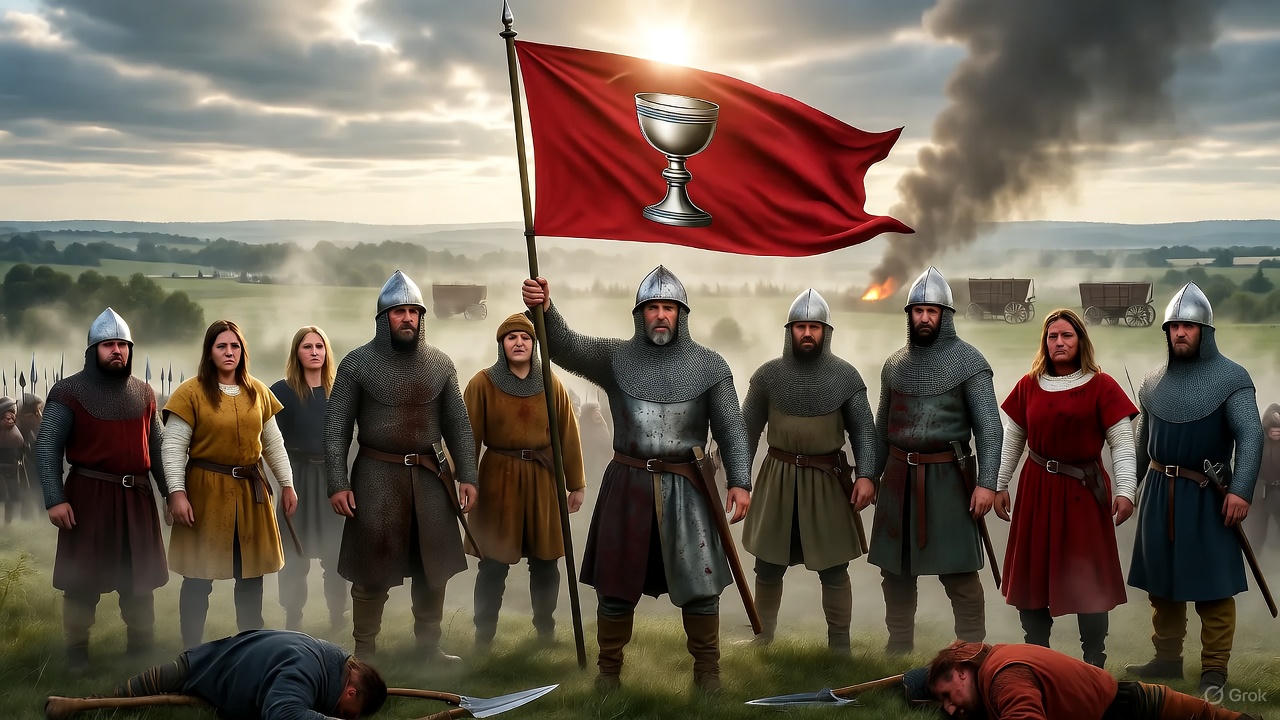
Imagine a crisp autumn morning in the Bohemian countryside, where the air hangs heavy with the scent of damp earth and smoldering campfires. It’s October 10, 1471, and the rolling hills near the village of Svibov tremble under the weight of armored boots and the low rumble of wagon wheels. On one side, a ragtag army of farmers, artisans, and priests—clad in mismatched chainmail and wielding flails fashioned from their harvest tools—stands defiant. Opposite them, a glittering host of knights, mercenaries, and papal crusaders, banners fluttering with the crosses of a fractured Christendom, prepares to crush what they see as heresy once and for all. This wasn’t just a clash of steel; it was the thunderous finale to fifteen years of brutal warfare, the Hussite Wars, a conflict that reshaped the soul of Europe. The Battle of Svibov, often whispered in the shadows of grander tales like the Reformation, marked the end of an era where faith was not inherited but fought for, tooth and nail, on blood-soaked fields.
But why does this dusty footnote from the 15th century matter today? Because in the chaos of that day, a small band of believers turned the tide against overwhelming odds, proving that conviction, ingenuity, and unyielding grit can rewrite history. The Hussites’ victory at Svibov didn’t just secure their survival; it planted seeds of religious tolerance and individual agency that echo through our modern world. As we navigate our own battles—against doubt, division, or daily drudgery—this story isn’t ancient dust. It’s a blueprint for building an unbreakable spirit. Join me as we dive deep into the flames of this forgotten conflagration, unearthing details that will educate your mind, tickle your sense of adventure, and light a fire under your ambitions.
## The Spark in Prague: Jan Hus and the Brewing Storm of Reform
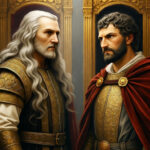
To understand Svibov, we must travel back further, to the bustling streets of 14th-century Prague, a city where the Vltava River mirrored the glittering spires of St. Vitus Cathedral and the clamor of Charles University’s lecture halls. It was here, in 1369, that Jan Hus was born into a world teetering on the edge of transformation. Bohemia, then a kingdom within the Holy Roman Empire, was a powder keg of discontent. The Catholic Church, bloated with wealth and corruption, sold indulgences like cheap trinkets—promises of heavenly shortcuts for a handful of silver. Peasants toiled under feudal lords while bishops dined on peacock tongues, and the Black Death’s shadow still lingered, claiming a third of Europe’s souls just decades before.
Hus, a blacksmith’s son turned scholar, arrived at Charles University in 1390, his mind sharp as a quill dipped in vinegar. He devoured the works of John Wycliffe, the English reformer whose ideas scorched like contraband firecrackers: the Bible should be in the vernacular, not hoarded in Latin; priests aren’t infallible; and the cup of communion should be shared with all, not just the clergy. By 1402, Hus was rector of the Bethlehem Chapel, a wooden wonder in Prague’s Old Town designed for preaching in Czech, not the elite’s Latin drone. Crowds swelled—merchants, weavers, even nobles—hanging on his words as he lambasted simony (selling church offices) and clerical immorality. “Seek the truth, hear the truth, learn the truth, love the truth, tell the truth, defend the truth even to death,” Hus thundered from his pulpit, his voice cutting through the incense like a Bohemian gale.
But truth-tellers rarely die in bed. In 1411, Pope John XXIII—yes, an antipope entangled in the Western Schism’s papal free-for-all—launched a crusade against Naples and taxed Bohemia to fund it. Hus protested, calling it extortion masked as piety. Excommunicated, he didn’t slink away; he preached from fields and forests, his followers multiplying like sparks in dry grass. By 1414, the Council of Constance summoned him, promising safe conduct under Emperor Sigismund’s banner. It was a trap. Dragged before the council’s kangaroo court, Hus faced charges of heresy: denying transubstantiation’s full miracle, criticizing papal supremacy, and—gasp—allowing laypeople the communion chalice. He defended himself with fiery eloquence, quoting Scripture against the assembled bishops’ bluster. “I did appeal to Christ,” he declared when pressed to recant. On July 6, 1415, they burned him at the stake, his skin blistering under a paper crown of demons, his last words a song of “Christ, Son of the Living God, have mercy on us.”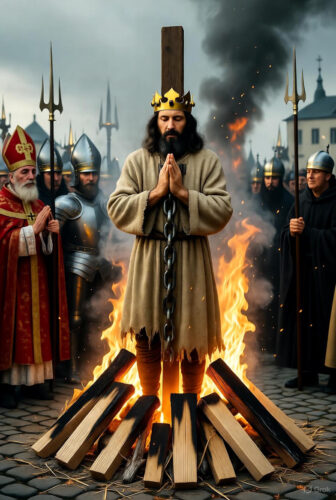
The execution wasn’t a snuffing; it was a bellows to the blaze. News raced back to Prague on horseback relays, igniting riots. Students toppled statues of the Virgin Mary mistaken for the Virgin of Constance (the council’s symbol), and Hus’s ashes, dumped in the Rhine, became mythic relics. Within months, his followers—Utraquists demanding “sub utraque specie” (communion under both kinds), Taborites the radical warriors, and moderate Praguers—coalesced into the Hussite movement. Bohemia became a republic of the righteous, defying the empire’s iron fist.
## The Wars Ignite: Crusades on Wheels and the Genius of the Wagenburg
The Hussite Wars erupted in 1419 with the First Defenestration of Prague—a spectacular act of protest where radical Hussites hurled the city councilors from New Town Hall’s windows. (They survived the 70-foot plunge into a manure pile, a divine intervention or comedic providence, depending on your view.) Emperor Sigismund, Hus’s half-brother and Constance’s enabler, declared a crusade. Five waves crashed against Bohemia from 1420 to 1434, each more ferocious than the last.
Enter the Taborites, named for Mount Tabor, their apocalyptic stronghold south of Prague. Led by firebrands like Jan Žižka, a one-eyed tactician whose gaze pierced like a lance, they were peasants turned prophets. Žižka, blinded in one eye by smallpox, later lost the other to infection yet fought on, barking orders from memory. His genius? The wagenburg—a fortress on wheels. Picture ox-drawn wagons, reinforced with iron plating, chained hub-to-hub into impenetrable squares. Inside, crossbowmen and handgunners rained hell; atop, flail-wielding infantry swung morningstars like scythes at harvest. These weren’t chariots of old; they were mobile bunkers, blending medieval engineering with desperate innovation. At the Battle of Sudoměř in 1420, 400 Taborites in a church held off 2,000 crusaders for days, emerging to rout them with wagons thundering like avalanches.
The crusades were a parade of Europe’s might: German knights in full plate, Polish lancers, Hungarian bowmen, even English longbowmen shipped across the Channel. The First Crusade (1420) saw Sigismund’s 30,000-strong army besiege Prague, only to be repelled by starvation and dysentery—Žižka’s scouts poisoned wells with plague-ridden corpses, a grim biological warfare antebellum. The Second (1421) ended at the Battle of Kutná Hora, where Taborite commander Jan Čapek ambushed imperial forces in silver mines, their screams echoing like damned souls. But tragedy struck in 1424: Žižka died of plague mid-campaign, his deathbed command a silver chainmail ball as a rallying standard—”Fight the good fight, as long as you live.”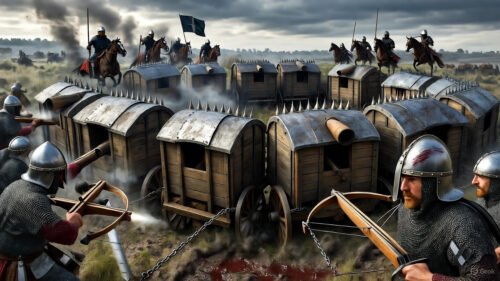
Undeterred, the Taborites pressed on under Prokop the Bald (not a fashion statement, but a tonsure from battle scars). The Third Crusade (1421-1422) fizzled when papal legate Branda Castiglione’s army mutinied over unpaid wages. The Fourth (1424-1427) climaxed at Ústí nad Labem, where 12,000 crusaders drowned in the Elbe River during a panicked retreat—Hussite raiders had cut bridges, turning victory into a watery grave. The Fifth (1431) brought English archers under Lord Talbot, but even they crumbled before the wagon walls at Domažlice, fleeing at the sound of Hussite war hymns bellowed in Czech.
These wars weren’t mere skirmishes; they were total war. Taborites sacked monasteries, melting chalices for cannonballs, while crusaders burned villages, crucifying priests on barn doors. Bohemia, a land of 3 million, lost perhaps 100,000 souls, its fields scarred by cannon fire—the Hussites pioneered field artillery, hauling bombards on wagons that belched brimstone. Yet amid the gore, culture flowered: Hussite hymns like “Ye Warriors of God” became anthems of resistance, their tunes echoing in folk songs centuries later. And the chalice? It became their banner, a silver cup on red, symbolizing equality in the divine feast.
By 1434, internal rifts cracked the movement. Moderate Utraquists, weary of Taborite zealotry, allied with Sigismund at the Battle of Lipany, where 20,000 Taborites perished in a slaughter. Prokop fell, his head on a pike. The radicals retreated to fortresses, their dream dimming. But embers glowed.
## The Final Reckoning: October 10, 1471, and the Echoes of Lipany
Fast-forward to 1471. Sigismund had died in 1437, his throne passing to his son-in-law Albert II, then a parade of weaklings: Ladislaus the Posthumous (crowned at birth, died at 17), George of Poděbrady (a Hussite king, excommunicated for heresy), and finally Vladislaus II Jagiellon, a Polish import more poet than warrior. Bohemia simmered under uneasy peace, the Compactata of Basel (1436) granting Utraquists their chalice but banning Taborite extremism. Yet old wounds festered. Catholic nobles, chafing at Hussite dominance, plotted with the Habsburgs and Pope Paul II, who dreamed of a Sixth Crusade.
Enter Jiří z Poděbrad’s son, Victorin, now leading a resurgent Taborite faction. Victorin, a bear of a man with a scholar’s mind, had studied at Leipzig and fought in Italy’s condottieri wars, blending chivalry with wagon tactics. Rumors swirled of Catholic conspiracies: forged letters claiming Hussite plots to assassinate the king, whispers of imperial troops massing at the borders. Tensions boiled over in summer 1471 when royal officials seized Taborite lands near Svibov, a hamlet 50 miles south of Prague, nestled in the Žďár Hills’ embrace—rolling meadows dotted with birch groves, ideal for ambushes.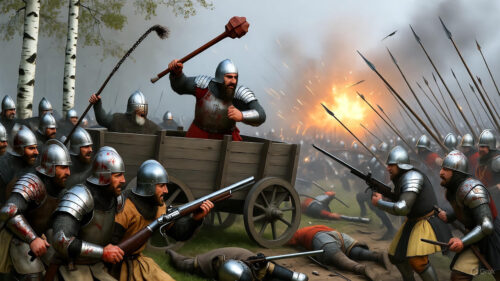
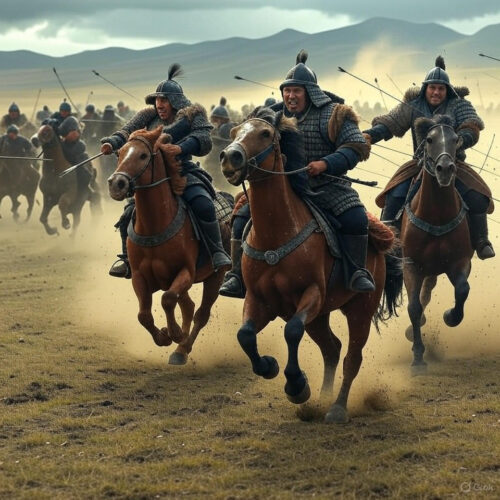
On October 9, Victorin’s scouts—peasant lads with eyes like hawks—spotted dust clouds: 8,000 Catholic troops under Zdeněk Kostka of Postupice, a lord whose family grudge ran deep (his father slain at Lipany). Kostka’s force was a medieval all-star team: Moravian knights in Milanese plate, Silesian crossbowmen, Hungarian hussars with sabers curved like scimitars, and Swiss pikemen mercenaries, their halberds gleaming. They marched with fanfare, priests chanting litanies, expecting a quick mop-up of “heretic scum.”
Victorin had 4,000: grizzled Taborites, Utraquist levies, and Chvojka’s irregulars—mine workers armed with picks. No time for grand strategy; they improvised. Overnight, wagons circled a hillock, chained and spiked, loopholes sawn for arquebuses. Flanks anchored by birch barricades, center a kill-zone of chained logs. Dawn broke foggy on October 10, the Žďár bells tolling like omens.
Kostka charged at 8 a.m., lancers thundering uphill, banners snapping. Hussite handgongs—crude trumpets—blared “Ktož jste Boží bojovníci” (Ye Who Are God’s Warriors), unnerving the horses. The first wave splintered on wagons, pikes snapping like twigs, knights unhorsed into flail-swinging melee. Crossbow bolts whined, but Taborite gunners, sheltered, poured lead—early firearms, matchlocks sputtering but deadly at 50 yards. A Hungarian captain, impaled on a flail chain, screamed as his visor filled with blood.
By noon, Kostka regrouped for a pincher: Silesians flanking left, Swiss right. Victorin countered brilliantly—Chvojka’s miners rolled powder kegs downhill, igniting in fiery avalanches that scorched grass and flesh. Smoke choked the valley, turning the field into Hades. A Swiss pike-square faltered in the murk, hacked apart by Utraquist axes. Kostka himself, atop a destrier, rallied a final assault, his mace felling three Hussites before a mine-pick caved his helm. Dead by 2 p.m., his host routed, leaving 2,500 corpses, wagons looted for boots and blades.
Victorin lost 800 but stood victorious. No trumpets; just weary cheers, the chalice banner bloodied but unbowed. News flew to Prague: the “Last Battle of the Hussites.” It was. The Compactata held, Bohemia dodged Habsburg jaws until 1526’s Mohács disaster. Svibov cemented Hussite autonomy, birthing a tolerant realm where Czech Bibles proliferated, foreshadowing Luther’s nails in Wittenberg’s door.
But the human tapestry? Tales abound. A Taborite widow, Anna of Tábor, fought disguised as a man, her flail christened “Hus’s Vengeance.” Young apprentice Václav, surviving a lance through his thigh, later forged the first printed Czech hymnal. Kostka’s squire, captured and converted, penned “The Fog of Folly,” a tract decrying crusader hubris. These weren’t abstractions; they were lives etched in sweat and song.
## Ripples Across Centuries: From Bohemian Hills to the World Stage
Svibov’s aftermath rippled far. In 1485, the Kutná Hora Diet formalized Utraquist rights, a mini-Magna Carta for faith. Bohemia’s silver mines, unscathed by crusader greed, funded Renaissance glories: astronomer Tycho Brahe studied here, inspired by Hussite star-charts etched on wagon hoods. The movement’s egalitarianism seeped into Anabaptists and English Puritans, their wagon tactics echoed in American frontier laagers. Even Napoleon nodded to Žižka, dubbing him “the soldier’s saint.”
Yet Svibov’s true genius was resilience. Facing five crusades, internal betrayals, and leaders felled by plague, the Hussites endured. Their victory wasn’t numerical; it was philosophical—faith as verb, not noun. They sang psalms amid cannonade, shared bread with enemies, and innovated from scraps. This underdog ethos influenced Gandhi’s satyagraha (wagons as nonviolent shields?) and MLK’s marches, turning defense into moral offense.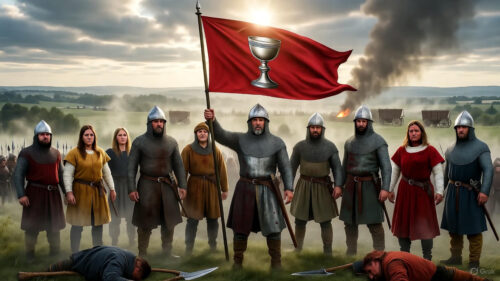
## Harnessing the Hussite Flame: Specific Ways to Ignite Your Life Today
The Battle of Svibov’s outcome—a triumph of adaptive faith over rigid dogma—offers a treasure trove for personal growth. In a world of fleeting trends and institutional inertia, channel this historical grit into your daily forge. Here’s how, with laser-focused applications:
– **Forge Your Personal Wagenburg: Build Defensible Boundaries.** Just as Hussites chained wagons into unbreakable circles, identify your core values—family time, creative pursuits, health—and ring-fence them. Start by auditing your week: track energy drains (endless scrolls? Toxic ties?) and erect “barriers”—a no-phone dinner ritual, a weekly solo hike. Benefit: Reduced burnout, amplified focus, turning chaos into a stronghold where your true self thrives.
– **Wield the Flail of Innovation: Turn Tools into Weapons.** Taborites alchemized farm flails into battlefield dominators; you can repurpose everyday items for breakthroughs. Stuck in a career rut? Transform your commute podcast into a skill-log: note one actionable idea per episode, prototype it by week’s end (e.g., a blog post from a history tidbit). Benefit: Accelerated learning, turning mundane routines into ladders of advancement, much like Žižka’s blind genius outmaneuvered sighted foes.
– **Sing Through the Smoke: Cultivate Vocal Resilience.** Hussite hymns rallied flagging spirits amid volleys; adopt “battle chants” for tough days. Craft a personal mantra—”I am the chalice, full and unbroken”—recite it during commutes or crises, pairing with deep breaths. Record victories in a “Hus Journal”: three gratitudes post-challenge. Benefit: Heightened emotional armor, transforming setbacks into symphonies of strength, fostering the unshakeable optimism that propelled Victorin uphill.
– **Share the Chalice: Foster Inclusive Alliances.** Utraquists demanded communion for all, bridging divides; apply this by hosting “chalice circles”—weekly meetups with diverse colleagues or friends, each sharing one vulnerability and one strength. Listen without fixing, respond with questions. Benefit: Deeper networks, innovation sparks from varied views, echoing how Hussite moderates outlasted radicals through coalition-building.
– **Defy the Stake: Embrace Calculated Risks for Truth.** Hus recanted nothing, facing flames for conviction; audit your life for “safe lies”—nodding in meetings, suppressing ideas—and counter with micro-defiances: pitch that bold project, voice the ethical dissent. Prepare with data, not drama. Benefit: Authentic growth, career leaps from integrity, mirroring how Svibov’s stand secured Bohemia’s soul.
## Your Svibov Strategy: A 30-Day Plan to Unleash Inner Hussite
Ready to charge your own hill? This step-by-step blueprint, drawn from the battle’s tactics, launches you in 30 days. Commit like Victorin at dawn—small steps, massive momentum.
**Week 1: Assemble the Wagenburg (Foundation Building)**
– Day 1-2: List your top three “sacred wagons”—non-negotiable priorities (e.g., 8 hours sleep, daily writing). Schedule them ironclad.
– Day 3-4: Identify threats—audit distractions (social media? Overcommitments?)—and chain barriers: app blockers, polite “no” scripts.
– Day 5-7: Test the circle: Simulate a “siege” (skip a priority intentionally), then reinforce. Journal: What held? What cracked?
**Week 2: Arm the Flails (Innovation Drill)**
– Day 8-9: Inventory tools—phone, notebook, skills—and brainstorm repurposes (e.g., voice memos for idea capture during walks).
– Day 10-11: Pick one: Execute a prototype (turn a hobby tool into a side hustle pitch). Share with a trusted ally for feedback.
– Day 12-14: Refine and deploy: Track results, iterate like Žižka’s wagons. Celebrate with a “victory hymn”—your favorite upbeat track.
**Week 3: Rally the Hymns (Resilience Forge)**
– Day 15-16: Craft your mantra and “Hus Journal.” Recite thrice daily, especially pre-stress.
– Day 17-18: Face a minor “crusade”—a feared call or task—post-mission, log three wins.
– Day 19-21: Amplify: Teach your mantra to one person, turning solo song into chorus.
**Week 4: Charge the Hill (Alliance and Risk Assault)**
– Day 22-23: Host your first chalice circle—invite three diverse contacts, set ground rules.
– Day 24-25: Spot a “stake” moment—voice truth at work/home—prep with facts, debrief in journal.
– Day 26-28: Scale: Propose one bold alliance (mentor outreach, collab pitch).
– Day 29-30: Reflect and renew: Review the month—what’s your Svibov? Plan the next “battle.” Toast with shared “chalice” (coffee round).
This plan isn’t drudgery; it’s adventure, each day a wagon wheel turning toward triumph. Like the Hussites emerging from fog victorious, you’ll find your life fortified, innovative, resonant.
## The Eternal Chalice: Why Svibov Still Calls Us to Arms
On that October day in 1471, Svibov wasn’t just a battlefield; it was a manifesto in mud and metal. The Hussites, outgunned and outnumbered, proved that a cause chained to conviction outlasts empires. Their legacy? A Europe inching toward tolerance, where faith’s fire warms rather than consumes. Today, as algorithms crusade against nuance and routines besiege our dreams, Svibov’s wagons remind us: Build your circle, swing your flail, sing your song. The hill awaits—charge it with joy, for history favors the defiant heart.
Share: