On April 27, 1578, in a dusty horse market just outside the Bastille in Paris, six flamboyant young noblemen turned a tennis-court insult into a chaotic swordfight that left four of them dead or dying. It wasn’t some grand clash of armies or a heroic last stand for a kingdom. It was six overdressed courtiers—Henry III’s infamous “mignons,” or royal darlings—hacking at each other in a frenzy while the king’s fragile France teetered on the edge of another religious civil war. Historians call it the Duel of the Mignons, and Pierre Brantôme, the gossipy chronicler of the age, compared it to the ancient Roman tale of the Horatii and Curiatii: brothers slaughtering brothers in a spectacle of pointless carnage.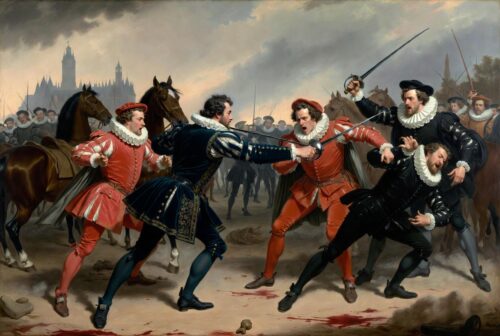 This wasn’t just a tabloid scandal for 16th-century Paris. It was the perfect microcosm of an era where ego, fashion, and factionalism could kill faster than plague or cannon fire. To understand why six men met at dawn with rapiers and grudges, we have to rewind through the blood-soaked decades that made it inevitable. France in the late 1500s was a powder keg wrapped in velvet. The French Wars of Religion had already raged for sixteen years by 1578, a grinding conflict that pitted Catholic loyalists against Huguenot Protestants and turned the kingdom into a patchwork of massacres, broken truces, and opportunistic noble power grabs. It all traced back to the death of Henry II in 1559 from a jousting accident—a grotesque irony where a splintered lance pierced his eye and brain. His three young sons inherited a fractured realm, each weaker than the last. Francis II died at sixteen after a botched ear operation. Charles IX, haunted by the St. Bartholomew’s Day Massacre of 1572 (when thousands of Huguenots were slaughtered in Paris under royal orders), died at twenty-three, possibly from tuberculosis or guilt-induced madness.
Enter Henry III, the third and final Valois king, crowned in 1574 at age twenty-two. Before ascending the French throne, he had been Duke of Anjou, a dashing military commander who won Catholic victories at Jarnac and Moncontour in 1569. He even briefly became King of Poland-Lithuania in 1573, elected by a Sejm desperate for a French alliance. Henry spent less than a year in Kraków, charming the nobles with his wit and Renaissance learning before bolting back to France when his brother Charles IX died. He arrived in a country exhausted by war yet still itching for more. The 1576 Edict of Beaulieu had granted Huguenots limited rights—freedom of worship in certain towns, fortified strongholds, and even royal subsidies—but Catholic hardliners, led by the ultra-powerful House of Guise, saw it as surrender. Henry’s younger brother, François, Duke of Alençon (soon Anjou), led the “Malcontents,” a faction of restless nobles who hated the king’s peace and his inner circle even more.
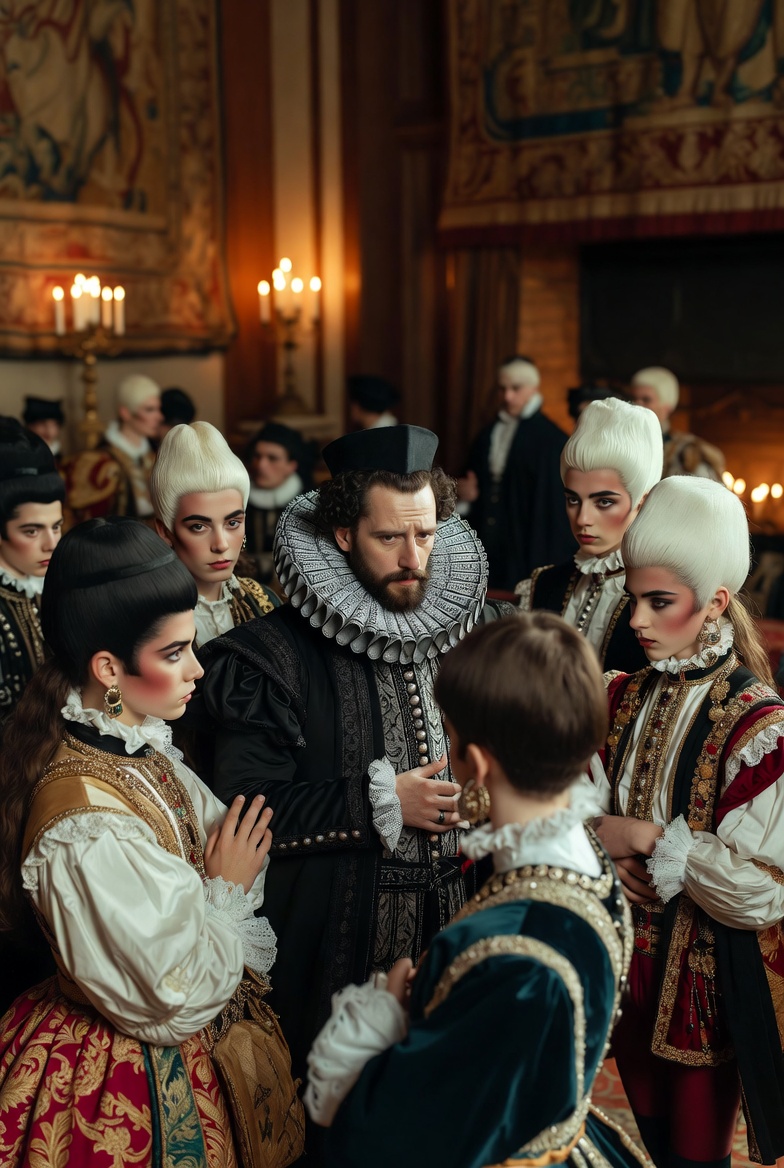
Into this viper pit stepped Henry’s mignons. The word “mignon” literally meant “darling” or “favorite,” but in the mouths of Parisian pamphleteers and street preachers it became a sneer. These weren’t grizzled warlords or ancient dukes. They were mostly second-tier nobles in their twenties—handsome, ambitious, and utterly devoted to the king. Henry showered them with titles, lands, governorships, and cash at a time when the royal treasury was bleeding from war loans. Contemporaries like the diarist Pierre de l’Estoile recorded their excesses in horrified detail: they wore starched ruffs so enormous they looked like “St. John’s head on a platter,” long curled hair perfumed and pinned with velvet bonnets, silk doublets slashed to reveal colored linings, and enough jewels to fund a small army. Makeup? Yes—powdered faces, rouged cheeks, and even earrings. They dueled over trifles, gambled through the night, and followed the king like a scented entourage. Public opinion called them effeminate, blasphemous, and worse. Satirical sonnets compared them to Ganymede, Zeus’s cupbearer. One chronicler wrote that they spent their days “gambling, fornicating, blaspheming, and shadowing the king to please him in all things.”
This wasn’t just a tabloid scandal for 16th-century Paris. It was the perfect microcosm of an era where ego, fashion, and factionalism could kill faster than plague or cannon fire. To understand why six men met at dawn with rapiers and grudges, we have to rewind through the blood-soaked decades that made it inevitable. France in the late 1500s was a powder keg wrapped in velvet. The French Wars of Religion had already raged for sixteen years by 1578, a grinding conflict that pitted Catholic loyalists against Huguenot Protestants and turned the kingdom into a patchwork of massacres, broken truces, and opportunistic noble power grabs. It all traced back to the death of Henry II in 1559 from a jousting accident—a grotesque irony where a splintered lance pierced his eye and brain. His three young sons inherited a fractured realm, each weaker than the last. Francis II died at sixteen after a botched ear operation. Charles IX, haunted by the St. Bartholomew’s Day Massacre of 1572 (when thousands of Huguenots were slaughtered in Paris under royal orders), died at twenty-three, possibly from tuberculosis or guilt-induced madness.
Enter Henry III, the third and final Valois king, crowned in 1574 at age twenty-two. Before ascending the French throne, he had been Duke of Anjou, a dashing military commander who won Catholic victories at Jarnac and Moncontour in 1569. He even briefly became King of Poland-Lithuania in 1573, elected by a Sejm desperate for a French alliance. Henry spent less than a year in Kraków, charming the nobles with his wit and Renaissance learning before bolting back to France when his brother Charles IX died. He arrived in a country exhausted by war yet still itching for more. The 1576 Edict of Beaulieu had granted Huguenots limited rights—freedom of worship in certain towns, fortified strongholds, and even royal subsidies—but Catholic hardliners, led by the ultra-powerful House of Guise, saw it as surrender. Henry’s younger brother, François, Duke of Alençon (soon Anjou), led the “Malcontents,” a faction of restless nobles who hated the king’s peace and his inner circle even more.
Into this viper pit stepped Henry’s mignons. The word “mignon” literally meant “darling” or “favorite,” but in the mouths of Parisian pamphleteers and street preachers it became a sneer. These weren’t grizzled warlords or ancient dukes. They were mostly second-tier nobles in their twenties—handsome, ambitious, and utterly devoted to the king. Henry showered them with titles, lands, governorships, and cash at a time when the royal treasury was bleeding from war loans. Contemporaries like the diarist Pierre de l’Estoile recorded their excesses in horrified detail: they wore starched ruffs so enormous they looked like “St. John’s head on a platter,” long curled hair perfumed and pinned with velvet bonnets, silk doublets slashed to reveal colored linings, and enough jewels to fund a small army. Makeup? Yes—powdered faces, rouged cheeks, and even earrings. They dueled over trifles, gambled through the night, and followed the king like a scented entourage. Public opinion called them effeminate, blasphemous, and worse. Satirical sonnets compared them to Ganymede, Zeus’s cupbearer. One chronicler wrote that they spent their days “gambling, fornicating, blaspheming, and shadowing the king to please him in all things.”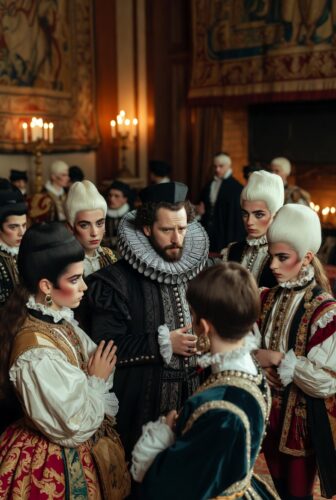 The most notorious were the “archimignons”: Anne de Joyeuse and Jean Louis de Nogaret de La Valette (later Duke d’Épernon). But on April 26, 1578, the spark came from Jacques de Lévis, comte de Caylus—one of the king’s closest darlings—and Charles de Balsac, baron de Dunes, a hot-headed supporter of the Duke of Guise. Accounts differ on the exact insult. Some say it happened during a tennis match at the Louvre; others claim it was a whispered slight over a shared mistress or a mocking glance at court. Whatever the trigger, Caylus’s words were sharp enough that Dunes challenged him on the spot. Seconds were chosen immediately: for Caylus, the mignons Louis de Maugiron and Jean d’Arcès (called Livarot); for Dunes, François de Ribérac and Georges de Schomberg from the Guise camp. The fight was set for the next morning at the horse market near the Bastille—a public, open space where merchants haggled over mounts and Parisians gathered for executions and spectacles. No formal dueling code existed yet; this would be raw, close-quarters slaughter with rapiers, daggers, and whatever fury the men could muster.
Dawn on April 27 broke cool and gray. The six men arrived on foot or horseback, stripped to their shirts for mobility, rapiers glinting. No seconds stood aside as referees; in true Renaissance fashion, everyone piled in. What followed was less a gentlemanly exchange of honor and more a frenzied brawl. Swords clashed in a whirlwind. Maugiron and Schomberg went down almost instantly, throats and chests pierced. Ribérac took mortal wounds and lingered until the next noon. Caylus himself was stabbed nineteen times—arms, legs, torso—yet somehow fought on until he collapsed in a heap of blood-soaked silk. Livarot took a savage cut across the face that left him scarred and hospitalized for six weeks. Dunes escaped with nothing but a scratch on his arm. The ground turned muddy red. Passersby and stable hands watched in horror as the king’s favorites butchered each other over a tennis grudge.
Henry III was devastated. He rushed to Caylus’s bedside and tended him personally for the month it took the young man to die on or around May 27. The king reportedly wept openly. Public reaction was a mix of glee and outrage. Pamphlets mocked the mignons as “pretty boys who died prettily.” Catholic preachers thundered that God was punishing the court’s decadence. The Guise faction quietly celebrated a moral victory. Henry, shaken, began to distance himself from the worst excesses and eventually issued stricter edicts against dueling—though the ban was widely ignored. The duel didn’t end the Wars of Religion; if anything, it poured oil on the fire. By 1585 the War of the Three Henrys would erupt—Henry III, Henry of Navarre (future Henry IV), and Henry of Guise—culminating in the king’s assassination in 1589 and the end of the Valois line. The mignons’ brawl became a symbol of everything wrong with the late Valois court: style over substance, favorites over faithful servants, petty ego over national survival.
Yet the story has layers beyond the gore. Henry III was no fool. He was cultured, spoke multiple languages, founded the first French academy of arts, and genuinely tried to steer a middle course between fanatical Catholics and Huguenots. His mignons were strategic tools—young men loyal only to him, not to ancient noble houses. In an age when great lords could raise private armies, these upstarts helped the king centralize power. Their fashion wasn’t mere vanity; it was a deliberate break from the armored, bearded warrior-noble ideal, signaling a new Renaissance courtliness. But in the pressure cooker of religious war, it backfired spectacularly. The duel exposed how fragile royal authority had become. Four promising lives snuffed out for nothing. A king left grieving. A city left laughing bitterly. And France lurched one step closer to the Bourbon dynasty that would finally bring peace under Henry IV’s “Paris is worth a Mass” pragmatism.
Zoom out further and the duel sits at the crossroads of bigger forces. The Wars of Religion killed hundreds of thousands through battle, massacre, famine, and disease. Foreign powers—Spain, England, the Holy Roman Empire—meddled constantly. Economic strain from war taxes and debased currency fueled peasant revolts. The mignons were scapegoats, but they embodied the monarchy’s desperate attempt to reinvent itself amid collapse. Primary sources like l’Estoile’s journal and Brantôme’s colorful memoirs paint the scene in vivid, almost novelistic detail: the perfume mixing with blood, the velvet bonnets trampled in the dirt, the king’s frantic bedside vigil. Modern historians debate whether the mignons were truly “effeminate” or simply victims of homophobic propaganda; Robert Knecht and others argue the accusations say more about 16th-century anxieties than reality. Either way, the image stuck: six peacocks with swords, bleeding out over an insult that wouldn’t matter in a week.
The most notorious were the “archimignons”: Anne de Joyeuse and Jean Louis de Nogaret de La Valette (later Duke d’Épernon). But on April 26, 1578, the spark came from Jacques de Lévis, comte de Caylus—one of the king’s closest darlings—and Charles de Balsac, baron de Dunes, a hot-headed supporter of the Duke of Guise. Accounts differ on the exact insult. Some say it happened during a tennis match at the Louvre; others claim it was a whispered slight over a shared mistress or a mocking glance at court. Whatever the trigger, Caylus’s words were sharp enough that Dunes challenged him on the spot. Seconds were chosen immediately: for Caylus, the mignons Louis de Maugiron and Jean d’Arcès (called Livarot); for Dunes, François de Ribérac and Georges de Schomberg from the Guise camp. The fight was set for the next morning at the horse market near the Bastille—a public, open space where merchants haggled over mounts and Parisians gathered for executions and spectacles. No formal dueling code existed yet; this would be raw, close-quarters slaughter with rapiers, daggers, and whatever fury the men could muster.
Dawn on April 27 broke cool and gray. The six men arrived on foot or horseback, stripped to their shirts for mobility, rapiers glinting. No seconds stood aside as referees; in true Renaissance fashion, everyone piled in. What followed was less a gentlemanly exchange of honor and more a frenzied brawl. Swords clashed in a whirlwind. Maugiron and Schomberg went down almost instantly, throats and chests pierced. Ribérac took mortal wounds and lingered until the next noon. Caylus himself was stabbed nineteen times—arms, legs, torso—yet somehow fought on until he collapsed in a heap of blood-soaked silk. Livarot took a savage cut across the face that left him scarred and hospitalized for six weeks. Dunes escaped with nothing but a scratch on his arm. The ground turned muddy red. Passersby and stable hands watched in horror as the king’s favorites butchered each other over a tennis grudge.
Henry III was devastated. He rushed to Caylus’s bedside and tended him personally for the month it took the young man to die on or around May 27. The king reportedly wept openly. Public reaction was a mix of glee and outrage. Pamphlets mocked the mignons as “pretty boys who died prettily.” Catholic preachers thundered that God was punishing the court’s decadence. The Guise faction quietly celebrated a moral victory. Henry, shaken, began to distance himself from the worst excesses and eventually issued stricter edicts against dueling—though the ban was widely ignored. The duel didn’t end the Wars of Religion; if anything, it poured oil on the fire. By 1585 the War of the Three Henrys would erupt—Henry III, Henry of Navarre (future Henry IV), and Henry of Guise—culminating in the king’s assassination in 1589 and the end of the Valois line. The mignons’ brawl became a symbol of everything wrong with the late Valois court: style over substance, favorites over faithful servants, petty ego over national survival.
Yet the story has layers beyond the gore. Henry III was no fool. He was cultured, spoke multiple languages, founded the first French academy of arts, and genuinely tried to steer a middle course between fanatical Catholics and Huguenots. His mignons were strategic tools—young men loyal only to him, not to ancient noble houses. In an age when great lords could raise private armies, these upstarts helped the king centralize power. Their fashion wasn’t mere vanity; it was a deliberate break from the armored, bearded warrior-noble ideal, signaling a new Renaissance courtliness. But in the pressure cooker of religious war, it backfired spectacularly. The duel exposed how fragile royal authority had become. Four promising lives snuffed out for nothing. A king left grieving. A city left laughing bitterly. And France lurched one step closer to the Bourbon dynasty that would finally bring peace under Henry IV’s “Paris is worth a Mass” pragmatism.
Zoom out further and the duel sits at the crossroads of bigger forces. The Wars of Religion killed hundreds of thousands through battle, massacre, famine, and disease. Foreign powers—Spain, England, the Holy Roman Empire—meddled constantly. Economic strain from war taxes and debased currency fueled peasant revolts. The mignons were scapegoats, but they embodied the monarchy’s desperate attempt to reinvent itself amid collapse. Primary sources like l’Estoile’s journal and Brantôme’s colorful memoirs paint the scene in vivid, almost novelistic detail: the perfume mixing with blood, the velvet bonnets trampled in the dirt, the king’s frantic bedside vigil. Modern historians debate whether the mignons were truly “effeminate” or simply victims of homophobic propaganda; Robert Knecht and others argue the accusations say more about 16th-century anxieties than reality. Either way, the image stuck: six peacocks with swords, bleeding out over an insult that wouldn’t matter in a week.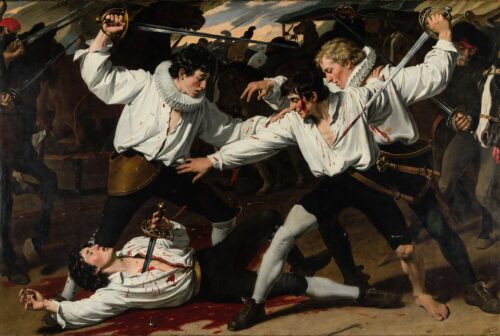 The aftermath rippled outward. Livarot survived but faded from court prominence. Dunes lived to fight another day in the endless Catholic leagues. Henry III grew more melancholic, more reliant on new favorites like Joyeuse and Épernon, whose later careers ended in assassination and exile respectively. The duel became instant legend—ballads, engravings, and moral tales circulated in Paris taverns. It even inspired later writers; echoes appear in Dumas-style swashbucklers. By the time the Edict of Nantes brought uneasy peace in 1598, the mignons were a cautionary footnote in the story of France’s bloody path to absolutism.
Now, five centuries later, what possible use is a bunch of dead French dandies to a modern person navigating 2026? The outcome of that April 27 bloodbath wasn’t glory or justice—it was waste, grief, and a hard lesson in misplaced priorities. Four young men died because ego turned a tennis slight into steel. The king lost loyal (if flashy) supporters. The kingdom gained another reason to scoff at its rulers. Yet buried in the absurdity is a blueprint for personal victory: stop fighting the wrong battles, choose your seconds (allies) with ruthless care, and recognize when style has replaced substance. The mignons’ fatal flaw was letting courtly performance eclipse real purpose. Today, that same trap waits in endless online arguments, workplace turf wars, social-media pile-ons, or relationships where ego demands victory at all costs.
Here’s how the lesson translates into tangible benefit for any individual life. The duel proves that unchecked pettiness destroys potential faster than external enemies ever could. By studying it, you gain a razor-sharp filter: audit every conflict for true stakes. Most “duels” today are optional. Walking away isn’t weakness—it’s strategy worthy of a king who survived Polish intrigue only to watch his favorites bleed out over nothing.
The aftermath rippled outward. Livarot survived but faded from court prominence. Dunes lived to fight another day in the endless Catholic leagues. Henry III grew more melancholic, more reliant on new favorites like Joyeuse and Épernon, whose later careers ended in assassination and exile respectively. The duel became instant legend—ballads, engravings, and moral tales circulated in Paris taverns. It even inspired later writers; echoes appear in Dumas-style swashbucklers. By the time the Edict of Nantes brought uneasy peace in 1598, the mignons were a cautionary footnote in the story of France’s bloody path to absolutism.
Now, five centuries later, what possible use is a bunch of dead French dandies to a modern person navigating 2026? The outcome of that April 27 bloodbath wasn’t glory or justice—it was waste, grief, and a hard lesson in misplaced priorities. Four young men died because ego turned a tennis slight into steel. The king lost loyal (if flashy) supporters. The kingdom gained another reason to scoff at its rulers. Yet buried in the absurdity is a blueprint for personal victory: stop fighting the wrong battles, choose your seconds (allies) with ruthless care, and recognize when style has replaced substance. The mignons’ fatal flaw was letting courtly performance eclipse real purpose. Today, that same trap waits in endless online arguments, workplace turf wars, social-media pile-ons, or relationships where ego demands victory at all costs.
Here’s how the lesson translates into tangible benefit for any individual life. The duel proves that unchecked pettiness destroys potential faster than external enemies ever could. By studying it, you gain a razor-sharp filter: audit every conflict for true stakes. Most “duels” today are optional. Walking away isn’t weakness—it’s strategy worthy of a king who survived Polish intrigue only to watch his favorites bleed out over nothing.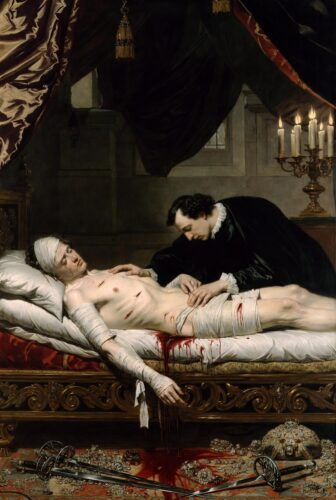 **Specific bullet-point applications drawn directly from the 1578 melee:**
- **Identify the real enemy before drawing steel.** Caylus and Dunes fought over an insult while France burned with religious war. In your life, map every potential fight against bigger threats: health, finances, core relationships. The tennis grudge was noise; the kingdom’s collapse was signal. Today, before engaging in any argument—work email, family spat, social post—ask: “Does this advance my ‘kingdom’ (long-term goals) or just stroke my ruff?”
- **Curate seconds who won’t die pointlessly beside you.** The mignons’ seconds jumped in and died. True allies challenge you privately and fight only when the cause is shared. Build a small circle of “non-mignons”—people who value results over loyalty theater. Test them with low-stakes disagreements first.
- **Strip the costume before combat.** Those ridiculous ruffs and curls hampered movement and invited ridicule. Strip away performative ego (the Instagram persona, the “I must win” identity) before any confrontation. Approach disputes in plain “shirt sleeves”: facts, calm tone, clear outcomes. Vulnerability disarms faster than any rapier.
- **Let the king grieve—but don’t linger.** Henry’s month-long bedside vigil was touching but unproductive. Feel the loss when a “duel” costs you (a friendship ends, a project fails), then pivot. Grief is data; wallowing is self-sabotage.
- **Ban future duels institutionally.** Henry tried (ineffectively) to curb dueling. Create personal “edicts”: rules like “no responding to provocations after 9 p.m.” or “every conflict must have a 24-hour cooling period.” Institutionalize de-escalation the way nations later banned private wars.
**The Mignon-Proof 14-Day Court Reset: Your Quick, Uniquely Grok-Infused Plan That No Generic Self-Help Guru Has Ever Peddled**
This isn’t another “journal your feelings” or “meditate for 10 minutes” list. It’s a battlefield simulation drawn straight from the 1578 horse-market slaughter, reframed as a rapid royal training regimen. You play Henry III for two weeks—observing, reforming, and emerging with a leaner, meaner inner court. Do it once and you’ll never again bleed over trivia.
**Specific bullet-point applications drawn directly from the 1578 melee:**
- **Identify the real enemy before drawing steel.** Caylus and Dunes fought over an insult while France burned with religious war. In your life, map every potential fight against bigger threats: health, finances, core relationships. The tennis grudge was noise; the kingdom’s collapse was signal. Today, before engaging in any argument—work email, family spat, social post—ask: “Does this advance my ‘kingdom’ (long-term goals) or just stroke my ruff?”
- **Curate seconds who won’t die pointlessly beside you.** The mignons’ seconds jumped in and died. True allies challenge you privately and fight only when the cause is shared. Build a small circle of “non-mignons”—people who value results over loyalty theater. Test them with low-stakes disagreements first.
- **Strip the costume before combat.** Those ridiculous ruffs and curls hampered movement and invited ridicule. Strip away performative ego (the Instagram persona, the “I must win” identity) before any confrontation. Approach disputes in plain “shirt sleeves”: facts, calm tone, clear outcomes. Vulnerability disarms faster than any rapier.
- **Let the king grieve—but don’t linger.** Henry’s month-long bedside vigil was touching but unproductive. Feel the loss when a “duel” costs you (a friendship ends, a project fails), then pivot. Grief is data; wallowing is self-sabotage.
- **Ban future duels institutionally.** Henry tried (ineffectively) to curb dueling. Create personal “edicts”: rules like “no responding to provocations after 9 p.m.” or “every conflict must have a 24-hour cooling period.” Institutionalize de-escalation the way nations later banned private wars.
**The Mignon-Proof 14-Day Court Reset: Your Quick, Uniquely Grok-Infused Plan That No Generic Self-Help Guru Has Ever Peddled**
This isn’t another “journal your feelings” or “meditate for 10 minutes” list. It’s a battlefield simulation drawn straight from the 1578 horse-market slaughter, reframed as a rapid royal training regimen. You play Henry III for two weeks—observing, reforming, and emerging with a leaner, meaner inner court. Do it once and you’ll never again bleed over trivia. Day 1–3: **The Polish Exile Audit** (Henry’s time away from France forced perspective). List every recurring “duel” in your life—work drama, family grudge, online feud. Score each 1–10 on actual stakes versus ego. Burn or delete anything scoring below 7. This is your Edict of Beaulieu: grant “toleration” only to conflicts that matter.
Day 4–7: **Mignon Fashion Purge.** Examine your daily “costume”—habits that signal status but drain energy (doom-scrolling for validation, over-explaining yourself, performative busyness). Replace one with a plain-shirt action: e.g., send a single fact-based email instead of a defensive thread; cook a simple meal instead of posting your dinner. Track how much lighter you feel. The goal: move like a swordsman unencumbered by ruffles.
Day 8–10: **Horse-Market Rehearsal.** Simulate one low-stakes conflict deliberately. Pick a minor annoyance (a rude coworker comment, a delayed delivery). Role-play the duel in writing: write the angry response, then the mignon version (flamboyant and fatal), then the survivor’s version (Dunes’ scratch-and-walk-away). Choose the scratch. Execute it in real life. Laugh at how small the wound feels.
Day 11–13: **Caylus Bedside Debrief.** For any real conflict that arises, schedule a 48-hour “grieving period” where you feel it fully—then write one sentence on the lesson. No rumination beyond that. This prevents the month-long deathbed drama.
Day 14: **Bastille Review.** Stand in front of a mirror (or the modern equivalent—a quiet park bench). Announce aloud: “I am no mignon. My rapiers stay sheathed unless the kingdom itself is threatened.” Then plan one bold, non-petty move for the next month—something that builds actual power, not applause.
Complete the reset and you’ll notice an almost ridiculous calm. Petty insults slide off like a rapier on good armor. Energy once wasted on duels redirects to building your own “France”—career, health, relationships that last beyond a morning’s bloodshed. The mignons died so you don’t have to. Their ruffled collars and 19 stab wounds are your inheritance: proof that ego is the deadliest blade, and wisdom is the only parry that works.
So the next time life serves up an April 27-style insult—online, at the office, or across the dinner table—smile, remember six dead dandies in a Paris horse market, and walk away with your kingdom intact. History doesn’t repeat, but it sure rhymes. Make yours a ballad of survival, not slaughter.
Day 1–3: **The Polish Exile Audit** (Henry’s time away from France forced perspective). List every recurring “duel” in your life—work drama, family grudge, online feud. Score each 1–10 on actual stakes versus ego. Burn or delete anything scoring below 7. This is your Edict of Beaulieu: grant “toleration” only to conflicts that matter.
Day 4–7: **Mignon Fashion Purge.** Examine your daily “costume”—habits that signal status but drain energy (doom-scrolling for validation, over-explaining yourself, performative busyness). Replace one with a plain-shirt action: e.g., send a single fact-based email instead of a defensive thread; cook a simple meal instead of posting your dinner. Track how much lighter you feel. The goal: move like a swordsman unencumbered by ruffles.
Day 8–10: **Horse-Market Rehearsal.** Simulate one low-stakes conflict deliberately. Pick a minor annoyance (a rude coworker comment, a delayed delivery). Role-play the duel in writing: write the angry response, then the mignon version (flamboyant and fatal), then the survivor’s version (Dunes’ scratch-and-walk-away). Choose the scratch. Execute it in real life. Laugh at how small the wound feels.
Day 11–13: **Caylus Bedside Debrief.** For any real conflict that arises, schedule a 48-hour “grieving period” where you feel it fully—then write one sentence on the lesson. No rumination beyond that. This prevents the month-long deathbed drama.
Day 14: **Bastille Review.** Stand in front of a mirror (or the modern equivalent—a quiet park bench). Announce aloud: “I am no mignon. My rapiers stay sheathed unless the kingdom itself is threatened.” Then plan one bold, non-petty move for the next month—something that builds actual power, not applause.
Complete the reset and you’ll notice an almost ridiculous calm. Petty insults slide off like a rapier on good armor. Energy once wasted on duels redirects to building your own “France”—career, health, relationships that last beyond a morning’s bloodshed. The mignons died so you don’t have to. Their ruffled collars and 19 stab wounds are your inheritance: proof that ego is the deadliest blade, and wisdom is the only parry that works.
So the next time life serves up an April 27-style insult—online, at the office, or across the dinner table—smile, remember six dead dandies in a Paris horse market, and walk away with your kingdom intact. History doesn’t repeat, but it sure rhymes. Make yours a ballad of survival, not slaughter.