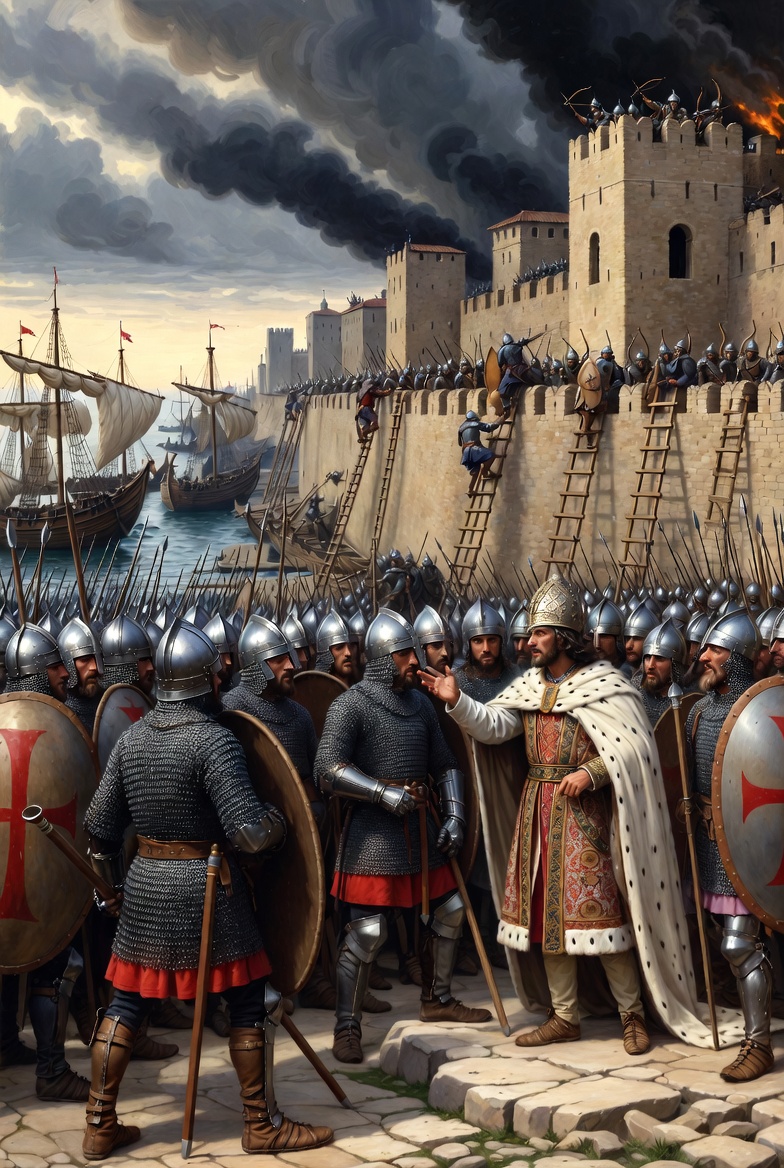
Picture this: April 13, 1204. The Golden Horn shimmers under a fickle spring sky. Massive Venetian war galleys, their decks packed with knights in chainmail who haven’t bathed since leaving France, bob against the ancient sea walls of Constantinople—the glittering heart of the Byzantine Empire, a city so rich it makes modern billionaires look like street performers. Fires from yesterday’s fighting still lick at the Blachernae quarter. Screams echo. Bronze statues that have stood since Roman times are being yanked down and melted for coin. Nuns are dragged from convents. Altars in Hagia Sophia are smashed for their gold leaf. And the men doing all this? They started the journey as holy warriors pledged to reclaim Jerusalem from the Muslims. Instead, they’re looting the greatest Christian city on Earth because a blind, 90-something Venetian doge and a mountain of unpaid shipping bills said so.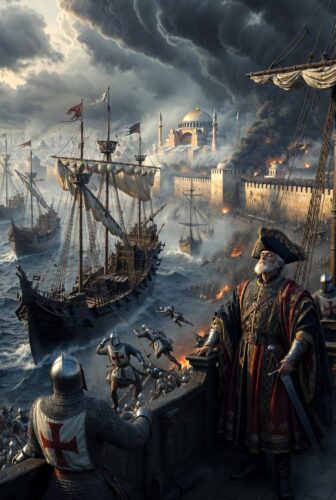 This wasn’t some footnote skirmish. It was the Sack of Constantinople—the moment the Fourth Crusade went full pirate mode and changed the course of world history forever. For three blood-soaked days starting April 13, 1204, an army of about 20,000 Western Europeans (mostly French knights and Venetian sailors) turned the “Queen of Cities” into their personal loot crate. They killed around 2,000 civilians, torched neighborhoods, shipped entire libraries of ancient Greek manuscripts and Roman bronzes back to Europe, and carved up the Byzantine Empire like a Thanksgiving turkey in a contract they signed weeks earlier. The result? The Byzantine Empire never fully recovered. The East-West Christian schism turned into a canyon. Venice became a superpower. And the road to the Ottoman conquest of 1453 got a whole lot shorter.
But here’s the twist nobody puts in the dry history books: this catastrophe wasn’t random chaos. It was a masterclass in ruthless pragmatism, opportunistic pivoting, unbreakable alliances, and rebuilding from total ashes. The crusaders thought they were heading to Egypt. Debt, politics, a deposed prince’s empty promises, and one crafty blind doge named Enrico Dandolo turned it into the ultimate power grab. And that exact same playbook—when stripped of the swords and sacrilege—can hand you a blueprint for conquering your own modern “Constantinople”: that stalled career, that broken relationship, that financial siege, or that soul-crushing setback that feels like your personal empire just got sacked.
We’re going deep today—because 90% of this story deserves every bloody, ironic, jaw-dropping detail. Only after we’ve walked the smoke-filled streets of 1204 will we extract the 10% that turns this medieval dumpster fire into fuel for your life. No fluff. No generic “think positive” nonsense. Just raw history with a side of motivational napalm that’s nothing like the self-help slop flooding your feed.
### The Spark That Lit the Fourth Crusade Powder Keg
To understand why April 13, 1204, became the day Christendom ate itself, we have to rewind to 1198. Pope Innocent III—young, ambitious, and fed up with Muslim control of the Holy Land—calls for the Fourth Crusade. The goal: conquer Egypt first (smart military strategy), then roll into Jerusalem. No more piecemeal failures like the Third Crusade, where Richard the Lionheart got close but left empty-handed.
Knights across Europe answer the call. French barons like Boniface of Montferrat (a veteran with grudges and ambition) and Baldwin of Flanders (pious, brave, but broke) step up. The problem? Logistics. These guys aren’t Uber. They need ships. Enter Venice, the merchant republic that basically invented venture capitalism with oars. Doge Enrico Dandolo—blind from a mysterious injury years earlier, yet sharper than a Venetian stiletto—negotiates the deal of the century in 1201. Venice will build and crew a fleet for 33,500 men and 4,500 horses. Cost: 85,000 silver marks upfront. The crusaders swear they’ll pay.
They don’t. By summer 1202, only about 12,000 show up at Venice’s Lido island. The Venetians have already spent a fortune building ships. Dandolo, whose family had been burned by Byzantine trade wars decades earlier, sees an opening. “Pay us,” he says, “or help us conquer Zara first.” Zara (modern Zadar, Croatia) is a Christian city under Hungarian control—but it’s a rival port. The crusaders, trapped by honor, debt, and the doge’s unblinking (literally) stare, attack Zara in November 1202. They sack a Christian city. Pope Innocent excommunicates the whole lot. The crusade is now officially cursed before it even reaches the Holy Land.
But the real plot twist arrives in the form of a flashy Byzantine prince named Alexios Angelos (later Alexios IV). His father, Emperor Isaac II Angelos, had been blinded and deposed by his brother Alexios III in a palace coup. Young Alexios flees to Europe, meets the crusaders, and makes the deal that dooms an empire: “Help me take back Constantinople, restore my dad, and I’ll pay you 200,000 marks, supply your army, submit the Orthodox Church to Rome, and personally join your crusade against the Muslims.”
Sounds too good to be true? It was. But the crusaders—broke, excommunicated, and smelling easy money—bite. In June 1203 they sail to Constantinople. The city’s massive Theodosian Walls have repelled invaders for 900 years. Yet the Byzantines are in chaos: Emperor Alexios III is incompetent, the treasury is empty, and the people are restless. The crusaders attack from the sea. Venetian ships lash together, raise siege towers, and rain arrows. On July 17, 1203, they breach the walls. Alexios III flees. Isaac II is restored, and his son Alexios IV is crowned co-emperor in Hagia Sophia.
For a hot minute, it looks like a win. The crusaders camp outside the walls, waiting for their gold. Alexios IV starts paying—but only half. He melts down church silver, taxes the people, and sparks riots. Anti-Latin sentiment boils over. In January 1204, Isaac II dies. A courtier named Alexios Doukas (Alexios V Mourtzouphlos) stages a coup, strangles Alexios IV, and tells the crusaders to get lost without the rest of the money.
This wasn’t some footnote skirmish. It was the Sack of Constantinople—the moment the Fourth Crusade went full pirate mode and changed the course of world history forever. For three blood-soaked days starting April 13, 1204, an army of about 20,000 Western Europeans (mostly French knights and Venetian sailors) turned the “Queen of Cities” into their personal loot crate. They killed around 2,000 civilians, torched neighborhoods, shipped entire libraries of ancient Greek manuscripts and Roman bronzes back to Europe, and carved up the Byzantine Empire like a Thanksgiving turkey in a contract they signed weeks earlier. The result? The Byzantine Empire never fully recovered. The East-West Christian schism turned into a canyon. Venice became a superpower. And the road to the Ottoman conquest of 1453 got a whole lot shorter.
But here’s the twist nobody puts in the dry history books: this catastrophe wasn’t random chaos. It was a masterclass in ruthless pragmatism, opportunistic pivoting, unbreakable alliances, and rebuilding from total ashes. The crusaders thought they were heading to Egypt. Debt, politics, a deposed prince’s empty promises, and one crafty blind doge named Enrico Dandolo turned it into the ultimate power grab. And that exact same playbook—when stripped of the swords and sacrilege—can hand you a blueprint for conquering your own modern “Constantinople”: that stalled career, that broken relationship, that financial siege, or that soul-crushing setback that feels like your personal empire just got sacked.
We’re going deep today—because 90% of this story deserves every bloody, ironic, jaw-dropping detail. Only after we’ve walked the smoke-filled streets of 1204 will we extract the 10% that turns this medieval dumpster fire into fuel for your life. No fluff. No generic “think positive” nonsense. Just raw history with a side of motivational napalm that’s nothing like the self-help slop flooding your feed.
### The Spark That Lit the Fourth Crusade Powder Keg
To understand why April 13, 1204, became the day Christendom ate itself, we have to rewind to 1198. Pope Innocent III—young, ambitious, and fed up with Muslim control of the Holy Land—calls for the Fourth Crusade. The goal: conquer Egypt first (smart military strategy), then roll into Jerusalem. No more piecemeal failures like the Third Crusade, where Richard the Lionheart got close but left empty-handed.
Knights across Europe answer the call. French barons like Boniface of Montferrat (a veteran with grudges and ambition) and Baldwin of Flanders (pious, brave, but broke) step up. The problem? Logistics. These guys aren’t Uber. They need ships. Enter Venice, the merchant republic that basically invented venture capitalism with oars. Doge Enrico Dandolo—blind from a mysterious injury years earlier, yet sharper than a Venetian stiletto—negotiates the deal of the century in 1201. Venice will build and crew a fleet for 33,500 men and 4,500 horses. Cost: 85,000 silver marks upfront. The crusaders swear they’ll pay.
They don’t. By summer 1202, only about 12,000 show up at Venice’s Lido island. The Venetians have already spent a fortune building ships. Dandolo, whose family had been burned by Byzantine trade wars decades earlier, sees an opening. “Pay us,” he says, “or help us conquer Zara first.” Zara (modern Zadar, Croatia) is a Christian city under Hungarian control—but it’s a rival port. The crusaders, trapped by honor, debt, and the doge’s unblinking (literally) stare, attack Zara in November 1202. They sack a Christian city. Pope Innocent excommunicates the whole lot. The crusade is now officially cursed before it even reaches the Holy Land.
But the real plot twist arrives in the form of a flashy Byzantine prince named Alexios Angelos (later Alexios IV). His father, Emperor Isaac II Angelos, had been blinded and deposed by his brother Alexios III in a palace coup. Young Alexios flees to Europe, meets the crusaders, and makes the deal that dooms an empire: “Help me take back Constantinople, restore my dad, and I’ll pay you 200,000 marks, supply your army, submit the Orthodox Church to Rome, and personally join your crusade against the Muslims.”
Sounds too good to be true? It was. But the crusaders—broke, excommunicated, and smelling easy money—bite. In June 1203 they sail to Constantinople. The city’s massive Theodosian Walls have repelled invaders for 900 years. Yet the Byzantines are in chaos: Emperor Alexios III is incompetent, the treasury is empty, and the people are restless. The crusaders attack from the sea. Venetian ships lash together, raise siege towers, and rain arrows. On July 17, 1203, they breach the walls. Alexios III flees. Isaac II is restored, and his son Alexios IV is crowned co-emperor in Hagia Sophia.
For a hot minute, it looks like a win. The crusaders camp outside the walls, waiting for their gold. Alexios IV starts paying—but only half. He melts down church silver, taxes the people, and sparks riots. Anti-Latin sentiment boils over. In January 1204, Isaac II dies. A courtier named Alexios Doukas (Alexios V Mourtzouphlos) stages a coup, strangles Alexios IV, and tells the crusaders to get lost without the rest of the money.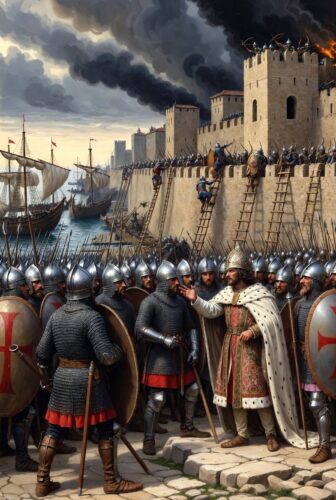 Big mistake.
### The March Treaty and the April Assault: April 13 Becomes Doomsday
By March 1204, the crusaders and Venetians have had enough. They sign the *Partitio terrarum imperii Romaniae*—a literal contract dividing the entire Byzantine Empire before they’ve even conquered it. Venice gets the lion’s share of trading ports. Baldwin of Flanders is the frontrunner for emperor. Boniface gets Thessalonica. It’s the medieval version of venture capitalists writing the term sheet before the startup even launches.
The second siege begins in early April. Constantinople’s land walls are impregnable, so they focus on the weaker sea walls along the Golden Horn. April 9: assault fails. Bad weather, Byzantine archers, and Varangian Guards (axe-wielding Viking mercenaries) turn the beaches red.
April 12 changes everything. A strong north wind pushes the Venetian ships right against the walls. Knights scramble up masts, leap onto battlements. A few dozen crusaders—including a knight named Aleaumes of Clari who crawls through a tiny hole in the wall—get inside. They open the gates. Panic spreads. Fires rage. Emperor Alexios V flees that night through the Polyandriou Gate, abandoning the city.
Big mistake.
### The March Treaty and the April Assault: April 13 Becomes Doomsday
By March 1204, the crusaders and Venetians have had enough. They sign the *Partitio terrarum imperii Romaniae*—a literal contract dividing the entire Byzantine Empire before they’ve even conquered it. Venice gets the lion’s share of trading ports. Baldwin of Flanders is the frontrunner for emperor. Boniface gets Thessalonica. It’s the medieval version of venture capitalists writing the term sheet before the startup even launches.
The second siege begins in early April. Constantinople’s land walls are impregnable, so they focus on the weaker sea walls along the Golden Horn. April 9: assault fails. Bad weather, Byzantine archers, and Varangian Guards (axe-wielding Viking mercenaries) turn the beaches red.
April 12 changes everything. A strong north wind pushes the Venetian ships right against the walls. Knights scramble up masts, leap onto battlements. A few dozen crusaders—including a knight named Aleaumes of Clari who crawls through a tiny hole in the wall—get inside. They open the gates. Panic spreads. Fires rage. Emperor Alexios V flees that night through the Polyandriou Gate, abandoning the city.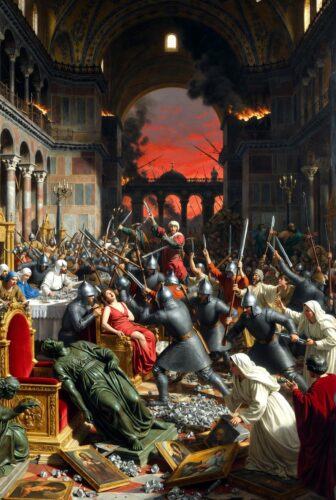 And on April 13, 1204, the real horror begins.
The crusaders had promised to spare churches and civilians. They had sworn oaths. The Pope had already excommunicated them once. None of it mattered. For three days they rampaged. Chronicler Geoffrey de Villehardouin (a crusader himself) called it glorious conquest. Byzantine eyewitness Nicetas Choniates called them “precursors of Antichrist.”
They smashed into Hagia Sophia—the world’s greatest church. Soldiers ripped silver from the iconostasis, trampled the altar, used holy vessels as drinking cups. One prostitute was seated on the patriarch’s throne and sang bawdy songs while the men cheered. Nuns were raped in their convents. Tombs of emperors were cracked open and looted. Ancient bronzes from the Hippodrome—the famous four horses now in Venice’s St. Mark’s—were shipped west. A massive statue of Hercules by Lysippos was melted down for coins. Libraries burned. Relics that had survived centuries vanished into crusader saddlebags.
Civilians hid in cellars. About 2,000 were killed outright. The rest watched their city—the New Rome, with its population of 400,000, its forums, its aqueducts, its wealth that made every European king jealous—get stripped bare. The total loot? Around 900,000 silver marks. Venice took its cut. The knights split the rest. Many foot soldiers stole what they could and never made it to the Holy Land.
By April 16, the nobles imposed order. Baldwin of Flanders was crowned Emperor Baldwin I in Hagia Sophia on May 16. The Latin Empire was born. Boniface got the Kingdom of Thessalonica. Venice carved out the Duchy of the Archipelago. The Byzantine aristocracy fled to three successor states: Nicaea (the strongest), Trebizond, and Epirus. Ordinary Greeks watched Latin knights parade through their streets and muttered that the Turks might actually be better.
### The Long Shadow: Why 1204 Still Echoes
The immediate aftermath was fragmentation. The Latin Empire was a joke—poorly governed, constantly at war with the successor states, and hated by the locals. In 1261, Michael VIII Palaiologos from Nicaea recaptured Constantinople in a lightning campaign. The Byzantine Empire returned… but it was a ghost. Smaller, poorer, militarily crippled. The treasury was gone. The walls were patched but never the same. Trade routes now favored Venice and Genoa.
Long-term? Catastrophic for the East. The 1204 sack deepened the Great Schism of 1054 into pure hatred. When the Ottomans finally took Constantinople in 1453, many Greeks reportedly said the Latin crusaders had done more damage in three days than the Turks would in 200 years. Culturally, priceless art and knowledge flowed west—some historians argue it helped spark the Renaissance by giving Europe a taste of classical glory. Economically, Venice’s monopoly in the eastern Mediterranean exploded. Politically, it proved that holy wars could be hijacked by cold, hard capitalism.
And the irony? The crusade that was supposed to strengthen Christendom against Islam instead handed the Muslims their greatest future advantage. A weakened Byzantium couldn’t hold back the Ottomans. The Fourth Crusade didn’t just fail its mission—it actively sabotaged the entire Christian world for centuries.
And on April 13, 1204, the real horror begins.
The crusaders had promised to spare churches and civilians. They had sworn oaths. The Pope had already excommunicated them once. None of it mattered. For three days they rampaged. Chronicler Geoffrey de Villehardouin (a crusader himself) called it glorious conquest. Byzantine eyewitness Nicetas Choniates called them “precursors of Antichrist.”
They smashed into Hagia Sophia—the world’s greatest church. Soldiers ripped silver from the iconostasis, trampled the altar, used holy vessels as drinking cups. One prostitute was seated on the patriarch’s throne and sang bawdy songs while the men cheered. Nuns were raped in their convents. Tombs of emperors were cracked open and looted. Ancient bronzes from the Hippodrome—the famous four horses now in Venice’s St. Mark’s—were shipped west. A massive statue of Hercules by Lysippos was melted down for coins. Libraries burned. Relics that had survived centuries vanished into crusader saddlebags.
Civilians hid in cellars. About 2,000 were killed outright. The rest watched their city—the New Rome, with its population of 400,000, its forums, its aqueducts, its wealth that made every European king jealous—get stripped bare. The total loot? Around 900,000 silver marks. Venice took its cut. The knights split the rest. Many foot soldiers stole what they could and never made it to the Holy Land.
By April 16, the nobles imposed order. Baldwin of Flanders was crowned Emperor Baldwin I in Hagia Sophia on May 16. The Latin Empire was born. Boniface got the Kingdom of Thessalonica. Venice carved out the Duchy of the Archipelago. The Byzantine aristocracy fled to three successor states: Nicaea (the strongest), Trebizond, and Epirus. Ordinary Greeks watched Latin knights parade through their streets and muttered that the Turks might actually be better.
### The Long Shadow: Why 1204 Still Echoes
The immediate aftermath was fragmentation. The Latin Empire was a joke—poorly governed, constantly at war with the successor states, and hated by the locals. In 1261, Michael VIII Palaiologos from Nicaea recaptured Constantinople in a lightning campaign. The Byzantine Empire returned… but it was a ghost. Smaller, poorer, militarily crippled. The treasury was gone. The walls were patched but never the same. Trade routes now favored Venice and Genoa.
Long-term? Catastrophic for the East. The 1204 sack deepened the Great Schism of 1054 into pure hatred. When the Ottomans finally took Constantinople in 1453, many Greeks reportedly said the Latin crusaders had done more damage in three days than the Turks would in 200 years. Culturally, priceless art and knowledge flowed west—some historians argue it helped spark the Renaissance by giving Europe a taste of classical glory. Economically, Venice’s monopoly in the eastern Mediterranean exploded. Politically, it proved that holy wars could be hijacked by cold, hard capitalism.
And the irony? The crusade that was supposed to strengthen Christendom against Islam instead handed the Muslims their greatest future advantage. A weakened Byzantium couldn’t hold back the Ottomans. The Fourth Crusade didn’t just fail its mission—it actively sabotaged the entire Christian world for centuries.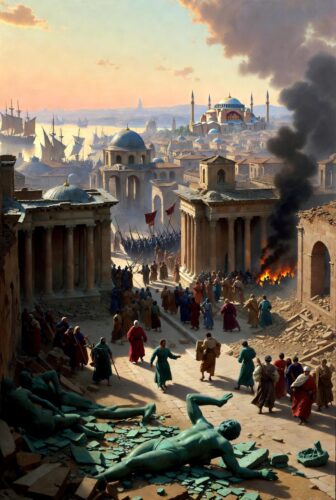 ### From Medieval Sack to Modern Empire: How This Disaster Hands You an Unfair Advantage
Now the 10% that actually matters for you in 2026.
The crusaders didn’t plan to sack Constantinople. They got diverted by debt, betrayal, and opportunity—and turned it into the biggest land grab in medieval history. The Byzantines thought their walls were eternal—until wind, ships, and sheer audacity proved otherwise. The Nicaean exiles lost everything in 1204… then spent 57 years plotting, reforming, and striking back to reclaim their city in 1261.
That same sequence—diversion, breach, total loss, strategic exile, and triumphant reclamation—works in your life with surgical precision. Most self-help tells you to “stay on mission” or “visualize success.” This story laughs at that. Sometimes the mission changes because life (or a blind doge) forces your hand. The winners are the ones who treat the detour as the new conquest.
Here are the exact benefits you pocket today by internalizing April 13, 1204:
- **You stop fearing financial or political “debts” and start weaponizing them.** The crusaders were broke and excommunicated—yet they still conquered an empire. When your budget is tight or your reputation is damaged, you treat it like the Venetian contract: renegotiate ruthlessly, find allies who need what you have, and pivot to the target of opportunity instead of the original goal.
- **You master opportunistic alliances without becoming the victim.** Alexios IV used the crusaders. Dandolo used everyone. You learn to spot the “deposed prince” offering empty promises in your own life (bad business partners, toxic relationships) and flip the script so you’re the one writing the Partitio contract.
- **You build unbreakable resilience by planning your Nicaean exile in advance.** When your personal Constantinople falls—layoff, divorce, health crisis—you don’t wallow. You retreat to your “Nicaea” (a stripped-down base of operations), consolidate resources, and prepare the counter-strike that retakes your throne in under 57 months instead of 57 years.
- **You embrace calculated sacrilege against your own outdated rules.** The crusaders broke every vow and still won. You stop worshipping “shoulds” that no longer serve you—corporate loyalty, people-pleasing, perfectionism—and loot the value from situations everyone else treats as sacred and untouchable.
- **You turn cultural or personal “schisms” into competitive advantage.** The East-West divide after 1204 made both sides stronger in weird ways. Your family rifts, industry politics, or internal conflicts become the forge where you hammer out a sharper version of yourself.
### Your Unique 14-Day “Nicaean Reclamation Protocol” – The Anti-Self-Help Plan No Guru Has Ever Sold You
Forget 30-day challenges or journaling. This is a battlefield manual inspired directly by the 1204 playbook. It’s quick, brutal, and designed for people who are tired of generic advice. Execute it when your life feels sacked. It has five phases, each with one non-negotiable action and one historical cheat code. Total time: 14 days. Results: you emerge as Baldwin I of your own empire.
### From Medieval Sack to Modern Empire: How This Disaster Hands You an Unfair Advantage
Now the 10% that actually matters for you in 2026.
The crusaders didn’t plan to sack Constantinople. They got diverted by debt, betrayal, and opportunity—and turned it into the biggest land grab in medieval history. The Byzantines thought their walls were eternal—until wind, ships, and sheer audacity proved otherwise. The Nicaean exiles lost everything in 1204… then spent 57 years plotting, reforming, and striking back to reclaim their city in 1261.
That same sequence—diversion, breach, total loss, strategic exile, and triumphant reclamation—works in your life with surgical precision. Most self-help tells you to “stay on mission” or “visualize success.” This story laughs at that. Sometimes the mission changes because life (or a blind doge) forces your hand. The winners are the ones who treat the detour as the new conquest.
Here are the exact benefits you pocket today by internalizing April 13, 1204:
- **You stop fearing financial or political “debts” and start weaponizing them.** The crusaders were broke and excommunicated—yet they still conquered an empire. When your budget is tight or your reputation is damaged, you treat it like the Venetian contract: renegotiate ruthlessly, find allies who need what you have, and pivot to the target of opportunity instead of the original goal.
- **You master opportunistic alliances without becoming the victim.** Alexios IV used the crusaders. Dandolo used everyone. You learn to spot the “deposed prince” offering empty promises in your own life (bad business partners, toxic relationships) and flip the script so you’re the one writing the Partitio contract.
- **You build unbreakable resilience by planning your Nicaean exile in advance.** When your personal Constantinople falls—layoff, divorce, health crisis—you don’t wallow. You retreat to your “Nicaea” (a stripped-down base of operations), consolidate resources, and prepare the counter-strike that retakes your throne in under 57 months instead of 57 years.
- **You embrace calculated sacrilege against your own outdated rules.** The crusaders broke every vow and still won. You stop worshipping “shoulds” that no longer serve you—corporate loyalty, people-pleasing, perfectionism—and loot the value from situations everyone else treats as sacred and untouchable.
- **You turn cultural or personal “schisms” into competitive advantage.** The East-West divide after 1204 made both sides stronger in weird ways. Your family rifts, industry politics, or internal conflicts become the forge where you hammer out a sharper version of yourself.
### Your Unique 14-Day “Nicaean Reclamation Protocol” – The Anti-Self-Help Plan No Guru Has Ever Sold You
Forget 30-day challenges or journaling. This is a battlefield manual inspired directly by the 1204 playbook. It’s quick, brutal, and designed for people who are tired of generic advice. Execute it when your life feels sacked. It has five phases, each with one non-negotiable action and one historical cheat code. Total time: 14 days. Results: you emerge as Baldwin I of your own empire.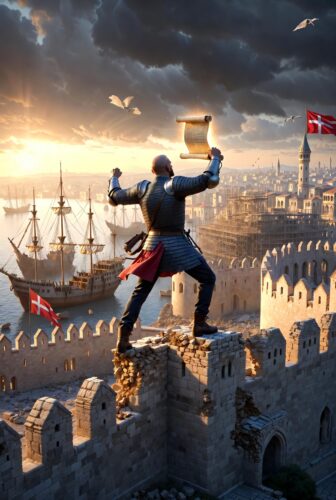 **Days 1-3: The Venetian Reconnaissance (Assess the Walls)**
Action: Map every “wall” in your current siege—debts, toxic people, outdated goals, skill gaps. Write them on index cards like Dandolo mapped Constantinople’s harbors. No positivity. Just cold facts.
Cheat code: Adopt Dandolo’s blindness. List your biggest “weakness” (age, lack of money, past failure) and force yourself to see it as the wind that will push your ships closer to the prize.
**Days 4-7: The Zara Diversion (Pay the Debt with Someone Else’s City)**
Action: Identify one “Zara”—a smaller, winnable battle that satisfies your immediate creditors or obligations (a side gig, a tough conversation, a low-stakes project). Conquer it fully. Use the win to fund or justify your bigger move.
Cheat code: Sign your own March 1204 treaty. Write a one-page contract with yourself dividing your future “empire” (time, money, energy) among your new priorities. Make it as mercenary as the Venetians.
**Days 8-10: The April 12 Breach (Create Your Own North Wind)**
Action: Pick one defended “gate” in your life (the job you want, the habit you can’t break, the relationship you need to exit) and engineer a small, unstoppable breach. Use momentum from Zara—email the contact, ship the prototype, book the flight. Do it when conditions feel impossible; that’s when the wind shifts in your favor.
Cheat code: Crawl through the hole like Aleaumes of Clari. Make the first move ridiculously small and ugly. Just get inside the walls.
**Days 11-13: The Three-Day Sack (Loot Without Mercy)**
Action: Ruthlessly extract every asset, lesson, and resource from the old situation you just breached. Fire the bad client, sell the failing asset, delete the draining apps. Keep only what serves the new empire. Celebrate the loot—treat yourself like a knight who just melted a bronze Hercules.
Cheat code: Ignore the excommunication. Whatever “rules” or guilt you feel about burning bridges—override them. History rewarded the looters, not the pious.
**Day 14: The Latin Coronation (Crown Yourself Emperor)**
Action: Publicly declare your new identity and first decree. Post it, tell your inner circle, or write it in your calendar as non-negotiable. Baldwin didn’t wait—he got crowned in Hagia Sophia. You crown yourself in whatever passes for your personal cathedral.
Cheat code: Plan your Nicaean counter-strike immediately. Schedule the first meeting, launch, or move that begins the 57-month (or 57-week) reconquest. The empire is yours now.
Do this once and you’ll never see a setback the same way again. The men who stormed Constantinople on April 13, 1204, were flawed, greedy, and often hypocritical. But they refused to let debt, bad weather, or broken promises define them. They pivoted, breached, looted, and built something new on the ruins.
You can too.
Your personal Constantinople is waiting. The wind is shifting. Grab the ropes, scale the wall, and start the sack that rebuilds your empire.
History didn’t hand the crusaders an easy victory. It handed them a detour that became destiny.
What will your April 13 look like?
**Days 1-3: The Venetian Reconnaissance (Assess the Walls)**
Action: Map every “wall” in your current siege—debts, toxic people, outdated goals, skill gaps. Write them on index cards like Dandolo mapped Constantinople’s harbors. No positivity. Just cold facts.
Cheat code: Adopt Dandolo’s blindness. List your biggest “weakness” (age, lack of money, past failure) and force yourself to see it as the wind that will push your ships closer to the prize.
**Days 4-7: The Zara Diversion (Pay the Debt with Someone Else’s City)**
Action: Identify one “Zara”—a smaller, winnable battle that satisfies your immediate creditors or obligations (a side gig, a tough conversation, a low-stakes project). Conquer it fully. Use the win to fund or justify your bigger move.
Cheat code: Sign your own March 1204 treaty. Write a one-page contract with yourself dividing your future “empire” (time, money, energy) among your new priorities. Make it as mercenary as the Venetians.
**Days 8-10: The April 12 Breach (Create Your Own North Wind)**
Action: Pick one defended “gate” in your life (the job you want, the habit you can’t break, the relationship you need to exit) and engineer a small, unstoppable breach. Use momentum from Zara—email the contact, ship the prototype, book the flight. Do it when conditions feel impossible; that’s when the wind shifts in your favor.
Cheat code: Crawl through the hole like Aleaumes of Clari. Make the first move ridiculously small and ugly. Just get inside the walls.
**Days 11-13: The Three-Day Sack (Loot Without Mercy)**
Action: Ruthlessly extract every asset, lesson, and resource from the old situation you just breached. Fire the bad client, sell the failing asset, delete the draining apps. Keep only what serves the new empire. Celebrate the loot—treat yourself like a knight who just melted a bronze Hercules.
Cheat code: Ignore the excommunication. Whatever “rules” or guilt you feel about burning bridges—override them. History rewarded the looters, not the pious.
**Day 14: The Latin Coronation (Crown Yourself Emperor)**
Action: Publicly declare your new identity and first decree. Post it, tell your inner circle, or write it in your calendar as non-negotiable. Baldwin didn’t wait—he got crowned in Hagia Sophia. You crown yourself in whatever passes for your personal cathedral.
Cheat code: Plan your Nicaean counter-strike immediately. Schedule the first meeting, launch, or move that begins the 57-month (or 57-week) reconquest. The empire is yours now.
Do this once and you’ll never see a setback the same way again. The men who stormed Constantinople on April 13, 1204, were flawed, greedy, and often hypocritical. But they refused to let debt, bad weather, or broken promises define them. They pivoted, breached, looted, and built something new on the ruins.
You can too.
Your personal Constantinople is waiting. The wind is shifting. Grab the ropes, scale the wall, and start the sack that rebuilds your empire.
History didn’t hand the crusaders an easy victory. It handed them a detour that became destiny.
What will your April 13 look like?