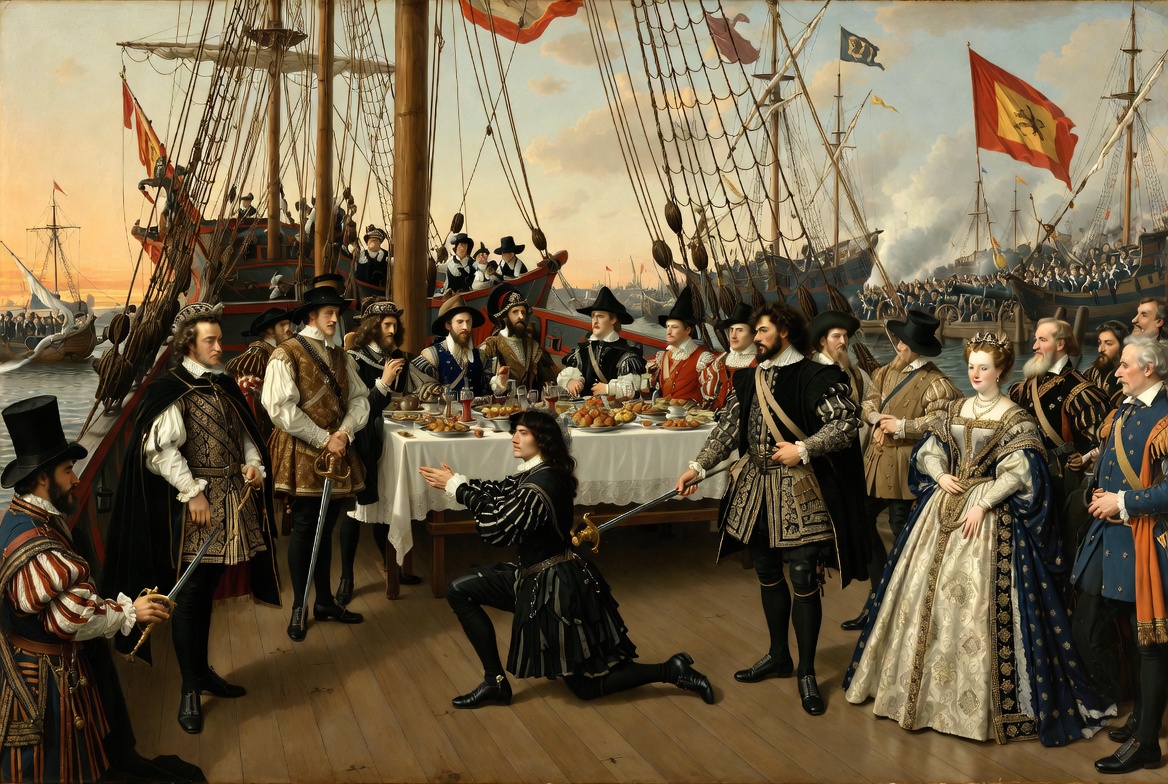
On April 4, 1581, at the docks of Deptford on the Thames, Queen Elizabeth I’s England threw the biggest, cheekiest party the Tudor world had ever seen. A battered but gleaming galleon, freshly returned from three years of hell and high water, sat proudly at anchor. Her captain, a sunburned, battle-scarred Devon man named Francis Drake, knelt on the deck in front of the French ambassador (standing in for the queen herself, who was watching from the shore with a grin). With a flourish and a sword tap on both shoulders, Drake rose as Sir Francis Drake, Knight. The crowd roared. Cannon salutes boomed. A banquet followed where the queen herself dined aboard the ship that had just circumnavigated the globe—the first Englishman ever to do so—and brought home a fortune in Spanish silver, gold, and spices that would make the crown’s coffers bulge and Spain’s blood boil.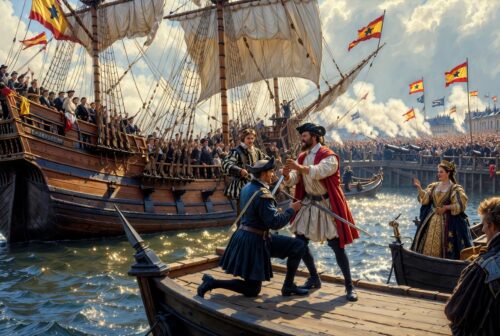 This wasn’t just a knighting. It was a deliberate thumb in the eye of the Spanish Empire, a masterstroke of Elizabethan realpolitik wrapped in swashbuckling theater, and the moment England officially embraced piracy as statecraft. The “Golden Hind” (renamed from the “Pelican” mid-voyage to honor Drake’s patron, Sir Christopher Hatton, whose crest featured a golden hind) had sailed 36,000 miles through storms, mutinies, shipwrecks, and enemy fire. Drake had raided Spanish ports from Chile to California, claimed land for England on the Pacific coast, and returned richer than Croesus. The knighting on April 4 sealed the deal: bold risk, relentless execution, and opportunistic genius could turn a commoner into a knight and a nation into a superpower.
To understand why this random April day in 1581 still echoes like a cannon shot across centuries, we have to plunge deep into the world that made it possible—the cutthroat chessboard of 16th-century Europe where Spain ruled the waves, England schemed in the shadows, and one audacious sailor decided the rules didn’t apply to him. Strap in. This is 90 percent pure, unfiltered history, packed with the blood, sweat, gold, and gallows humor that turned Drake from a nobody into a legend. Only at the end will we flip the script and show exactly how you can apply the hard-won lessons of the Golden Hind to your own daily grind in ways no generic self-help guru has ever dared.
Let’s set the stage in the 1550s and 1560s, when Francis Drake was born around 1540 in a crowded farmhouse near Tavistock, Devon. His father was a Protestant preacher and tenant farmer; the family was poor, devout, and constantly dodging Catholic authorities under Queen Mary’s bloody reign. Young Francis was shipped off at age twelve or thirteen to be apprenticed to a sea captain on the Thames barges, learning the brutal basics of navigation, sails, and survival. By his early twenties he had joined the Hawkins family—a powerful Plymouth clan of merchants and privateers who saw opportunity in challenging Spain’s New World monopoly. John Hawkins, Drake’s cousin and mentor, pioneered the English slave trade triangle (England to Africa to Spanish Caribbean), but the Spanish didn’t take kindly to interlopers. In 1568, at the Battle of San Juan de Ulúa off Mexico, a Spanish fleet ambushed Hawkins and Drake’s squadron. Ships were sunk, men slaughtered, and Drake barely escaped with his life—swimming to safety through shark-infested waters while watching his comrades die. He later wrote that the Spanish treachery “kindled a fire” in him that would burn for decades.
This wasn’t just a knighting. It was a deliberate thumb in the eye of the Spanish Empire, a masterstroke of Elizabethan realpolitik wrapped in swashbuckling theater, and the moment England officially embraced piracy as statecraft. The “Golden Hind” (renamed from the “Pelican” mid-voyage to honor Drake’s patron, Sir Christopher Hatton, whose crest featured a golden hind) had sailed 36,000 miles through storms, mutinies, shipwrecks, and enemy fire. Drake had raided Spanish ports from Chile to California, claimed land for England on the Pacific coast, and returned richer than Croesus. The knighting on April 4 sealed the deal: bold risk, relentless execution, and opportunistic genius could turn a commoner into a knight and a nation into a superpower.
To understand why this random April day in 1581 still echoes like a cannon shot across centuries, we have to plunge deep into the world that made it possible—the cutthroat chessboard of 16th-century Europe where Spain ruled the waves, England schemed in the shadows, and one audacious sailor decided the rules didn’t apply to him. Strap in. This is 90 percent pure, unfiltered history, packed with the blood, sweat, gold, and gallows humor that turned Drake from a nobody into a legend. Only at the end will we flip the script and show exactly how you can apply the hard-won lessons of the Golden Hind to your own daily grind in ways no generic self-help guru has ever dared.
Let’s set the stage in the 1550s and 1560s, when Francis Drake was born around 1540 in a crowded farmhouse near Tavistock, Devon. His father was a Protestant preacher and tenant farmer; the family was poor, devout, and constantly dodging Catholic authorities under Queen Mary’s bloody reign. Young Francis was shipped off at age twelve or thirteen to be apprenticed to a sea captain on the Thames barges, learning the brutal basics of navigation, sails, and survival. By his early twenties he had joined the Hawkins family—a powerful Plymouth clan of merchants and privateers who saw opportunity in challenging Spain’s New World monopoly. John Hawkins, Drake’s cousin and mentor, pioneered the English slave trade triangle (England to Africa to Spanish Caribbean), but the Spanish didn’t take kindly to interlopers. In 1568, at the Battle of San Juan de Ulúa off Mexico, a Spanish fleet ambushed Hawkins and Drake’s squadron. Ships were sunk, men slaughtered, and Drake barely escaped with his life—swimming to safety through shark-infested waters while watching his comrades die. He later wrote that the Spanish treachery “kindled a fire” in him that would burn for decades.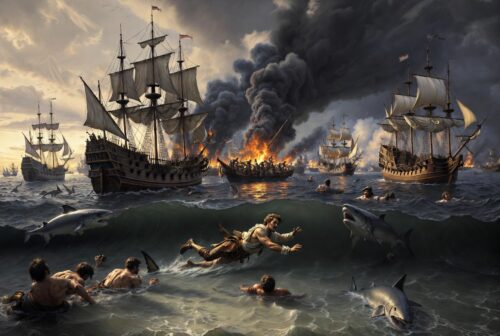 That fire fueled the next decade of raids. Drake captained small ships harassing Spanish shipping in the Caribbean, learning their routes, ports, and weaknesses. He captured treasure galleons, liberated (and sometimes pressed into service) enslaved Africans and Indigenous sailors who became loyal crew, and built a reputation as “El Draque”—the Dragon—to the Spanish. By 1577, Queen Elizabeth I herself was quietly bankrolling a new venture. Officially, Drake was to sail south through the Strait of Magellan to explore the Pacific for a northwest passage back to England. Unofficially? Raid Spanish Pacific holdings, which no one had dared touch since Magellan. Five ships left Plymouth on December 13, 1577: the Pelican (later Golden Hind, 100 tons), Elizabeth, Marigold, Swan, and Benedict. Crew totaled about 164 men—sailors, soldiers, musicians, even a chaplain and a few gentlemen adventurers. Drake’s leadership style was already legendary: strict discipline mixed with surprising fairness. He ate with the crew, shared hardships, but enforced order with an iron fist.
The voyage was pure nightmare fuel from the start. Atlantic storms battered the fleet. Supplies spoiled. In the Cape Verde Islands they captured a Portuguese ship for extra stores. By the time they reached the brutal Strait of Magellan in August 1578, only three ships remained. The strait itself was a gauntlet of 350 miles of screaming gales, hidden rocks, and freezing cold. Drake’s ship was the only one to make it through intact; the Marigold vanished with all hands in a storm, and the Elizabeth turned back. Drake pressed on alone into the vast, unknown Pacific—exactly what the Spanish thought impossible.
What followed was five months of relentless raiding up the undefended Pacific coast of South America. In Chile they hit Valparaíso, looting wine, gold, and supplies while the locals partied, thinking the English were friendly. Further north, Drake captured the treasure ship Nuestra Señora de la Concepción—nicknamed Cacafuego (“Fire-shitter”) by her terrified crew—off Ecuador. The haul was staggering: 26 tons of silver, 80 pounds of gold, jewels, pearls, and spices worth over £100,000 (millions today). Drake’s men danced on deck with captured Spanish gentlemen while the musicians played. He famously told one captive, “We are all one company, and the world is our stage.” The Spanish were stunned; no one had ever hit their Pacific lifeline.
That fire fueled the next decade of raids. Drake captained small ships harassing Spanish shipping in the Caribbean, learning their routes, ports, and weaknesses. He captured treasure galleons, liberated (and sometimes pressed into service) enslaved Africans and Indigenous sailors who became loyal crew, and built a reputation as “El Draque”—the Dragon—to the Spanish. By 1577, Queen Elizabeth I herself was quietly bankrolling a new venture. Officially, Drake was to sail south through the Strait of Magellan to explore the Pacific for a northwest passage back to England. Unofficially? Raid Spanish Pacific holdings, which no one had dared touch since Magellan. Five ships left Plymouth on December 13, 1577: the Pelican (later Golden Hind, 100 tons), Elizabeth, Marigold, Swan, and Benedict. Crew totaled about 164 men—sailors, soldiers, musicians, even a chaplain and a few gentlemen adventurers. Drake’s leadership style was already legendary: strict discipline mixed with surprising fairness. He ate with the crew, shared hardships, but enforced order with an iron fist.
The voyage was pure nightmare fuel from the start. Atlantic storms battered the fleet. Supplies spoiled. In the Cape Verde Islands they captured a Portuguese ship for extra stores. By the time they reached the brutal Strait of Magellan in August 1578, only three ships remained. The strait itself was a gauntlet of 350 miles of screaming gales, hidden rocks, and freezing cold. Drake’s ship was the only one to make it through intact; the Marigold vanished with all hands in a storm, and the Elizabeth turned back. Drake pressed on alone into the vast, unknown Pacific—exactly what the Spanish thought impossible.
What followed was five months of relentless raiding up the undefended Pacific coast of South America. In Chile they hit Valparaíso, looting wine, gold, and supplies while the locals partied, thinking the English were friendly. Further north, Drake captured the treasure ship Nuestra Señora de la Concepción—nicknamed Cacafuego (“Fire-shitter”) by her terrified crew—off Ecuador. The haul was staggering: 26 tons of silver, 80 pounds of gold, jewels, pearls, and spices worth over £100,000 (millions today). Drake’s men danced on deck with captured Spanish gentlemen while the musicians played. He famously told one captive, “We are all one company, and the world is our stage.” The Spanish were stunned; no one had ever hit their Pacific lifeline.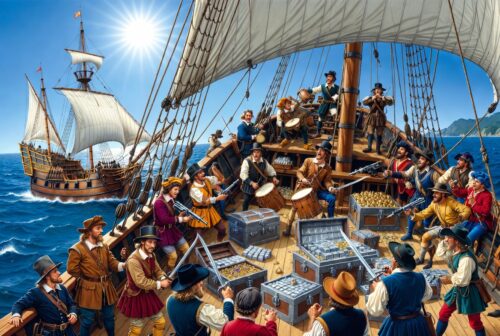 Drake continued north, raiding as he went, then turned west across the Pacific in July 1579. The crossing was another epic of suffering: scurvy ravaged the crew until they stopped at islands for fresh fruit and water. They reached the Moluccas (Spice Islands) in November, trading for cloves and nearly wrecking on reefs. From there it was the Indian Ocean, around the Cape of Good Hope (another storm-lashed ordeal), and up the Atlantic. On September 26, 1580, the Golden Hind limped into Plymouth Sound with just 56 survivors and enough treasure to make every man aboard wealthy. Drake had done the impossible: circumnavigated the globe, claimed “New Albion” (California) for England with a brass plate and a ceremony involving local Miwok people, and returned with proof that Spain’s empire had feet of clay.
The political fallout was immediate and deliciously tense. Spain demanded Drake’s head. Elizabeth needed plausible deniability—but the treasure was too tempting. She kept Drake’s ship under guard while negotiations raged. Finally, on April 4, 1581, she made her move. The Golden Hind was moved to Deptford. A massive crowd gathered. The queen arrived by barge. After a lavish banquet, she ordered the French ambassador to perform the knighting so she could claim it wasn’t her directly provoking Spain. Drake knelt. The sword came down. “Rise, Sir Francis Drake.” Cannons thundered. The queen dined aboard, toured the ship, and reportedly told Drake she would make him the richest man in England. She was as good as her word; Drake received a knighthood, a coat of arms, and a share of the loot that let him buy Buckland Abbey and live like minor royalty.
The long-term ripples reshaped history. Drake’s voyage proved England could challenge Spain anywhere. It inspired the next generation of seadogs—Raleigh, Frobisher, Hawkins. The wealth funded shipbuilding and naval reform. When the Spanish Armada sailed in 1588, Drake was vice-admiral, famously finishing his game of bowls before sailing out to help destroy the invasion fleet with fire ships and superior gunnery. Spain never fully recovered its monopoly. England’s naval tradition, empire-building, and global reach all trace a direct line back to that battered galleon moored at Deptford on April 4, 1581.
But the story isn’t just triumph. Drake’s life after the knighting was a rollercoaster of glory and controversy. He led failed expeditions, faced accusations of greed and brutality from some crew (the 1578 execution of gentleman Thomas Doughty for alleged mutiny was a stain that haunted him), and died of dysentery in 1596 off Panama while raiding again. Yet his legend endured—ballads, plays, and national hero status. The Golden Hind itself was preserved in a dry dock at Deptford for decades, a tourist attraction until it rotted away. Models and replicas still sail today as reminders.
Drake continued north, raiding as he went, then turned west across the Pacific in July 1579. The crossing was another epic of suffering: scurvy ravaged the crew until they stopped at islands for fresh fruit and water. They reached the Moluccas (Spice Islands) in November, trading for cloves and nearly wrecking on reefs. From there it was the Indian Ocean, around the Cape of Good Hope (another storm-lashed ordeal), and up the Atlantic. On September 26, 1580, the Golden Hind limped into Plymouth Sound with just 56 survivors and enough treasure to make every man aboard wealthy. Drake had done the impossible: circumnavigated the globe, claimed “New Albion” (California) for England with a brass plate and a ceremony involving local Miwok people, and returned with proof that Spain’s empire had feet of clay.
The political fallout was immediate and deliciously tense. Spain demanded Drake’s head. Elizabeth needed plausible deniability—but the treasure was too tempting. She kept Drake’s ship under guard while negotiations raged. Finally, on April 4, 1581, she made her move. The Golden Hind was moved to Deptford. A massive crowd gathered. The queen arrived by barge. After a lavish banquet, she ordered the French ambassador to perform the knighting so she could claim it wasn’t her directly provoking Spain. Drake knelt. The sword came down. “Rise, Sir Francis Drake.” Cannons thundered. The queen dined aboard, toured the ship, and reportedly told Drake she would make him the richest man in England. She was as good as her word; Drake received a knighthood, a coat of arms, and a share of the loot that let him buy Buckland Abbey and live like minor royalty.
The long-term ripples reshaped history. Drake’s voyage proved England could challenge Spain anywhere. It inspired the next generation of seadogs—Raleigh, Frobisher, Hawkins. The wealth funded shipbuilding and naval reform. When the Spanish Armada sailed in 1588, Drake was vice-admiral, famously finishing his game of bowls before sailing out to help destroy the invasion fleet with fire ships and superior gunnery. Spain never fully recovered its monopoly. England’s naval tradition, empire-building, and global reach all trace a direct line back to that battered galleon moored at Deptford on April 4, 1581.
But the story isn’t just triumph. Drake’s life after the knighting was a rollercoaster of glory and controversy. He led failed expeditions, faced accusations of greed and brutality from some crew (the 1578 execution of gentleman Thomas Doughty for alleged mutiny was a stain that haunted him), and died of dysentery in 1596 off Panama while raiding again. Yet his legend endured—ballads, plays, and national hero status. The Golden Hind itself was preserved in a dry dock at Deptford for decades, a tourist attraction until it rotted away. Models and replicas still sail today as reminders.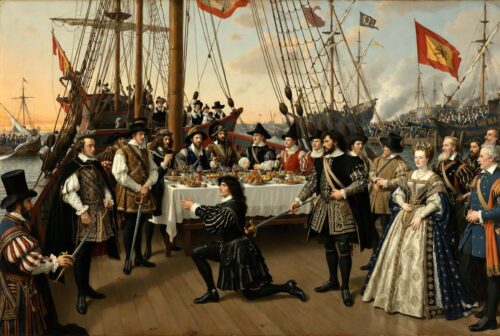 What makes this April 4 moment so electric is the perfect storm of personality, timing, and audacity. Drake wasn’t born noble; he earned every inch through cunning, seamanship, and sheer refusal to accept “no.” Elizabeth wasn’t a fool—she backed him because it cost her nothing and gained everything. The Spanish were arrogant and overstretched. The crew was a motley mix of loyalists and opportunists held together by Drake’s charisma and the promise of gold. Every storm, every raid, every near-mutiny was a lesson in leadership under impossible pressure. The knighting wasn’t the end of the story—it was the official stamp of approval on a new way of doing empire: lean, opportunistic, merit-based, and gloriously cheeky.
Now, fast-forward four-and-a-half centuries. You’re not captaining a galleon through the Strait of Magellan or raiding Spanish treasure fleets. But every single day you navigate your own unknown oceans: career dead-ends, financial storms, personal mutinies of doubt and distraction, rival “empires” (competitors, bureaucracies, bad habits) that seem unbeatable. The outcome of April 4, 1581, wasn’t just a shiny title or a pile of silver. It was proof that one person, backed by smart alliances and relentless execution, can flip the script on seemingly invincible powers and claim lasting treasure for themselves and their “nation” (your family, your team, your future self).
Here’s how that historical fact delivers concrete, immediate benefits to your individual life when you internalize it. These aren’t vague inspirations—they’re direct translations of Drake’s tactics into modern action:
- **You learn to treat every “impossible” barrier like the Strait of Magellan**: Drake didn’t wait for calm seas; he sailed into the storm with patched sails and iron will. Today, that means attacking your biggest life obstacle head-on instead of circling it for years. The benefit? You break through faster than anyone who plays it safe, emerging on the other side with skills and confidence no one can take away.
- **You master the art of opportunistic raiding**: Drake didn’t conquer entire continents; he hit soft targets for maximum gain with minimal risk. Apply this and you stop grinding endlessly at dead-end tasks. You scan your week for “Cacafuego moments”—quick, high-reward opportunities like a side project, a bold ask at work, or a neglected skill that suddenly pays off. Result: your personal treasure chest fills without burning you out.
- **You build a mutiny-proof inner crew**: Drake executed one traitor but inspired loyalty in the rest through shared hardship and shared spoils. In your life, this means ruthlessly pruning toxic influences (negative self-talk, energy-draining people) while rewarding the parts of yourself that show up. You end up with unbreakable self-discipline and a support network that actually rows in the same direction.
- **You claim your own “New Albion”**: Drake planted a brass plate and declared territory. You do the same by publicly committing to a bold personal project (a book, a business, a fitness goal) and documenting it. The benefit is ownership: once claimed, it becomes yours, and the world starts treating you as the authority on it.
- **You turn enemies into unwitting funders**: Spain’s wealth literally financed England’s rise. In daily life, your “Spanish Empire” (a tough boss, market competition, even your own procrastination) can be raided for lessons, contacts, or resources. You walk away richer instead of defeated.
- **You embrace the theater of victory**: The knighting was pure spectacle. Drake knew symbolism matters. Celebrate your wins publicly and theatrically—post the evidence, throw the party, tell the story. People rally around winners who own their success, opening doors Drake himself would envy.
- **You survive the return voyage stronger**: Drake lost four ships and most of his men yet returned a hero. Your setbacks (failed launches, health scares, financial hits) stop defining you. You sail home anyway, treasure in hand, because the circumnavigation itself builds the legend.
- **You redefine loyalty upward**: Drake answered only to the queen and his vision. You stop seeking approval from everyone and align only with your highest goals and a tiny circle of true allies. Freedom and speed follow.
What makes this April 4 moment so electric is the perfect storm of personality, timing, and audacity. Drake wasn’t born noble; he earned every inch through cunning, seamanship, and sheer refusal to accept “no.” Elizabeth wasn’t a fool—she backed him because it cost her nothing and gained everything. The Spanish were arrogant and overstretched. The crew was a motley mix of loyalists and opportunists held together by Drake’s charisma and the promise of gold. Every storm, every raid, every near-mutiny was a lesson in leadership under impossible pressure. The knighting wasn’t the end of the story—it was the official stamp of approval on a new way of doing empire: lean, opportunistic, merit-based, and gloriously cheeky.
Now, fast-forward four-and-a-half centuries. You’re not captaining a galleon through the Strait of Magellan or raiding Spanish treasure fleets. But every single day you navigate your own unknown oceans: career dead-ends, financial storms, personal mutinies of doubt and distraction, rival “empires” (competitors, bureaucracies, bad habits) that seem unbeatable. The outcome of April 4, 1581, wasn’t just a shiny title or a pile of silver. It was proof that one person, backed by smart alliances and relentless execution, can flip the script on seemingly invincible powers and claim lasting treasure for themselves and their “nation” (your family, your team, your future self).
Here’s how that historical fact delivers concrete, immediate benefits to your individual life when you internalize it. These aren’t vague inspirations—they’re direct translations of Drake’s tactics into modern action:
- **You learn to treat every “impossible” barrier like the Strait of Magellan**: Drake didn’t wait for calm seas; he sailed into the storm with patched sails and iron will. Today, that means attacking your biggest life obstacle head-on instead of circling it for years. The benefit? You break through faster than anyone who plays it safe, emerging on the other side with skills and confidence no one can take away.
- **You master the art of opportunistic raiding**: Drake didn’t conquer entire continents; he hit soft targets for maximum gain with minimal risk. Apply this and you stop grinding endlessly at dead-end tasks. You scan your week for “Cacafuego moments”—quick, high-reward opportunities like a side project, a bold ask at work, or a neglected skill that suddenly pays off. Result: your personal treasure chest fills without burning you out.
- **You build a mutiny-proof inner crew**: Drake executed one traitor but inspired loyalty in the rest through shared hardship and shared spoils. In your life, this means ruthlessly pruning toxic influences (negative self-talk, energy-draining people) while rewarding the parts of yourself that show up. You end up with unbreakable self-discipline and a support network that actually rows in the same direction.
- **You claim your own “New Albion”**: Drake planted a brass plate and declared territory. You do the same by publicly committing to a bold personal project (a book, a business, a fitness goal) and documenting it. The benefit is ownership: once claimed, it becomes yours, and the world starts treating you as the authority on it.
- **You turn enemies into unwitting funders**: Spain’s wealth literally financed England’s rise. In daily life, your “Spanish Empire” (a tough boss, market competition, even your own procrastination) can be raided for lessons, contacts, or resources. You walk away richer instead of defeated.
- **You embrace the theater of victory**: The knighting was pure spectacle. Drake knew symbolism matters. Celebrate your wins publicly and theatrically—post the evidence, throw the party, tell the story. People rally around winners who own their success, opening doors Drake himself would envy.
- **You survive the return voyage stronger**: Drake lost four ships and most of his men yet returned a hero. Your setbacks (failed launches, health scares, financial hits) stop defining you. You sail home anyway, treasure in hand, because the circumnavigation itself builds the legend.
- **You redefine loyalty upward**: Drake answered only to the queen and his vision. You stop seeking approval from everyone and align only with your highest goals and a tiny circle of true allies. Freedom and speed follow. These benefits compound because Drake’s story isn’t about luck—it’s about repeatable systems: preparation, adaptability, bold strikes, and unapologetic celebration.
Now, the part no other self-help article online dares to give you: a detailed, quick, utterly unique plan built exclusively from the Golden Hind playbook. Forget vision boards, morning routines that feel like chores, or generic “hustle harder” nonsense. This is the **Privateer’s 21-Day Circumnavigation Protocol**—a nautical raid on your own mediocrity that you can launch this week. It’s designed to be finished fast, executed with swashbuckling flair, and leave you knighted in your own eyes with actual treasure (money, skills, freedom) to show for it. Do it once and you’ll have a repeatable system for life.
**Week 1: Chart the Unknown Waters (Days 1-7)**
Map your personal Pacific. Spend 30 minutes daily listing every “Spanish holding” in your life—dead-end job tasks, draining relationships, unused talents, financial leaks. Rank them by vulnerability and reward like Drake scouting ports. Then pick three high-value targets (e.g., launch a side hustle, confront a bad habit, pitch a raise). Assemble your “crew”: identify three real allies (mentor, accountability partner, skill resource) and one “gentleman adventurer” (someone outside your circle for fresh ideas). End each day with a log entry like Drake’s crew: one victory, one lesson, one captured “prize.” By day 7 you have a raid map no one else possesses.
**Week 2: Run the Strait and Raid (Days 8-14)**
Execute the first strike. Block out two “storm days” where you do nothing but attack one target with total focus—no distractions, phone off, full Drake intensity. Capture the treasure: measure it in concrete terms (money earned, pages written, pounds lost, clients landed). If mutiny arises (procrastination, doubt), handle it decisively like Doughty—eliminate it immediately and move on. Mid-week, stage a small “banquet”: celebrate the first win publicly with your crew, even if it’s just coffee and a brag. This builds momentum and symbolism. Track every mile: journal the discomfort because that’s where the gold is forged.
**Week 3: Cross the Pacific and Claim New Albion (Days 15-21)**
Sail home by adapting on the fly. Use the second and third targets, incorporating lessons from the first raid. When scurvy (burnout) hits, provision with rest, fresh input, or a deliberate detour. On day 18, plant your brass plate: publicly declare your New Albion (launch the project, post the update, file the paperwork) with ceremony—dress up, take the photo, tell the story as if you’re already Sir You. Day 21 is knighting day: review the full log, calculate your total treasure (tangible gains plus intangibles like confidence), and knight yourself—literally tap your own shoulders with a symbolic object (letter opener, favorite pen) while saying the outcome aloud. Reward the crew (your allies) with something tangible.
The protocol is unique because it’s zero fluff, 100 percent action modeled on real naval warfare, and built for quick, repeatable victories instead of endless self-reflection. No apps required beyond a notebook. No community needed beyond the three you choose. It laughs at “consistency hacks” by embracing the chaos of real voyages—storms make you stronger. Run it quarterly and you’ll amass a personal empire the way Drake built England’s.
April 4, 1581, wasn’t an accident of history. It was the inevitable result of one man deciding the world’s rules were suggestions. You don’t need a queen or a galleon. You already have the map, the crew, and the courage inside you. The Golden Hind is waiting in your harbor right now. Weigh anchor. Raid boldly. And when you return—richer, harder, and undeniably knighted—remember the date that proved it could be done.
The seas are yours. What are you waiting for?
These benefits compound because Drake’s story isn’t about luck—it’s about repeatable systems: preparation, adaptability, bold strikes, and unapologetic celebration.
Now, the part no other self-help article online dares to give you: a detailed, quick, utterly unique plan built exclusively from the Golden Hind playbook. Forget vision boards, morning routines that feel like chores, or generic “hustle harder” nonsense. This is the **Privateer’s 21-Day Circumnavigation Protocol**—a nautical raid on your own mediocrity that you can launch this week. It’s designed to be finished fast, executed with swashbuckling flair, and leave you knighted in your own eyes with actual treasure (money, skills, freedom) to show for it. Do it once and you’ll have a repeatable system for life.
**Week 1: Chart the Unknown Waters (Days 1-7)**
Map your personal Pacific. Spend 30 minutes daily listing every “Spanish holding” in your life—dead-end job tasks, draining relationships, unused talents, financial leaks. Rank them by vulnerability and reward like Drake scouting ports. Then pick three high-value targets (e.g., launch a side hustle, confront a bad habit, pitch a raise). Assemble your “crew”: identify three real allies (mentor, accountability partner, skill resource) and one “gentleman adventurer” (someone outside your circle for fresh ideas). End each day with a log entry like Drake’s crew: one victory, one lesson, one captured “prize.” By day 7 you have a raid map no one else possesses.
**Week 2: Run the Strait and Raid (Days 8-14)**
Execute the first strike. Block out two “storm days” where you do nothing but attack one target with total focus—no distractions, phone off, full Drake intensity. Capture the treasure: measure it in concrete terms (money earned, pages written, pounds lost, clients landed). If mutiny arises (procrastination, doubt), handle it decisively like Doughty—eliminate it immediately and move on. Mid-week, stage a small “banquet”: celebrate the first win publicly with your crew, even if it’s just coffee and a brag. This builds momentum and symbolism. Track every mile: journal the discomfort because that’s where the gold is forged.
**Week 3: Cross the Pacific and Claim New Albion (Days 15-21)**
Sail home by adapting on the fly. Use the second and third targets, incorporating lessons from the first raid. When scurvy (burnout) hits, provision with rest, fresh input, or a deliberate detour. On day 18, plant your brass plate: publicly declare your New Albion (launch the project, post the update, file the paperwork) with ceremony—dress up, take the photo, tell the story as if you’re already Sir You. Day 21 is knighting day: review the full log, calculate your total treasure (tangible gains plus intangibles like confidence), and knight yourself—literally tap your own shoulders with a symbolic object (letter opener, favorite pen) while saying the outcome aloud. Reward the crew (your allies) with something tangible.
The protocol is unique because it’s zero fluff, 100 percent action modeled on real naval warfare, and built for quick, repeatable victories instead of endless self-reflection. No apps required beyond a notebook. No community needed beyond the three you choose. It laughs at “consistency hacks” by embracing the chaos of real voyages—storms make you stronger. Run it quarterly and you’ll amass a personal empire the way Drake built England’s.
April 4, 1581, wasn’t an accident of history. It was the inevitable result of one man deciding the world’s rules were suggestions. You don’t need a queen or a galleon. You already have the map, the crew, and the courage inside you. The Golden Hind is waiting in your harbor right now. Weigh anchor. Raid boldly. And when you return—richer, harder, and undeniably knighted—remember the date that proved it could be done.
The seas are yours. What are you waiting for?