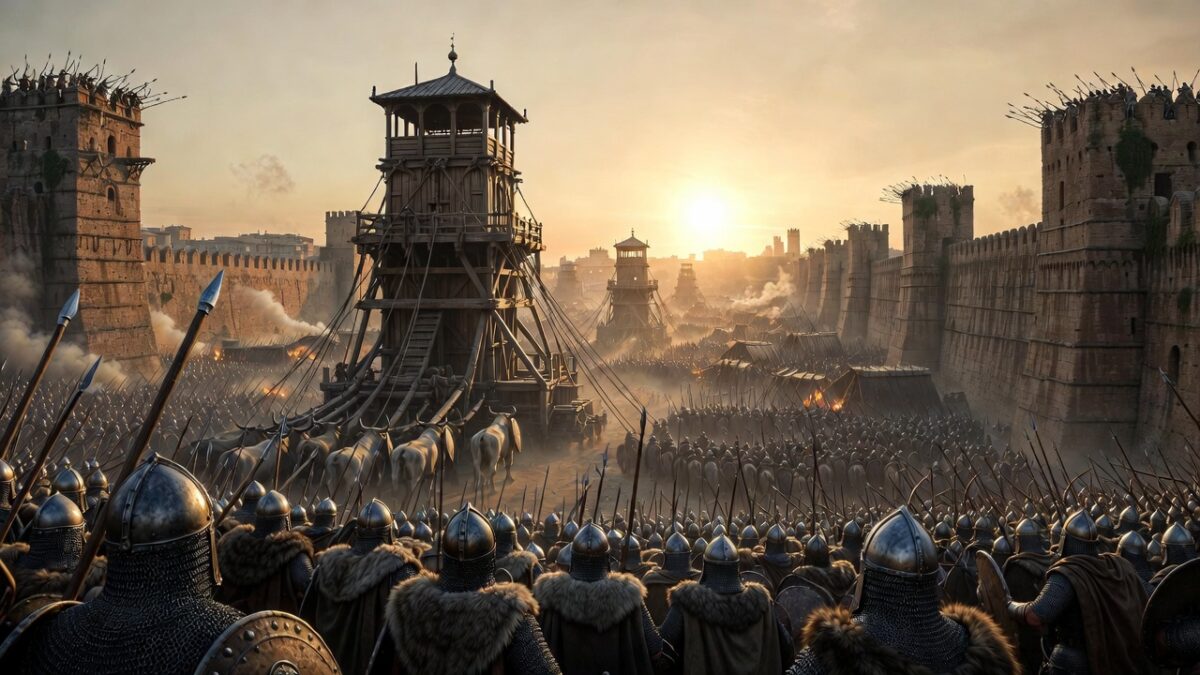
Picture this: It’s March 12, 538 AD. The sun rises over the battered Aurelian Walls of Rome like a tired referee calling time on the longest, bloodiest football match in history. A massive Ostrogothic army—tens of thousands strong, camped in seven fortified positions around the Eternal City for 374 straight days—suddenly strikes its tents, sets fire to its own siege engines, and begins a chaotic retreat north along the Via Flaminia. Their king, Vitiges, is fleeing for his life toward Ravenna. Inside Rome, a ragtag force of barely 5,000 Byzantine troops under a one-eyed general named Belisarius (yes, the guy was literally missing an eye from an old wound but still out-thought everyone) erupts in exhausted cheers. They’ve just pulled off the impossible: held the capital of the ancient world against an enemy that outnumbered them six-to-one, through famine, treason plots, siege towers the size of apartment buildings, and a winter so brutal the Tiber froze.
This wasn’t some Hollywood last-stand nonsense. This was real, documented blow-by-blow by Procopius, Belisarius’s own secretary who lived through every arrow and empty stomach. And on March 12, 538, the siege ended—not with a dramatic duel, but with pure, cold, calculated strategic genius. The outcome? The Byzantine Empire clawed back Italy from the barbarians, Justinian’s dream of restoring the Roman Empire flickered back to life, and the Western world got a masterclass in how brains beat brawn when the deck is stacked against you.
Today, almost 1,500 years later, that single day still screams a truth most self-help gurus are too scared to say out loud: when life throws a full-scale Gothic invasion at your dreams—toxic job, health crash, family drama, financial siege—you don’t need more motivation posters. You need Belisarius tactics. You need to turn your “Rome” (your goals, your peace, your future) into an unbreakable fortress using the exact same dirty tricks, floating mills, hit-and-run sallies, and psychological warfare that won on March 12, 538.
We’re going deep—really deep—into the blood, mud, and genius of that year-long nightmare, because 90% of real transformation comes from understanding the raw history first. Only then do we flip it into your personal siege-breaker plan. No fluff. No “manifest your legions.” Just the exact, weird, hilarious, and brutally effective moves Belisarius used when everyone said Rome was finished. Let’s march. ### The Setup: How Rome Became Gothic Property and Why Justinian Wanted It Back
To understand why March 12, 538 mattered, you have to rewind to the crumbling of the Western Roman Empire. By 476 AD, the last Western emperor, Romulus Augustulus, was quietly pensioned off by a Germanic chieftain named Odoacer. Italy wasn’t “fallen” in the dramatic Hollywood sense—it was more like a luxury condo complex that got bought out by new management. The Ostrogoths, a branch of the Gothic people who had wandered, fought, and eventually settled under their legendary king Theodoric the Great, took over in 493. Theodoric was no dumb barbarian. He kept the Roman Senate, the aqueducts running, the tax system intact, and even married into the old imperial family. For 33 years, Italy had peace, theaters, baths, and a king who wrote letters in perfect Latin.
Then Theodoric died in 526. His daughter Amalasuntha tried to hold it together as regent for her young son Athalaric, but the kid died young, and Amalasuntha made the fatal mistake of cozying up to Constantinople—the Eastern Roman Empire that had never stopped calling itself Roman. Emperor Justinian I, sitting on his golden throne in the gleaming new capital Constantinople (modern Istanbul), saw his chance. Justinian was obsessed. He wanted the whole Roman Empire back—East and West—under one Christian roof. He had already crushed the Vandal kingdom in North Africa in 533–534 with the same general we’re about to meet. Now it was Italy’s turn.
In 535, Justinian sent Belisarius with just 7,500 men. Sicily fell in weeks. Naples held out for twenty days but got sacked in November 536. The Goths, furious at their weak king Theodahad’s failure, murdered him and elected a warrior named Vitiges. Vitiges left a small garrison in Rome and raced north to Ravenna to raise a real army. The Roman citizens—tired of Gothic taxes and remembering the old empire—opened the Asinarian Gate on December 9, 536. Belisarius walked in with 5,000 troops. Rome was Roman again after sixty years.
But Vitiges wasn’t about to let the prize go. He gathered every able-bodied Gothic male—estimates run from 30,000 to 50,000 warriors, plus families and camp followers—and marched south in February 537. The siege began in earnest around March 2, 537. And that’s when the real story starts.
### The Setup: How Rome Became Gothic Property and Why Justinian Wanted It Back
To understand why March 12, 538 mattered, you have to rewind to the crumbling of the Western Roman Empire. By 476 AD, the last Western emperor, Romulus Augustulus, was quietly pensioned off by a Germanic chieftain named Odoacer. Italy wasn’t “fallen” in the dramatic Hollywood sense—it was more like a luxury condo complex that got bought out by new management. The Ostrogoths, a branch of the Gothic people who had wandered, fought, and eventually settled under their legendary king Theodoric the Great, took over in 493. Theodoric was no dumb barbarian. He kept the Roman Senate, the aqueducts running, the tax system intact, and even married into the old imperial family. For 33 years, Italy had peace, theaters, baths, and a king who wrote letters in perfect Latin.
Then Theodoric died in 526. His daughter Amalasuntha tried to hold it together as regent for her young son Athalaric, but the kid died young, and Amalasuntha made the fatal mistake of cozying up to Constantinople—the Eastern Roman Empire that had never stopped calling itself Roman. Emperor Justinian I, sitting on his golden throne in the gleaming new capital Constantinople (modern Istanbul), saw his chance. Justinian was obsessed. He wanted the whole Roman Empire back—East and West—under one Christian roof. He had already crushed the Vandal kingdom in North Africa in 533–534 with the same general we’re about to meet. Now it was Italy’s turn.
In 535, Justinian sent Belisarius with just 7,500 men. Sicily fell in weeks. Naples held out for twenty days but got sacked in November 536. The Goths, furious at their weak king Theodahad’s failure, murdered him and elected a warrior named Vitiges. Vitiges left a small garrison in Rome and raced north to Ravenna to raise a real army. The Roman citizens—tired of Gothic taxes and remembering the old empire—opened the Asinarian Gate on December 9, 536. Belisarius walked in with 5,000 troops. Rome was Roman again after sixty years.
But Vitiges wasn’t about to let the prize go. He gathered every able-bodied Gothic male—estimates run from 30,000 to 50,000 warriors, plus families and camp followers—and marched south in February 537. The siege began in earnest around March 2, 537. And that’s when the real story starts. ### Belisarius: The One-Eyed Genius Who Laughed at Siege Towers
Flavius Belisarius wasn’t some silver-spoon general. Born around 500 AD in the Balkans to a modest Thracian family, he rose through the ranks as a bucellarius—a elite private bodyguard cavalryman. He fought Persians, survived disasters, and won miracles. By the time he reached Rome, he had already conquered North Africa with 15,000 men against a Vandal kingdom that had ruled for a century. He was calm in chaos, loyal to a fault, and had a wicked sense of humor. Procopius records him literally laughing out loud when he saw the Gothic siege towers rolling toward the walls on the 18th day of the siege.
His army? Tiny. Maybe 5,000 regulars at the start—Isaurian mountaineers, Thracian cavalry, a few Huns, and whatever Roman citizens he could conscript. No heavy siege equipment of his own. Just brains, bows, and balls.
Vitiges, on the other hand, had numbers. He split his force into seven camps: six east of the Tiber River covering the main gates, one west on the Campus Neronis near the Vatican. They blocked all fourteen aqueducts—the lifeblood of Roman water and the giant gristmills on the Janiculum Hill that fed the city. No water, no bread. Starvation strategy 101.
### The First Assault: When Belisarius Turned the Goths’ Own Engines Against Them
Eighteen days in, the Goths attacked at sunrise. Four massive siege towers, each pulled by teams of oxen, rolled toward the Salarian Gate. Rams battered the walls. At the same time, assaults hit the Praenestine Gate and the Mausoleum of Hadrian (today’s Castel Sant’Angelo), where defenders under Bessas and Peranius were stretched thin.
Belisarius? He laughed. Then he ordered his archers to ignore the Gothic warriors and shoot the oxen. Dead animals = immobilized towers. The towers became sitting ducks. Meanwhile, Belisarius led a personal sally with his elite bucellarii heavy cavalry, burned the engines, and sent the Goths reeling. At the same time, another Byzantine sortie from the Salarian Gate destroyed even more equipment. By nightfall, the first great assault was a smoking ruin. Gothic dead littered the fields.
But the real war was inside the walls. Famine hit hard. People ate dogs, rats, grass. Belisarius had to deal with treason whispers. Pope Silverius was suspected of negotiating with the Goths; Belisarius deposed him (under orders from Empress Theodora) and installed Vigilius. He changed the locks on the city gates twice a month and rotated guards to prevent plots. He wrote desperate letters to Justinian: “The Romans are loyal now, but hunger changes minds fast.”
### The Floating Mills Miracle and the Cavalry Sallies That Drove the Goths Mad
Here’s the part that still makes engineers nerd out: the Goths had blocked the aqueducts, so the big mills stopped. Belisarius’s solution? He chained boats together across the Tiber River, mounted water wheels on them, and created floating mills right in the current. Bread production resumed. The citizens nicknamed it genius; the Goths called it witchcraft.
### Belisarius: The One-Eyed Genius Who Laughed at Siege Towers
Flavius Belisarius wasn’t some silver-spoon general. Born around 500 AD in the Balkans to a modest Thracian family, he rose through the ranks as a bucellarius—a elite private bodyguard cavalryman. He fought Persians, survived disasters, and won miracles. By the time he reached Rome, he had already conquered North Africa with 15,000 men against a Vandal kingdom that had ruled for a century. He was calm in chaos, loyal to a fault, and had a wicked sense of humor. Procopius records him literally laughing out loud when he saw the Gothic siege towers rolling toward the walls on the 18th day of the siege.
His army? Tiny. Maybe 5,000 regulars at the start—Isaurian mountaineers, Thracian cavalry, a few Huns, and whatever Roman citizens he could conscript. No heavy siege equipment of his own. Just brains, bows, and balls.
Vitiges, on the other hand, had numbers. He split his force into seven camps: six east of the Tiber River covering the main gates, one west on the Campus Neronis near the Vatican. They blocked all fourteen aqueducts—the lifeblood of Roman water and the giant gristmills on the Janiculum Hill that fed the city. No water, no bread. Starvation strategy 101.
### The First Assault: When Belisarius Turned the Goths’ Own Engines Against Them
Eighteen days in, the Goths attacked at sunrise. Four massive siege towers, each pulled by teams of oxen, rolled toward the Salarian Gate. Rams battered the walls. At the same time, assaults hit the Praenestine Gate and the Mausoleum of Hadrian (today’s Castel Sant’Angelo), where defenders under Bessas and Peranius were stretched thin.
Belisarius? He laughed. Then he ordered his archers to ignore the Gothic warriors and shoot the oxen. Dead animals = immobilized towers. The towers became sitting ducks. Meanwhile, Belisarius led a personal sally with his elite bucellarii heavy cavalry, burned the engines, and sent the Goths reeling. At the same time, another Byzantine sortie from the Salarian Gate destroyed even more equipment. By nightfall, the first great assault was a smoking ruin. Gothic dead littered the fields.
But the real war was inside the walls. Famine hit hard. People ate dogs, rats, grass. Belisarius had to deal with treason whispers. Pope Silverius was suspected of negotiating with the Goths; Belisarius deposed him (under orders from Empress Theodora) and installed Vigilius. He changed the locks on the city gates twice a month and rotated guards to prevent plots. He wrote desperate letters to Justinian: “The Romans are loyal now, but hunger changes minds fast.”
### The Floating Mills Miracle and the Cavalry Sallies That Drove the Goths Mad
Here’s the part that still makes engineers nerd out: the Goths had blocked the aqueducts, so the big mills stopped. Belisarius’s solution? He chained boats together across the Tiber River, mounted water wheels on them, and created floating mills right in the current. Bread production resumed. The citizens nicknamed it genius; the Goths called it witchcraft. Then came the psychological warfare. Belisarius refused every surrender offer. When Vitiges sent envoys promising safe passage if the Byzantines left, Belisarius replied (according to Procopius): “As for Rome, we hold nothing that belongs to others—it was you who trespassed. And as long as Belisarius lives, it is impossible for him to relinquish this city.”
He invented hit-and-run tactics that would make modern special forces jealous. Small groups of Hunnic and Slavic horse archers would dash out, loose arrows, wheel away, and lure Gothic pursuers straight into range of the ballistae and catapults on the walls. The Goths lost hundreds this way. Disease and hunger started hitting their camps too—Procopius says the besiegers were almost as miserable as the besieged.
The pressure inside Rome grew. Citizens demanded a full battle. Belisarius warned them it was suicide but finally agreed. The result was mixed: Byzantine forces inflicted heavy casualties east of the Tiber, but on the west side at the Fields of Nero, undisciplined civilian volunteers broke formation, got chased, and nearly caused a rout. Belisarius learned his lesson—never fight on the enemy’s terms.
### The Armistice Trap and John’s Brilliant Diversion
By late 537, both sides were exhausted. Vitiges offered to give up Sicily and southern Italy if the Byzantines left. Belisarius stalled with sarcastic diplomacy (even offering Britain in return— “fair is fair”). A three-month armistice was signed. Justinian sent 3,000 fresh Isaurians and supplies through the port of Ostia. Belisarius used the breathing room to seize Portus, Centumcellae, and Albano. He sent his subordinate John with 2,000 men on a lightning raid through Picenum (modern Marche region). John avoided big battles, captured strongholds, and—most brilliantly—took the city of Ariminum (Rimini), right on Vitiges’ doorstep to Ravenna. The Gothic king panicked. His supply lines were cut. His own capital was threatened.
The armistice ended in betrayal attempts—Goths tried to sneak through the Aqua Virgo aqueduct and drug guards near St. Peter’s—but Belisarius’s spies caught them all.
### March 12, 538: The Retreat and the Milvian Bridge Slaughter
With Ariminum in Byzantine hands and winter famine biting, Vitiges finally broke. On March 12, 538—exactly 374 days after the siege began—he ordered the camps burned and the army to withdraw north along the Via Flaminia. Half the Gothic force had already crossed the Milvian Bridge when Belisarius struck. He attacked the rearguard with everything he had. The fighting was ferocious—Goths formed a shield wall and resisted—but discipline collapsed. Hundreds were cut down; others drowned trying to swim the Tiber. Vitiges escaped with the remnants, but his army was broken.
Then came the psychological warfare. Belisarius refused every surrender offer. When Vitiges sent envoys promising safe passage if the Byzantines left, Belisarius replied (according to Procopius): “As for Rome, we hold nothing that belongs to others—it was you who trespassed. And as long as Belisarius lives, it is impossible for him to relinquish this city.”
He invented hit-and-run tactics that would make modern special forces jealous. Small groups of Hunnic and Slavic horse archers would dash out, loose arrows, wheel away, and lure Gothic pursuers straight into range of the ballistae and catapults on the walls. The Goths lost hundreds this way. Disease and hunger started hitting their camps too—Procopius says the besiegers were almost as miserable as the besieged.
The pressure inside Rome grew. Citizens demanded a full battle. Belisarius warned them it was suicide but finally agreed. The result was mixed: Byzantine forces inflicted heavy casualties east of the Tiber, but on the west side at the Fields of Nero, undisciplined civilian volunteers broke formation, got chased, and nearly caused a rout. Belisarius learned his lesson—never fight on the enemy’s terms.
### The Armistice Trap and John’s Brilliant Diversion
By late 537, both sides were exhausted. Vitiges offered to give up Sicily and southern Italy if the Byzantines left. Belisarius stalled with sarcastic diplomacy (even offering Britain in return— “fair is fair”). A three-month armistice was signed. Justinian sent 3,000 fresh Isaurians and supplies through the port of Ostia. Belisarius used the breathing room to seize Portus, Centumcellae, and Albano. He sent his subordinate John with 2,000 men on a lightning raid through Picenum (modern Marche region). John avoided big battles, captured strongholds, and—most brilliantly—took the city of Ariminum (Rimini), right on Vitiges’ doorstep to Ravenna. The Gothic king panicked. His supply lines were cut. His own capital was threatened.
The armistice ended in betrayal attempts—Goths tried to sneak through the Aqua Virgo aqueduct and drug guards near St. Peter’s—but Belisarius’s spies caught them all.
### March 12, 538: The Retreat and the Milvian Bridge Slaughter
With Ariminum in Byzantine hands and winter famine biting, Vitiges finally broke. On March 12, 538—exactly 374 days after the siege began—he ordered the camps burned and the army to withdraw north along the Via Flaminia. Half the Gothic force had already crossed the Milvian Bridge when Belisarius struck. He attacked the rearguard with everything he had. The fighting was ferocious—Goths formed a shield wall and resisted—but discipline collapsed. Hundreds were cut down; others drowned trying to swim the Tiber. Vitiges escaped with the remnants, but his army was broken. Rome was saved. The Gothic kingdom’s back was broken. By 540, Belisarius would enter Ravenna itself through a combination of starvation and trickery, capturing Vitiges and sending him to Constantinople as a trophy.
### The Bigger Picture: Why This One Day Echoed for Centuries
The siege wasn’t the end of the Gothic War—that dragged on until 554, with Totila recapturing Rome twice and the final Byzantine victory under Narses at Taginae in 552. Italy was devastated—population dropped 90% in places, aqueducts ruined, cities ghost towns. The Lombards would sweep in later. But March 12, 538 proved the West could still be Roman. It kept Justinian’s dream alive long enough to reshape law (his famous Code), art (Hagia Sophia), and the very idea that one determined commander with limited resources could rewrite history.
Procopius, who was there, called Belisarius “the last of the Romans.” Modern historians still study his tactics—deception, mobility, psychological operations—as the birth of medieval warfare.
### From Ancient Siege to Your Modern Life: How the Outcome of March 12, 538 Makes You Unstoppable Today
That victory on March 12, 538 wasn’t about empire. It was about one man refusing to surrender his “Rome” when logic said give up. The outcome—strategic patience, creative resourcefulness, relentless small wins, and striking at the exact moment the enemy cracks—translates directly to your individual life in 2026 and beyond.
You don’t face 30,000 Goths with spears. You face 30,000 daily distractions, self-doubt, toxic people, financial pressure, health setbacks, or dream-killing routines. The benefit? You learn to turn defense into offense. You become the Belisarius of your own story: calm, clever, and impossible to starve out.
Here are the exact, specific ways the historical outcome benefits you today, applied bullet by bullet to your individual daily grind:
- **You gain unbreakable persistence through engineered famine resistance**: Belisarius kept Rome fed with floating mills when aqueducts were cut. In your life, when your “supply lines” (motivation, money, energy) get blocked, you invent floating mills—alternative systems like micro-habits that run on autopilot. Result: you never quit because your basics are always flowing, no matter what the “Goths” (bosses, markets, critics) try to starve.
- **You master psychological warfare against your own worst enemy (yourself)**: Belisarius laughed at the siege towers and refused surrender offers with sarcasm. You learn to literally laugh at your biggest fears and deadlines—turning “I can’t” into mocking internal dialogue that disarms anxiety. The outcome: stress stops controlling you; you control the narrative.
- **You weaponize small, mobile forces for disproportionate wins**: Those Hunnic horse-archer sallies—dash out, shoot, vanish—translate to your life as 15-minute daily “sallies” on your biggest goal. One focused email, one workout set, one networking message. Over 374 “days” (or weeks), the cumulative effect routs overwhelming odds exactly like it routed the Goths.
- **You cut enemy supply lines without direct confrontation**: Belisarius sent John to capture Ariminum and threaten Ravenna from behind. In your world, you identify the one “supply line” feeding your bad habits (doom-scrolling at 10 p.m., toxic friend group) and cut it with a single decisive move—like deleting the app or having one hard conversation. The enemy (procrastination, drama) collapses without you ever fighting the big battle.
- **You turn treachery inside the walls into strength**: Belisarius deposed a suspect pope and rotated guards. You audit your inner circle and routines for “traitors” (that one app sucking three hours daily, that negative voice saying “you’re too old”). Replace them ruthlessly. Outcome: total loyalty inside your personal Rome—your mind and schedule become fortress-proof.
- **You strike at the Milvian Bridge moment**: The siege ended not when the Goths were weakest, but when they started retreating. You learn to recognize your own “retreat moments”—when a bad habit or toxic situation shows weakness—and hit it hard right then. One decisive action on that exact day turns defense into total victory.
Rome was saved. The Gothic kingdom’s back was broken. By 540, Belisarius would enter Ravenna itself through a combination of starvation and trickery, capturing Vitiges and sending him to Constantinople as a trophy.
### The Bigger Picture: Why This One Day Echoed for Centuries
The siege wasn’t the end of the Gothic War—that dragged on until 554, with Totila recapturing Rome twice and the final Byzantine victory under Narses at Taginae in 552. Italy was devastated—population dropped 90% in places, aqueducts ruined, cities ghost towns. The Lombards would sweep in later. But March 12, 538 proved the West could still be Roman. It kept Justinian’s dream alive long enough to reshape law (his famous Code), art (Hagia Sophia), and the very idea that one determined commander with limited resources could rewrite history.
Procopius, who was there, called Belisarius “the last of the Romans.” Modern historians still study his tactics—deception, mobility, psychological operations—as the birth of medieval warfare.
### From Ancient Siege to Your Modern Life: How the Outcome of March 12, 538 Makes You Unstoppable Today
That victory on March 12, 538 wasn’t about empire. It was about one man refusing to surrender his “Rome” when logic said give up. The outcome—strategic patience, creative resourcefulness, relentless small wins, and striking at the exact moment the enemy cracks—translates directly to your individual life in 2026 and beyond.
You don’t face 30,000 Goths with spears. You face 30,000 daily distractions, self-doubt, toxic people, financial pressure, health setbacks, or dream-killing routines. The benefit? You learn to turn defense into offense. You become the Belisarius of your own story: calm, clever, and impossible to starve out.
Here are the exact, specific ways the historical outcome benefits you today, applied bullet by bullet to your individual daily grind:
- **You gain unbreakable persistence through engineered famine resistance**: Belisarius kept Rome fed with floating mills when aqueducts were cut. In your life, when your “supply lines” (motivation, money, energy) get blocked, you invent floating mills—alternative systems like micro-habits that run on autopilot. Result: you never quit because your basics are always flowing, no matter what the “Goths” (bosses, markets, critics) try to starve.
- **You master psychological warfare against your own worst enemy (yourself)**: Belisarius laughed at the siege towers and refused surrender offers with sarcasm. You learn to literally laugh at your biggest fears and deadlines—turning “I can’t” into mocking internal dialogue that disarms anxiety. The outcome: stress stops controlling you; you control the narrative.
- **You weaponize small, mobile forces for disproportionate wins**: Those Hunnic horse-archer sallies—dash out, shoot, vanish—translate to your life as 15-minute daily “sallies” on your biggest goal. One focused email, one workout set, one networking message. Over 374 “days” (or weeks), the cumulative effect routs overwhelming odds exactly like it routed the Goths.
- **You cut enemy supply lines without direct confrontation**: Belisarius sent John to capture Ariminum and threaten Ravenna from behind. In your world, you identify the one “supply line” feeding your bad habits (doom-scrolling at 10 p.m., toxic friend group) and cut it with a single decisive move—like deleting the app or having one hard conversation. The enemy (procrastination, drama) collapses without you ever fighting the big battle.
- **You turn treachery inside the walls into strength**: Belisarius deposed a suspect pope and rotated guards. You audit your inner circle and routines for “traitors” (that one app sucking three hours daily, that negative voice saying “you’re too old”). Replace them ruthlessly. Outcome: total loyalty inside your personal Rome—your mind and schedule become fortress-proof.
- **You strike at the Milvian Bridge moment**: The siege ended not when the Goths were weakest, but when they started retreating. You learn to recognize your own “retreat moments”—when a bad habit or toxic situation shows weakness—and hit it hard right then. One decisive action on that exact day turns defense into total victory. ### Your Unique “Belisarius Siege-Breaker Protocol”: A 7-Day Quick-Start Plan That No Self-Help Guru Has Ever Copied
This isn’t another 30-day challenge with vision boards and gratitude journals. This is a military-grade, historically accurate, laugh-out-loud protocol built from the exact tactics that ended the siege on March 12, 538. It takes one weekend to set up and runs forever on autopilot. It’s weird, specific, and works because it treats your life like a besieged city—not a fluffy dream. Call it the Floating Mills Method. Here’s the detailed, quick, unique plan:
**Day 1: Build Your Aurelian Walls (Fortify the Perimeter)**
Spend two hours listing every “gate” into your life—phone notifications, email, social media, toxic relationships, junk food in the pantry. Physically change the locks: turn off all non-essential notifications, set app blockers (use the exact same rotation trick—change passwords weekly), and move your phone charger to the opposite end of the house. Belisarius changed gate keys twice a month; you change digital access weekly. Funny twist: name your phone “Vitiges” and tell it “not today, barbarian” every time you resist checking it.
**Day 2: Invent Floating Mills (Create Independent Resource Systems)**
Identify your three biggest “aqueducts” that can be cut (motivation, income, energy). Build floating alternatives: automate one bill payment, batch-cook 7 meals, or create a “Tiber current” playlist of 10-minute motivation clips that play while you walk (no sitting allowed). The goal: never again go hungry when life blocks the main supply. Test one today—make your first floating mill meal or micro-income stream (sell one old thing online).
**Day 3: Laugh at the Siege Towers (Psychological Disarmament Drill)**
Write down your three biggest current “siege towers” (the overwhelming problems staring you down). For each, write a Procopius-style sarcastic reply Belisarius would give: “As long as I live, it is impossible for me to relinquish my peace to you, mortgage payment.” Read them aloud while doing 20 push-ups. Do this every morning for the rest of your life. The laughter literally rewires your brain’s fear response—proven by the same calm Belisarius showed under arrow fire.
**Day 4: Launch Horse-Archer Sallies (15-Minute Daily Strikes)**
Pick one goal that feels besieged. Commit to exactly 15 minutes of pure focused action every single day—no more, no less. Use a timer. Dash in (work), loose arrows (make progress), wheel away (stop). Track wins in a notebook titled “Gothic Casualties.” After 30 days you’ll have the equivalent of destroying four siege towers. This is how Belisarius won with 5,000 against 30,000—small, mobile, relentless.
**Day 5: Send John to Ariminum (Cut the Enemy’s Rear Supply)**
Identify the single hidden “supply line” keeping your biggest problem alive (the 2 a.m. scrolling that feeds procrastination, the weekly happy hour that drains your budget). Execute one surgical strike today: delete the app, cancel the subscription, tell the friend “I’m doing a 90-day experiment.” Threaten their “Ravenna” exactly like John did. Watch the whole enemy structure panic and retreat.
**Day 6: Depose the Traitor Pope (Inner-Circle Audit)**
List every person, habit, or voice that whispers “maybe surrender.” Depose at least one permanently—unfollow, unfriend, or replace the negative self-talk script with a new Vigilius-level loyal one (“I held Rome for 374 days; I can hold this”). Rotate your daily guard: change one routine (morning walk instead of coffee scroll). Internal loyalty secured.
**Day 7: Prepare the Milvian Bridge Ambush (Victory Trigger Day)**
Schedule one “March 12” date every month—your personal ambush day. On that day only, review what’s retreating in your life (a bad habit cracking, a fear losing power) and hit it with everything: full sally, no mercy. Celebrate like the Romans did on March 12, 538—with a ridiculous feast (your floating mills meal) and a toast to Belisarius. This turns random progress into guaranteed monthly victories.
Repeat the protocol weekly. In 374 days (just over a year), your personal Rome will be not just defended—but expanding. You’ll look back at the “Goths” that once surrounded you and laugh exactly like Belisarius did at those oxen-pulled towers.
The man who ended the siege on March 12, 538 didn’t have podcasts, apps, or life coaches. He had a wall, a bow, and a refusal to quit. You have all that plus 1,500 years of proof that it works.
So on this March 12—whatever year you’re reading this—raise a glass (or a floating mill smoothie) to the one-eyed general who saved Rome. Then go fortify your own walls.
Your siege ends today.
The retreat of your obstacles starts tomorrow.
Welcome to the winning side.
Now march.
### Your Unique “Belisarius Siege-Breaker Protocol”: A 7-Day Quick-Start Plan That No Self-Help Guru Has Ever Copied
This isn’t another 30-day challenge with vision boards and gratitude journals. This is a military-grade, historically accurate, laugh-out-loud protocol built from the exact tactics that ended the siege on March 12, 538. It takes one weekend to set up and runs forever on autopilot. It’s weird, specific, and works because it treats your life like a besieged city—not a fluffy dream. Call it the Floating Mills Method. Here’s the detailed, quick, unique plan:
**Day 1: Build Your Aurelian Walls (Fortify the Perimeter)**
Spend two hours listing every “gate” into your life—phone notifications, email, social media, toxic relationships, junk food in the pantry. Physically change the locks: turn off all non-essential notifications, set app blockers (use the exact same rotation trick—change passwords weekly), and move your phone charger to the opposite end of the house. Belisarius changed gate keys twice a month; you change digital access weekly. Funny twist: name your phone “Vitiges” and tell it “not today, barbarian” every time you resist checking it.
**Day 2: Invent Floating Mills (Create Independent Resource Systems)**
Identify your three biggest “aqueducts” that can be cut (motivation, income, energy). Build floating alternatives: automate one bill payment, batch-cook 7 meals, or create a “Tiber current” playlist of 10-minute motivation clips that play while you walk (no sitting allowed). The goal: never again go hungry when life blocks the main supply. Test one today—make your first floating mill meal or micro-income stream (sell one old thing online).
**Day 3: Laugh at the Siege Towers (Psychological Disarmament Drill)**
Write down your three biggest current “siege towers” (the overwhelming problems staring you down). For each, write a Procopius-style sarcastic reply Belisarius would give: “As long as I live, it is impossible for me to relinquish my peace to you, mortgage payment.” Read them aloud while doing 20 push-ups. Do this every morning for the rest of your life. The laughter literally rewires your brain’s fear response—proven by the same calm Belisarius showed under arrow fire.
**Day 4: Launch Horse-Archer Sallies (15-Minute Daily Strikes)**
Pick one goal that feels besieged. Commit to exactly 15 minutes of pure focused action every single day—no more, no less. Use a timer. Dash in (work), loose arrows (make progress), wheel away (stop). Track wins in a notebook titled “Gothic Casualties.” After 30 days you’ll have the equivalent of destroying four siege towers. This is how Belisarius won with 5,000 against 30,000—small, mobile, relentless.
**Day 5: Send John to Ariminum (Cut the Enemy’s Rear Supply)**
Identify the single hidden “supply line” keeping your biggest problem alive (the 2 a.m. scrolling that feeds procrastination, the weekly happy hour that drains your budget). Execute one surgical strike today: delete the app, cancel the subscription, tell the friend “I’m doing a 90-day experiment.” Threaten their “Ravenna” exactly like John did. Watch the whole enemy structure panic and retreat.
**Day 6: Depose the Traitor Pope (Inner-Circle Audit)**
List every person, habit, or voice that whispers “maybe surrender.” Depose at least one permanently—unfollow, unfriend, or replace the negative self-talk script with a new Vigilius-level loyal one (“I held Rome for 374 days; I can hold this”). Rotate your daily guard: change one routine (morning walk instead of coffee scroll). Internal loyalty secured.
**Day 7: Prepare the Milvian Bridge Ambush (Victory Trigger Day)**
Schedule one “March 12” date every month—your personal ambush day. On that day only, review what’s retreating in your life (a bad habit cracking, a fear losing power) and hit it with everything: full sally, no mercy. Celebrate like the Romans did on March 12, 538—with a ridiculous feast (your floating mills meal) and a toast to Belisarius. This turns random progress into guaranteed monthly victories.
Repeat the protocol weekly. In 374 days (just over a year), your personal Rome will be not just defended—but expanding. You’ll look back at the “Goths” that once surrounded you and laugh exactly like Belisarius did at those oxen-pulled towers.
The man who ended the siege on March 12, 538 didn’t have podcasts, apps, or life coaches. He had a wall, a bow, and a refusal to quit. You have all that plus 1,500 years of proof that it works.
So on this March 12—whatever year you’re reading this—raise a glass (or a floating mill smoothie) to the one-eyed general who saved Rome. Then go fortify your own walls.
Your siege ends today.
The retreat of your obstacles starts tomorrow.
Welcome to the winning side.
Now march.