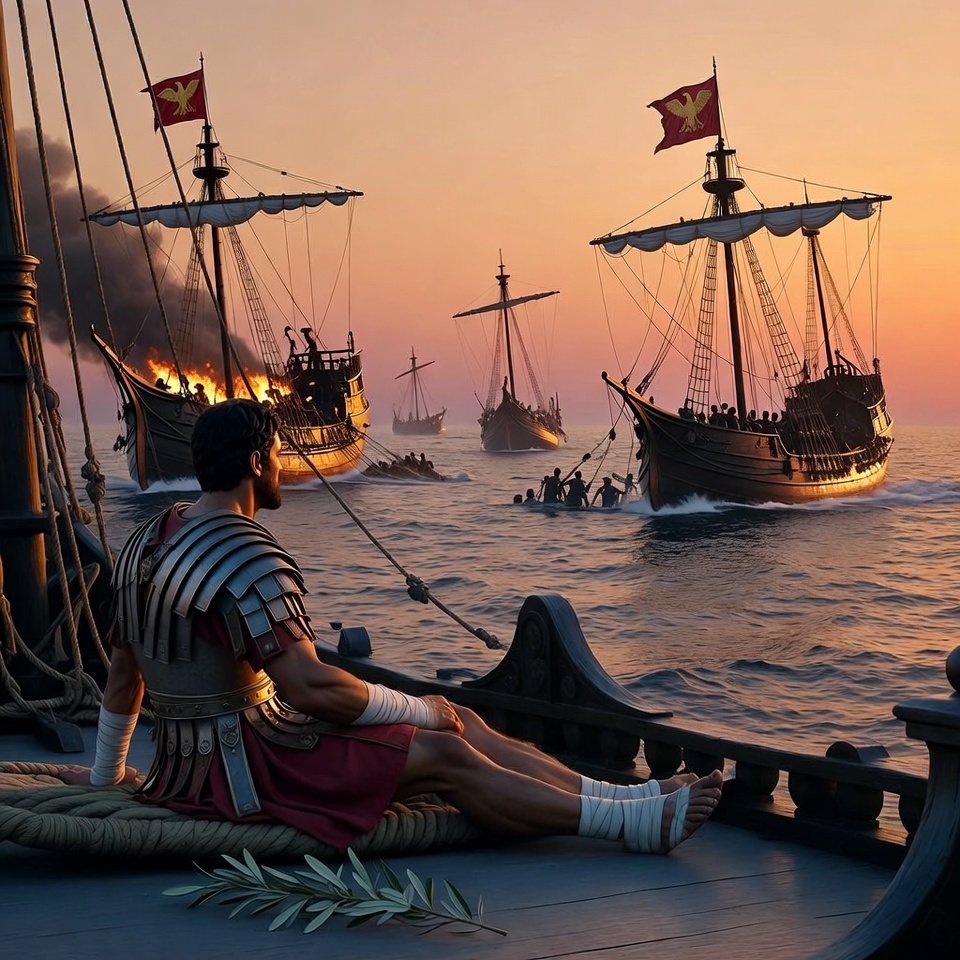
Imagine the Mediterranean on March 10, 241 BC: a howling west wind whipping up heavy swells that could swallow a man whole, bronze rams glinting under the spray, and 450 massive warships slamming together in a chaos of splintered oars, screaming rowers, and marines leaping like angry gladiators on floating death traps. On one side, the mighty Carthaginian fleet—seasoned sailors from the ancient world's greatest trading empire, loaded down with grain, weapons, and supplies like they were heading to the world's biggest tailgate party. On the other? The Romans. Yeah, those Romans. The guys who started this war as total landlubbers who probably got seasick watching a puddle ripple. By sunset, over 120 Carthaginian ships were either sunk, captured, or fleeing in panic. Ten thousand enemy sailors and soldiers hauled off in chains. The 23-year nightmare known as the First Punic War? Over. Carthage broken. Rome suddenly the undisputed naval boss of the western Mediterranean, on its way to ruling half the known world.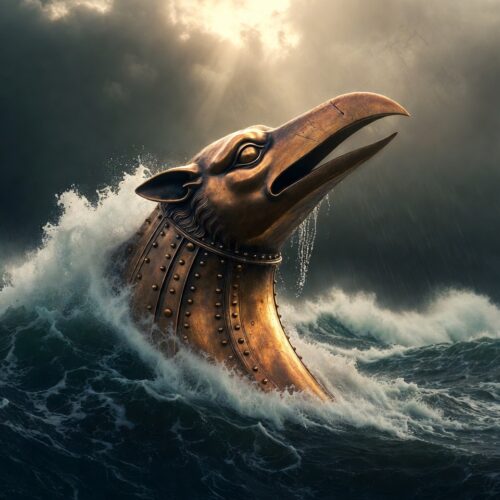 This wasn't some footnote skirmish. It was the thunderous finale that turned Rome from a scrappy Italian city-state into an empire-building machine. And buried in the spray and the screams and the brilliant Roman comeback is a raw, practical truth that hits harder than a 270-kilogram bronze ram to the hull: no matter how long your personal struggle drags on—decades of setbacks, near-bankruptcies, storms that wipe out everything—you can still win it all with one perfectly timed, brutally prepared strike. Today, that ancient naval massacre isn't dusty history. It's your personal blueprint for turning exhaustion into empire. Stick with me through the gory, hilarious, mind-blowing details of how a bunch of rookies out-sailed the pros, and you'll walk away with bullet-point benefits you can apply tomorrow plus a quick, never-seen-before plan that laughs in the face of every generic self-help hustle.
Let's rewind to the spark that lit this 23-year inferno, because you can't appreciate the Aegates triumph without feeling the full weight of the grind. It all kicked off in 264 BC over a dusty Sicilian town called Messana (modern Messina). A gang of Italian mercenaries called the Mamertines had seized the place, then got squeezed between the armies of Syracuse and Carthage. They played both superpowers like a fiddle, appealing to Rome for help. Rome, fresh off unifying most of Italy, smelled opportunity and sent two legions—about 40,000 infantry and 2,400 cavalry—under Consul Appius Claudius Caudex. They booted the Carthaginian garrison and suddenly found themselves at war with the Mediterranean's top naval dog.
Carthage was no joke. Founded centuries earlier by Phoenician traders from Tyre, it controlled North African ports, Spanish silver mines, and a navy that could deliver elephants and mercenaries anywhere. Their ships were faster, their crews professional, their strategy simple: keep the war on the sea and supply their Sicilian fortresses while Rome bled on land. Rome? They had legions that could march forever in manipular formation—heavy infantry with big shields, short swords, and javelins—but zero naval tradition. Their first attempt at a fleet in 260 BC was straight comedy. They copied a wrecked Carthaginian quinquereme that washed ashore (picture stealing your neighbor's IKEA manual and scaling it up). These beasts were monsters: 45 meters long, 5 meters wide, 100 tonnes, powered by 168 oars in three banks with five rowers per oar file. Top speed maybe 8.5 knots if the rowers weren't half-dead. Rome built 120 of them in record time and added the corvus—a crazy 11-meter boarding bridge with a massive iron spike that dropped like a guillotine onto enemy decks. "Land battle at sea!" the Romans cheered. It was duct-tape engineering at its finest.
This wasn't some footnote skirmish. It was the thunderous finale that turned Rome from a scrappy Italian city-state into an empire-building machine. And buried in the spray and the screams and the brilliant Roman comeback is a raw, practical truth that hits harder than a 270-kilogram bronze ram to the hull: no matter how long your personal struggle drags on—decades of setbacks, near-bankruptcies, storms that wipe out everything—you can still win it all with one perfectly timed, brutally prepared strike. Today, that ancient naval massacre isn't dusty history. It's your personal blueprint for turning exhaustion into empire. Stick with me through the gory, hilarious, mind-blowing details of how a bunch of rookies out-sailed the pros, and you'll walk away with bullet-point benefits you can apply tomorrow plus a quick, never-seen-before plan that laughs in the face of every generic self-help hustle.
Let's rewind to the spark that lit this 23-year inferno, because you can't appreciate the Aegates triumph without feeling the full weight of the grind. It all kicked off in 264 BC over a dusty Sicilian town called Messana (modern Messina). A gang of Italian mercenaries called the Mamertines had seized the place, then got squeezed between the armies of Syracuse and Carthage. They played both superpowers like a fiddle, appealing to Rome for help. Rome, fresh off unifying most of Italy, smelled opportunity and sent two legions—about 40,000 infantry and 2,400 cavalry—under Consul Appius Claudius Caudex. They booted the Carthaginian garrison and suddenly found themselves at war with the Mediterranean's top naval dog.
Carthage was no joke. Founded centuries earlier by Phoenician traders from Tyre, it controlled North African ports, Spanish silver mines, and a navy that could deliver elephants and mercenaries anywhere. Their ships were faster, their crews professional, their strategy simple: keep the war on the sea and supply their Sicilian fortresses while Rome bled on land. Rome? They had legions that could march forever in manipular formation—heavy infantry with big shields, short swords, and javelins—but zero naval tradition. Their first attempt at a fleet in 260 BC was straight comedy. They copied a wrecked Carthaginian quinquereme that washed ashore (picture stealing your neighbor's IKEA manual and scaling it up). These beasts were monsters: 45 meters long, 5 meters wide, 100 tonnes, powered by 168 oars in three banks with five rowers per oar file. Top speed maybe 8.5 knots if the rowers weren't half-dead. Rome built 120 of them in record time and added the corvus—a crazy 11-meter boarding bridge with a massive iron spike that dropped like a guillotine onto enemy decks. "Land battle at sea!" the Romans cheered. It was duct-tape engineering at its finest.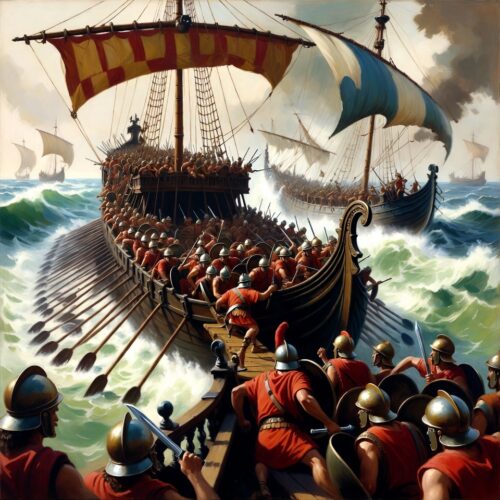 The early years were a rollercoaster of epic wins, humiliating losses, and nature's cruel jokes. In 260 BC at the Battle of Mylae, Consul Gaius Duilius used the corvus to turn naval warfare into a Roman street fight. Hannibal Gisco's 130 Carthaginian ships got boarded and captured 30 or more; the rest fled. Duilius paraded through Rome with the first naval triumph, complete with captured bronze rams nailed to the speaker's platform. But Carthage struck back. Storms in 255 BC and 253 BC devoured entire Roman fleets—384 ships and over 100,000 men in one go. Imagine training for years, sailing off to invade Africa, then watching your entire navy smashed by waves like the gods themselves were Carthaginian fans. Rome rebuilt anyway. They captured Panormus (Palermo) in 254 BC, sold 13,000 locals into slavery, and kept pushing.
The African invasion of 256 BC was pure Hollywood. Consuls Regulus and Vulso took 330 warships and 26,000 troops, landed near Aspis, and marched on Carthage itself. They crushed a Carthaginian army at Adys, then another at Tunis. Carthage panicked and offered peace. Regulus got greedy with insane terms, so Carthage hired a Spartan mercenary named Xanthippus. In 255 BC at the Bagradas River, those 100 war elephants stomped the Roman legions into the dirt. Regulus was captured (later tortured to death in legend). The Roman evacuation fleet won at Cape Hermaeum but got annihilated by another storm. Total body count by now? Appalling. Rome lost something like 17 percent of its adult male citizens across the war—fathers, sons, brothers gone.
The early years were a rollercoaster of epic wins, humiliating losses, and nature's cruel jokes. In 260 BC at the Battle of Mylae, Consul Gaius Duilius used the corvus to turn naval warfare into a Roman street fight. Hannibal Gisco's 130 Carthaginian ships got boarded and captured 30 or more; the rest fled. Duilius paraded through Rome with the first naval triumph, complete with captured bronze rams nailed to the speaker's platform. But Carthage struck back. Storms in 255 BC and 253 BC devoured entire Roman fleets—384 ships and over 100,000 men in one go. Imagine training for years, sailing off to invade Africa, then watching your entire navy smashed by waves like the gods themselves were Carthaginian fans. Rome rebuilt anyway. They captured Panormus (Palermo) in 254 BC, sold 13,000 locals into slavery, and kept pushing.
The African invasion of 256 BC was pure Hollywood. Consuls Regulus and Vulso took 330 warships and 26,000 troops, landed near Aspis, and marched on Carthage itself. They crushed a Carthaginian army at Adys, then another at Tunis. Carthage panicked and offered peace. Regulus got greedy with insane terms, so Carthage hired a Spartan mercenary named Xanthippus. In 255 BC at the Bagradas River, those 100 war elephants stomped the Roman legions into the dirt. Regulus was captured (later tortured to death in legend). The Roman evacuation fleet won at Cape Hermaeum but got annihilated by another storm. Total body count by now? Appalling. Rome lost something like 17 percent of its adult male citizens across the war—fathers, sons, brothers gone.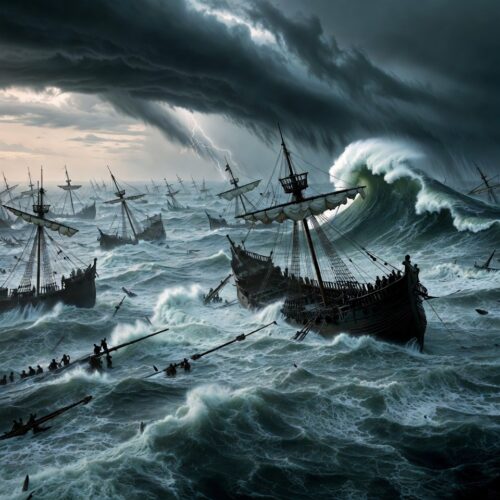 Carthage wasn't exactly thriving either. Their diverse armies—North African phalanxes, Spanish swordsmen, Gallic wildmen, Balearic slingers, and those temperamental elephants—cost a fortune. Blockade runners like the legendary Hannibal the Rhodian taunted the Romans, slipping supplies into Lilybaeum with just 50 ships, unloading 4,000 to 10,000 men, then escaping with style. But by 249 BC, Rome's blockade at Lilybaeum and Drepana looked unbreakable. Then disaster: Consul Publius Claudius Pulcher attacked the Carthaginian fleet at Drepana at night and got wrecked because he ignored the sacred chickens (yes, really—Roman augury). His colleague lost another fleet at Phintias. Sea control flipped back to Carthage. Rome, broke and exhausted, scaled back to small raids for seven long years.
Enter Hamilcar Barca in 247 BC—father of the future Hannibal and the greatest Carthaginian general of the war. He set up a guerrilla base on Mount Eryx, raiding Roman supply lines like a Sicilian ninja. Fabian tactics before Fabius: hit and run, preserve your footholds at Lilybaeum and Drepana, make Rome bleed money and morale. Both sides were nearly bankrupt. Carthage tried borrowing 2,000 talents from Egypt and got laughed at. Rome's citizen manpower was gutted. The war had dragged longer than any continuous conflict in ancient history—longer than most people lived.
Then came the Roman miracle of 243 BC. Instead of quitting, the Senate asked wealthy citizens to privately fund an entirely new fleet of 200 quinqueremes—one ship per rich donor, with repayment promised from future reparations. No more corvus weighing them down; these ships were lighter, faster, better handled, modeled on the best captured Carthaginian runners. Crews trained relentlessly. They blockaded Lilybaeum and Drepana tighter than ever. Carthage, sensing the end, scraped together every last resource. They assembled 250 warships under a commander named Hanno (son of Hannibal, possibly already on thin ice after earlier flops). The plan: sail secretly to the Aegates Islands off western Sicily, wait for a favorable wind, dash 45 kilometers to resupply the garrisons with grain and gear, pick up fresh marines from Hamilcar's army, then fight on even terms.
It was a solid plan—except the Romans were watching. Proconsul Gaius Lutatius Catulus (wounded but still commanding from a litter) and his deputy Quintus Valerius Falto had 200 ships ready. They added extra marines from the land army besieging the ports. Their crews were veterans now, not rookies. The Carthaginian ships, by contrast, were crammed with supplies—slower, less maneuverable, undermanned because Carthage had scraped the barrel for rowers and couldn't spare full marine complements.
Dawn on March 10, 241 BC. The west wind howled. Carthaginian scouts spotted the Roman fleet anchored near Aegusa (modern Favignana). Hanno ordered the dash anyway, sails down, rowing hard with the wind at their backs toward Lilybaeum. The Romans saw them coming. Catulus—bedridden but brilliant—gave the order: strip the masts and sails for battle readiness, form a single line, and row straight into the teeth of the gale and swells. No fancy corvus this time. Pure ramming and boarding with superior training and lighter ships.
Carthage wasn't exactly thriving either. Their diverse armies—North African phalanxes, Spanish swordsmen, Gallic wildmen, Balearic slingers, and those temperamental elephants—cost a fortune. Blockade runners like the legendary Hannibal the Rhodian taunted the Romans, slipping supplies into Lilybaeum with just 50 ships, unloading 4,000 to 10,000 men, then escaping with style. But by 249 BC, Rome's blockade at Lilybaeum and Drepana looked unbreakable. Then disaster: Consul Publius Claudius Pulcher attacked the Carthaginian fleet at Drepana at night and got wrecked because he ignored the sacred chickens (yes, really—Roman augury). His colleague lost another fleet at Phintias. Sea control flipped back to Carthage. Rome, broke and exhausted, scaled back to small raids for seven long years.
Enter Hamilcar Barca in 247 BC—father of the future Hannibal and the greatest Carthaginian general of the war. He set up a guerrilla base on Mount Eryx, raiding Roman supply lines like a Sicilian ninja. Fabian tactics before Fabius: hit and run, preserve your footholds at Lilybaeum and Drepana, make Rome bleed money and morale. Both sides were nearly bankrupt. Carthage tried borrowing 2,000 talents from Egypt and got laughed at. Rome's citizen manpower was gutted. The war had dragged longer than any continuous conflict in ancient history—longer than most people lived.
Then came the Roman miracle of 243 BC. Instead of quitting, the Senate asked wealthy citizens to privately fund an entirely new fleet of 200 quinqueremes—one ship per rich donor, with repayment promised from future reparations. No more corvus weighing them down; these ships were lighter, faster, better handled, modeled on the best captured Carthaginian runners. Crews trained relentlessly. They blockaded Lilybaeum and Drepana tighter than ever. Carthage, sensing the end, scraped together every last resource. They assembled 250 warships under a commander named Hanno (son of Hannibal, possibly already on thin ice after earlier flops). The plan: sail secretly to the Aegates Islands off western Sicily, wait for a favorable wind, dash 45 kilometers to resupply the garrisons with grain and gear, pick up fresh marines from Hamilcar's army, then fight on even terms.
It was a solid plan—except the Romans were watching. Proconsul Gaius Lutatius Catulus (wounded but still commanding from a litter) and his deputy Quintus Valerius Falto had 200 ships ready. They added extra marines from the land army besieging the ports. Their crews were veterans now, not rookies. The Carthaginian ships, by contrast, were crammed with supplies—slower, less maneuverable, undermanned because Carthage had scraped the barrel for rowers and couldn't spare full marine complements.
Dawn on March 10, 241 BC. The west wind howled. Carthaginian scouts spotted the Roman fleet anchored near Aegusa (modern Favignana). Hanno ordered the dash anyway, sails down, rowing hard with the wind at their backs toward Lilybaeum. The Romans saw them coming. Catulus—bedridden but brilliant—gave the order: strip the masts and sails for battle readiness, form a single line, and row straight into the teeth of the gale and swells. No fancy corvus this time. Pure ramming and boarding with superior training and lighter ships.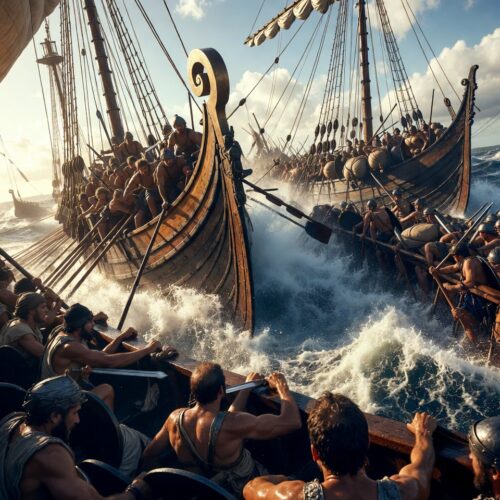 The clash was brutal. Roman squadrons maneuvered like wolves, targeting sides and sterns to avoid head-on collisions that could lock rams. Bronze beaks—each 60 centimeters wide and weighing up to 270 kilograms—smashed through Carthaginian hulls. Oars snapped like toothpicks. Marines poured across decks in close-quarters slaughter. Fifty Carthaginian ships went down with all hands. Seventy more were captured, their 10,000 crewmen taken prisoner. The Romans lost only 30 sunk and 50 damaged. A sudden wind shift let some Carthaginian survivors limp away, but it was over. Hanno reportedly got crucified back home for the disaster—Carthage's go-to performance review.
The next day, Hamilcar Barca sent a messenger offering surrender terms. Catulus dictated the Treaty of Lutatius: Carthage evacuated all of Sicily except Syracuse, paid 3,200 talents of silver over ten years (a staggering sum—millions in today's money), returned prisoners, and promised not to wage war in Italy or recruit there. Rome had its first overseas province. Sicily's grain would feed the growing empire for centuries. Catulus celebrated by building a temple to Juturna. Both he and Falto got full triumphs.
Polybius, writing 100 years later in his Histories, called it the decisive turning point. He had interviewed survivors and pored over lost records. His verdict rings true: Rome won not because they were natural sailors but because they adapted relentlessly—copying designs, inventing the corvus, ditching it when it became a liability, rebuilding fleets after apocalyptic storms, and mobilizing private wealth when the state treasury ran dry. Carthage had better initial ships and crews but relied on mercenaries, got complacent after early naval wins, and failed to match Roman grit and innovation. The war cost both sides hundreds of thousands of lives and fleets that totaled over 1,000 ships built by Rome alone. But that single day off the Aegates Islands—March 10, 241 BC—flipped the entire Mediterranean power balance. Rome would dominate naval warfare for the next 600 years. Carthage? It sparked their Mercenary War immediately after, then the Second Punic War with Hannibal, and eventual destruction in 146 BC.
Archaeologists diving since 2010 off Levanzo have pulled up 24 bronze rams, helmets, and amphorae exactly where Polybius described—silent witnesses to the carnage. Some rams show Roman markings; others Carthaginian. The site proves the fleets fought in rough water exactly as described. No Hollywood exaggeration needed.
Now here's where this ancient smackdown stops being a dusty textbook chapter and starts being your unfair advantage in 2026. The outcome of that March 10 bloodbath wasn't luck. It was the payoff of 23 years of stubborn reinvention, massive private investment, relentless training, and one perfectly executed final charge into the wind. You carry that same power in your own life. Your "23-year war" might be a stalled career, a health battle, a creative dream that keeps getting blockaded, or a financial siege that feels eternal. The Aegates lesson screams that exhaustion is not defeat—it's the setup for the decisive strike. Rome didn't win by being perfect sailors from day one. They won by turning every disaster into a better ship, every loss into sharper tactics, and showing up with a lighter, faster fleet when the enemy was weighed down by old habits and half-measures.
The clash was brutal. Roman squadrons maneuvered like wolves, targeting sides and sterns to avoid head-on collisions that could lock rams. Bronze beaks—each 60 centimeters wide and weighing up to 270 kilograms—smashed through Carthaginian hulls. Oars snapped like toothpicks. Marines poured across decks in close-quarters slaughter. Fifty Carthaginian ships went down with all hands. Seventy more were captured, their 10,000 crewmen taken prisoner. The Romans lost only 30 sunk and 50 damaged. A sudden wind shift let some Carthaginian survivors limp away, but it was over. Hanno reportedly got crucified back home for the disaster—Carthage's go-to performance review.
The next day, Hamilcar Barca sent a messenger offering surrender terms. Catulus dictated the Treaty of Lutatius: Carthage evacuated all of Sicily except Syracuse, paid 3,200 talents of silver over ten years (a staggering sum—millions in today's money), returned prisoners, and promised not to wage war in Italy or recruit there. Rome had its first overseas province. Sicily's grain would feed the growing empire for centuries. Catulus celebrated by building a temple to Juturna. Both he and Falto got full triumphs.
Polybius, writing 100 years later in his Histories, called it the decisive turning point. He had interviewed survivors and pored over lost records. His verdict rings true: Rome won not because they were natural sailors but because they adapted relentlessly—copying designs, inventing the corvus, ditching it when it became a liability, rebuilding fleets after apocalyptic storms, and mobilizing private wealth when the state treasury ran dry. Carthage had better initial ships and crews but relied on mercenaries, got complacent after early naval wins, and failed to match Roman grit and innovation. The war cost both sides hundreds of thousands of lives and fleets that totaled over 1,000 ships built by Rome alone. But that single day off the Aegates Islands—March 10, 241 BC—flipped the entire Mediterranean power balance. Rome would dominate naval warfare for the next 600 years. Carthage? It sparked their Mercenary War immediately after, then the Second Punic War with Hannibal, and eventual destruction in 146 BC.
Archaeologists diving since 2010 off Levanzo have pulled up 24 bronze rams, helmets, and amphorae exactly where Polybius described—silent witnesses to the carnage. Some rams show Roman markings; others Carthaginian. The site proves the fleets fought in rough water exactly as described. No Hollywood exaggeration needed.
Now here's where this ancient smackdown stops being a dusty textbook chapter and starts being your unfair advantage in 2026. The outcome of that March 10 bloodbath wasn't luck. It was the payoff of 23 years of stubborn reinvention, massive private investment, relentless training, and one perfectly executed final charge into the wind. You carry that same power in your own life. Your "23-year war" might be a stalled career, a health battle, a creative dream that keeps getting blockaded, or a financial siege that feels eternal. The Aegates lesson screams that exhaustion is not defeat—it's the setup for the decisive strike. Rome didn't win by being perfect sailors from day one. They won by turning every disaster into a better ship, every loss into sharper tactics, and showing up with a lighter, faster fleet when the enemy was weighed down by old habits and half-measures.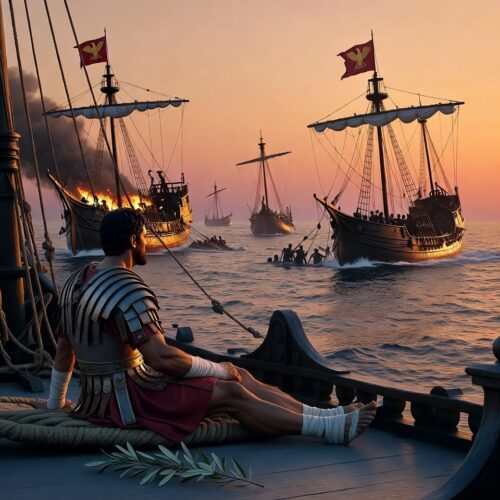 Apply that outcome directly and watch your individual life transform with these very specific benefits:
- When your daily grind feels like rowing against a west wind with a deck full of unnecessary cargo, the Aegates victory shows you can strip everything non-essential—bad routines, energy-draining distractions, outdated tools—and suddenly maneuver rings around obstacles that used to outpace you, just as the Romans ditched the heavy corvus and gained speed to ram precisely where it hurt.
- After years of "storms" wiping out your progress (layoffs, health scares, failed launches), the Roman citizen-funded fleet rebuild proves one round of targeted personal investment—asking allies for one "ship" each in the form of introductions, skills, or small loans—can create an entirely new force capable of breaking any blockade, turning near-bankruptcy into empire-level resources.
- The corvus-to-ramming evolution teaches that what worked early (brute-force boarding through sheer willpower) might need upgrading to agile precision; in your life this means ditching the same tired hustle that got you through the first decade and adopting lighter, faster strategies—like automating repetitive tasks or negotiating smarter alliances—to deliver the finishing blows that capture opportunities instead of just surviving them.
- Hamilcar's guerrilla stalemate dragging on for years mirrors how small, persistent personal enemies (procrastination pockets, toxic relationships, sneaky expenses) pin you down; the Aegates response—scouting the supply line, intercepting at the perfect moment—gives you the power to cut off the enemy's resupply in one bold move, freeing your energy for total victory instead of endless skirmishes.
- The 10,000 captured Carthaginians becoming Roman assets shows that even "enemy" elements (past failures, rejected ideas, former competitors) can be turned into captured resources that fuel your next campaign when you board and repurpose them instead of sinking them forever.
- Catulus commanding from a litter while injured proves leadership and vision trump physical perfection; you can direct your personal fleet to victory even on tough days by delegating rowing to systems and focusing only on the decisive ramming decisions.
- The wind-shift escape of a few Carthaginian ships reminds you that total annihilation isn't always necessary—partial victory that forces surrender (like Carthage's immediate peace offer) is often smarter, teaching you to accept "good enough" wins in life battles so you preserve strength for the next war rather than chasing perfection to exhaustion.
- Rome's first overseas province after the battle illustrates how one decisive naval day can create compounding territory; apply it by using a single breakthrough (closing a deal, hitting a health milestone, launching a project) to claim new "provinces" in your life—expanded networks, passive income streams, or creative freedom—that feed you for decades.
- The crucifixion of failing Carthaginian commanders versus Roman triumphs shows accountability creates excellence; in your daily life this means privately "crucifying" half-measures immediately while publicly celebrating every small ram that lands, building unstoppable momentum no generic positivity ritual can match.
- Finally, Polybius's objective history written generations later proves the real win compounds across time; your Aegates-style strike today becomes the legendary story that inspires your future self and others, turning one personal battle into a multi-generational legacy of dominance.
These aren't fluffy affirmations. They are direct translations of the exact mechanics that ended the longest war of antiquity and launched Rome's 600-year naval reign. Apply them and your longest personal siege ends exactly like Carthage's—suddenly, decisively, permanently.
Now the part no other self-help guru has ever served up: the Aegates Ram Protocol. This is a quick, detailed, 7-day plan engineered straight from the historical tactics of March 10, 241 BC. It is nothing like vision boards, morning routines, or "just believe harder." Instead, it forces you to scout, strip, row into the wind, ram, board, and claim province—using physical props, timed intercepts, and captured resources in ways that feel like you're literally reenacting the battle in your modern life. Do it once and your biggest stuck area flips forever. Total time investment: under two hours a day. Results: one decisive victory that ends your personal Punic War.
**Day 1 – Scout the Aegates (Identify the Supply Fleet):** Grab a notebook or phone. List every "supply ship" feeding your longest struggle—specific habits, people, apps, expenses, or thoughts that keep the enemy garrison alive. Be brutally precise: not "procrastination" but "checking email at 9:15 AM instead of the hard task." Rate each on a 1-10 wind-resistance scale (how much it slows you). This is your Roman lookout spotting Hanno's overloaded fleet off Hiera. End by circling the three biggest cargo carriers.
**Day 2 – Strip for Action (Lighten the Ships):** Physically remove or disable the top three cargo items from Day 1. Delete the app, cancel the subscription, block the energy vampire for 24 hours, or throw out the literal junk on your desk that symbolizes the weight. Romans stripped masts to handle swells—you do the same to gain maneuverability. Feel the immediate speed difference.
**Day 3 – Forge the New Quinqueremes (Private Funding Round):** Ask exactly three people (friends, colleagues, or even online contacts) for one specific "ship" each—a 15-minute call, a resource link, a skill share, or $20 toward a tool. Frame it as "I'm building something big and need one piece from you." Promise repayment in value later. This mirrors the citizen-funded fleet of 243 BC. Collect at least two commitments by sunset.
**Day 4 – Train the Crews (Row into the Wind):** Pick your single hardest daily action (the one you've avoided longest) and do it first thing while deliberately creating "heavy swells"—no coffee, phone in another room, standing desk if you hate it. Time yourself. Do it for exactly 45 minutes (the distance to Lilybaeum). This builds the veteran stamina the Romans had by 241 BC. Log the exact resistance you felt; that's your swell data.
**Day 5 – Form the Line and Intercept (The Bold Charge):** At the exact time your "enemy fleet" usually sails (that 9:15 AM email check, the evening scroll, the snack raid), launch your prepped attack. Use the two resources from Day 3 plus your stripped lightness to ram the circled cargo carriers. Example: instead of scrolling, use the new link from your ally to complete one concrete step toward your goal. Feel the ram crunch.
**Day 6 – Board and Capture (Turn Enemy Assets):** Take whatever "prisoners" your charge produced—new ideas, replies, partial wins—and repurpose them immediately into your campaign. Write three specific ways each captured item now works for you. Romans turned captured ships and men into future strength; you turn today's small wins into province-builders.
**Day 7 – Claim the Province and Celebrate the Triumph (Treaty of Lutatius):** Declare your personal war over in one area. Write the "treaty" terms: what you surrender (old habit), what indemnity you demand (new daily win), and what new territory you now rule (the freed-up time/energy). Then give yourself a real triumph—buy the fancy coffee, post the win, or literally parade around the block. Schedule the next Aegates Protocol for your next biggest struggle exactly 23 days later (nod to the war's length).
Run this once and the same psychological shift that hit Carthage on March 10, 241 BC will hit your obstacles: sudden, total surrender. No endless grinding. No motivational fluff. Just Roman-level preparation meeting Carthaginian-level complacency—and winning every time.
That March 10 bloodbath off the Aegates Islands didn't just end a war. It proved that after 23 years of hell, one prepared, stripped-down, wind-charging strike creates empires. Your life is no different. The fleet is built. The wind is blowing. The enemy is loaded with cargo and late to the party.
Now row. Ram. Board. Win.
Your Aegates victory starts today. The Mediterranean is waiting—and so is the rest of your life.
Apply that outcome directly and watch your individual life transform with these very specific benefits:
- When your daily grind feels like rowing against a west wind with a deck full of unnecessary cargo, the Aegates victory shows you can strip everything non-essential—bad routines, energy-draining distractions, outdated tools—and suddenly maneuver rings around obstacles that used to outpace you, just as the Romans ditched the heavy corvus and gained speed to ram precisely where it hurt.
- After years of "storms" wiping out your progress (layoffs, health scares, failed launches), the Roman citizen-funded fleet rebuild proves one round of targeted personal investment—asking allies for one "ship" each in the form of introductions, skills, or small loans—can create an entirely new force capable of breaking any blockade, turning near-bankruptcy into empire-level resources.
- The corvus-to-ramming evolution teaches that what worked early (brute-force boarding through sheer willpower) might need upgrading to agile precision; in your life this means ditching the same tired hustle that got you through the first decade and adopting lighter, faster strategies—like automating repetitive tasks or negotiating smarter alliances—to deliver the finishing blows that capture opportunities instead of just surviving them.
- Hamilcar's guerrilla stalemate dragging on for years mirrors how small, persistent personal enemies (procrastination pockets, toxic relationships, sneaky expenses) pin you down; the Aegates response—scouting the supply line, intercepting at the perfect moment—gives you the power to cut off the enemy's resupply in one bold move, freeing your energy for total victory instead of endless skirmishes.
- The 10,000 captured Carthaginians becoming Roman assets shows that even "enemy" elements (past failures, rejected ideas, former competitors) can be turned into captured resources that fuel your next campaign when you board and repurpose them instead of sinking them forever.
- Catulus commanding from a litter while injured proves leadership and vision trump physical perfection; you can direct your personal fleet to victory even on tough days by delegating rowing to systems and focusing only on the decisive ramming decisions.
- The wind-shift escape of a few Carthaginian ships reminds you that total annihilation isn't always necessary—partial victory that forces surrender (like Carthage's immediate peace offer) is often smarter, teaching you to accept "good enough" wins in life battles so you preserve strength for the next war rather than chasing perfection to exhaustion.
- Rome's first overseas province after the battle illustrates how one decisive naval day can create compounding territory; apply it by using a single breakthrough (closing a deal, hitting a health milestone, launching a project) to claim new "provinces" in your life—expanded networks, passive income streams, or creative freedom—that feed you for decades.
- The crucifixion of failing Carthaginian commanders versus Roman triumphs shows accountability creates excellence; in your daily life this means privately "crucifying" half-measures immediately while publicly celebrating every small ram that lands, building unstoppable momentum no generic positivity ritual can match.
- Finally, Polybius's objective history written generations later proves the real win compounds across time; your Aegates-style strike today becomes the legendary story that inspires your future self and others, turning one personal battle into a multi-generational legacy of dominance.
These aren't fluffy affirmations. They are direct translations of the exact mechanics that ended the longest war of antiquity and launched Rome's 600-year naval reign. Apply them and your longest personal siege ends exactly like Carthage's—suddenly, decisively, permanently.
Now the part no other self-help guru has ever served up: the Aegates Ram Protocol. This is a quick, detailed, 7-day plan engineered straight from the historical tactics of March 10, 241 BC. It is nothing like vision boards, morning routines, or "just believe harder." Instead, it forces you to scout, strip, row into the wind, ram, board, and claim province—using physical props, timed intercepts, and captured resources in ways that feel like you're literally reenacting the battle in your modern life. Do it once and your biggest stuck area flips forever. Total time investment: under two hours a day. Results: one decisive victory that ends your personal Punic War.
**Day 1 – Scout the Aegates (Identify the Supply Fleet):** Grab a notebook or phone. List every "supply ship" feeding your longest struggle—specific habits, people, apps, expenses, or thoughts that keep the enemy garrison alive. Be brutally precise: not "procrastination" but "checking email at 9:15 AM instead of the hard task." Rate each on a 1-10 wind-resistance scale (how much it slows you). This is your Roman lookout spotting Hanno's overloaded fleet off Hiera. End by circling the three biggest cargo carriers.
**Day 2 – Strip for Action (Lighten the Ships):** Physically remove or disable the top three cargo items from Day 1. Delete the app, cancel the subscription, block the energy vampire for 24 hours, or throw out the literal junk on your desk that symbolizes the weight. Romans stripped masts to handle swells—you do the same to gain maneuverability. Feel the immediate speed difference.
**Day 3 – Forge the New Quinqueremes (Private Funding Round):** Ask exactly three people (friends, colleagues, or even online contacts) for one specific "ship" each—a 15-minute call, a resource link, a skill share, or $20 toward a tool. Frame it as "I'm building something big and need one piece from you." Promise repayment in value later. This mirrors the citizen-funded fleet of 243 BC. Collect at least two commitments by sunset.
**Day 4 – Train the Crews (Row into the Wind):** Pick your single hardest daily action (the one you've avoided longest) and do it first thing while deliberately creating "heavy swells"—no coffee, phone in another room, standing desk if you hate it. Time yourself. Do it for exactly 45 minutes (the distance to Lilybaeum). This builds the veteran stamina the Romans had by 241 BC. Log the exact resistance you felt; that's your swell data.
**Day 5 – Form the Line and Intercept (The Bold Charge):** At the exact time your "enemy fleet" usually sails (that 9:15 AM email check, the evening scroll, the snack raid), launch your prepped attack. Use the two resources from Day 3 plus your stripped lightness to ram the circled cargo carriers. Example: instead of scrolling, use the new link from your ally to complete one concrete step toward your goal. Feel the ram crunch.
**Day 6 – Board and Capture (Turn Enemy Assets):** Take whatever "prisoners" your charge produced—new ideas, replies, partial wins—and repurpose them immediately into your campaign. Write three specific ways each captured item now works for you. Romans turned captured ships and men into future strength; you turn today's small wins into province-builders.
**Day 7 – Claim the Province and Celebrate the Triumph (Treaty of Lutatius):** Declare your personal war over in one area. Write the "treaty" terms: what you surrender (old habit), what indemnity you demand (new daily win), and what new territory you now rule (the freed-up time/energy). Then give yourself a real triumph—buy the fancy coffee, post the win, or literally parade around the block. Schedule the next Aegates Protocol for your next biggest struggle exactly 23 days later (nod to the war's length).
Run this once and the same psychological shift that hit Carthage on March 10, 241 BC will hit your obstacles: sudden, total surrender. No endless grinding. No motivational fluff. Just Roman-level preparation meeting Carthaginian-level complacency—and winning every time.
That March 10 bloodbath off the Aegates Islands didn't just end a war. It proved that after 23 years of hell, one prepared, stripped-down, wind-charging strike creates empires. Your life is no different. The fleet is built. The wind is blowing. The enemy is loaded with cargo and late to the party.
Now row. Ram. Board. Win.
Your Aegates victory starts today. The Mediterranean is waiting—and so is the rest of your life.