Picture this: It’s March 9, 1776, in the smoky streets of London. Printers William Strahan and Thomas Cadell are stacking fresh two-volume sets of a dense, 900-page brick of a book onto bookstore shelves. The author? A lanky, twitching Scottish bachelor back in Edinburgh, probably muttering to himself while staring at his shoes. No parades. No fireworks. Just a quiet release of *An Inquiry into the Nature and Causes of the Wealth of Nations* by Adam Smith. Most passersby that day would have shrugged it off as another dusty treatise. Little did they know this absent-minded professor had just lit the fuse on the modern world’s greatest wealth-creation machine—one that still hums beneath every smartphone you buy, every gig you land, and every raise you negotiate.
That single publication day didn’t just birth classical economics. It demolished centuries of royal gold-hoarding nonsense and replaced it with a radical, almost cheeky idea: let ordinary people chase their own self-interest, and society gets richer than any king ever dreamed. The outcome? An explosion of productivity, trade, and innovation that dragged humanity out of feudal poverty and into the Industrial Age and beyond. And here’s the wild part: the same principles that turned 18th-century pin factories into global supply chains can turn your chaotic daily grind into a personal empire of time, money, and freedom—if you apply them with the precision of a Scottish moral philosopher who once fell into a literal pit of tanning chemicals while lecturing about free trade.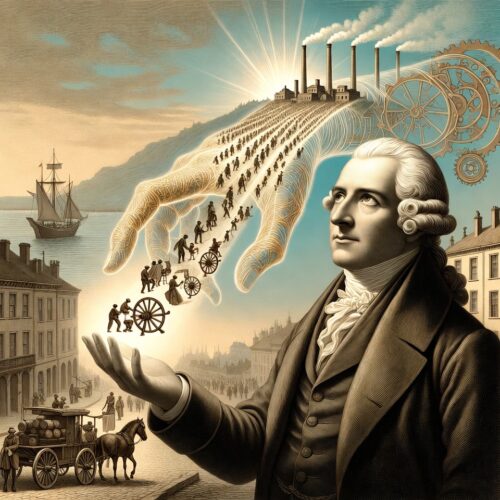 This isn’t some vague “think positive” history lesson. We’re diving deep—ninety percent of this tale is the raw, hilarious, blood-and-ink reality of how one man’s book on March 9, 1776, rewired human civilization. Only at the end will we flip the script to your life with bullet-point precision and a plan so quirky, so anti-every-other-self-help-guru, it would make Smith himself chuckle into his nightgown.
Let’s travel back to the beginning of the man who made March 9 matter.
Adam Smith entered the world in Kirkcaldy, Scotland, baptized June 5, 1723—exact birth date lost to the mists, fitting for a guy who spent his life lost in thought. His father, a customs comptroller and lawyer, had died months earlier. Young Adam was raised by his widowed mother, Margaret Douglas, who poured every ounce of her considerable intellect into the boy. At age four, while visiting relatives at Strathendry on the banks of the River Leven, toddler Adam was snatched by a band of tinkers—Scottish gypsies known for wandering trades. The family mounted a frantic search. Hours later, the boy was recovered unharmed, already showing the wide-eyed curiosity that would later make him question why nations stayed poor while others prospered. Imagine the scene: a future titan of economics toddling among vagabonds, perhaps already pondering the division of labor in their ragtag camp. Rescued, he returned home to a quiet life of books and long walks, his mother shielding him from the rougher edges of 18th-century Scottish life.
By 1729, Smith was enrolled at the Burgh School of Kirkcaldy, mastering Latin, Greek, mathematics, and history with a speed that impressed his teachers. At fourteen—yes, fourteen—he walked into the University of Glasgow, a hotbed of the Scottish Enlightenment. There, moral philosopher Francis Hutcheson became his hero. Hutcheson preached that human nature wasn’t nasty and brutish but capable of benevolence and reason. Smith soaked it up. He devoured lectures on ethics, logic, and natural jurisprudence, developing the core belief that would later underpin his masterpiece: self-interest, properly channeled, benefits everyone.
In 1740, a scholarship whisked him to Balliol College, Oxford. Disaster. Oxford’s tutors were lazy relics peddling outdated Aristotelian nonsense while collecting fat salaries. Smith called the place a waste of time. He smuggled in forbidden books by David Hume—his future best friend—and got punished for it. The stress triggered nervous fits and a breakdown. He left in 1746 without a degree, self-educating in the Bodleian Library instead. Back in Scotland, he launched public lectures in Edinburgh on rhetoric and “the progress of opulence.” Crowds loved his witty, rapid-fire style. One attendee later recalled Smith delivering complex ideas so quickly his tongue seemed to outrun his brain.
In 1751, Glasgow University appointed him Professor of Logic, then Moral Philosophy in 1752. This was his happiest decade. Students flocked to his classes. He lectured without notes, pacing, gesturing wildly, occasionally forgetting where he was. His 1759 book *The Theory of Moral Sentiments*—exploring how sympathy and imagination bind society—made him famous across Europe. But economics was bubbling underneath. In his lectures, Smith already argued that labor, not gold or silver, created national wealth. Mercantilism—the reigning dogma that nations should hoard bullion and restrict trade—was, in his view, a colossal con job.
This isn’t some vague “think positive” history lesson. We’re diving deep—ninety percent of this tale is the raw, hilarious, blood-and-ink reality of how one man’s book on March 9, 1776, rewired human civilization. Only at the end will we flip the script to your life with bullet-point precision and a plan so quirky, so anti-every-other-self-help-guru, it would make Smith himself chuckle into his nightgown.
Let’s travel back to the beginning of the man who made March 9 matter.
Adam Smith entered the world in Kirkcaldy, Scotland, baptized June 5, 1723—exact birth date lost to the mists, fitting for a guy who spent his life lost in thought. His father, a customs comptroller and lawyer, had died months earlier. Young Adam was raised by his widowed mother, Margaret Douglas, who poured every ounce of her considerable intellect into the boy. At age four, while visiting relatives at Strathendry on the banks of the River Leven, toddler Adam was snatched by a band of tinkers—Scottish gypsies known for wandering trades. The family mounted a frantic search. Hours later, the boy was recovered unharmed, already showing the wide-eyed curiosity that would later make him question why nations stayed poor while others prospered. Imagine the scene: a future titan of economics toddling among vagabonds, perhaps already pondering the division of labor in their ragtag camp. Rescued, he returned home to a quiet life of books and long walks, his mother shielding him from the rougher edges of 18th-century Scottish life.
By 1729, Smith was enrolled at the Burgh School of Kirkcaldy, mastering Latin, Greek, mathematics, and history with a speed that impressed his teachers. At fourteen—yes, fourteen—he walked into the University of Glasgow, a hotbed of the Scottish Enlightenment. There, moral philosopher Francis Hutcheson became his hero. Hutcheson preached that human nature wasn’t nasty and brutish but capable of benevolence and reason. Smith soaked it up. He devoured lectures on ethics, logic, and natural jurisprudence, developing the core belief that would later underpin his masterpiece: self-interest, properly channeled, benefits everyone.
In 1740, a scholarship whisked him to Balliol College, Oxford. Disaster. Oxford’s tutors were lazy relics peddling outdated Aristotelian nonsense while collecting fat salaries. Smith called the place a waste of time. He smuggled in forbidden books by David Hume—his future best friend—and got punished for it. The stress triggered nervous fits and a breakdown. He left in 1746 without a degree, self-educating in the Bodleian Library instead. Back in Scotland, he launched public lectures in Edinburgh on rhetoric and “the progress of opulence.” Crowds loved his witty, rapid-fire style. One attendee later recalled Smith delivering complex ideas so quickly his tongue seemed to outrun his brain.
In 1751, Glasgow University appointed him Professor of Logic, then Moral Philosophy in 1752. This was his happiest decade. Students flocked to his classes. He lectured without notes, pacing, gesturing wildly, occasionally forgetting where he was. His 1759 book *The Theory of Moral Sentiments*—exploring how sympathy and imagination bind society—made him famous across Europe. But economics was bubbling underneath. In his lectures, Smith already argued that labor, not gold or silver, created national wealth. Mercantilism—the reigning dogma that nations should hoard bullion and restrict trade—was, in his view, a colossal con job. Enter the Duke of Buccleuch’s stepfather, Charles Townshend. In 1763, Townshend hired Smith as tutor to the young Duke for an eye-watering £300 a year plus expenses—more than double his professor salary. Smith resigned his chair mid-term. Students begged him to stay and even refused fee refunds. Off to Europe they went: Toulouse, Geneva, Paris. In France, Smith met the physiocrats—François Quesnay and his circle—who argued agriculture was the sole source of wealth and governments should butt out (*laissez-faire*). Smith loved the hands-off part but thought they overrated farms. He toured factories, debated in salons, and dined with Benjamin Franklin and Voltaire. One night in Paris, the conversation crackled; Smith took mental notes that would fuel his magnum opus.
Back home in 1766, he settled in Kirkcaldy with his mother and began the marathon. For ten years he wrote, revised, and paced. David Hume—now his closest confidant—wrote encouraging letters. “I am very anxious to see your performance,” Hume teased. Smith’s health was shaky: chronic digestion issues, a limp possibly from childhood, a high-pitched voice, and that famous absent-mindedness. He talked to himself on the street. He stacked books in teetering piles. Once, during a Glasgow tannery tour, he got so wrapped up explaining free trade that he strolled straight into a pit of chemicals. Friends hauled him out, dripping and still mid-sentence. Another breakfast disaster: deep in discussion, he absent-mindedly dropped his toast into the teapot, poured himself a cup, sipped, and declared it “the worst tea I ever met with.” He once walked fifteen miles in his nightgown, lost in thought. These weren’t quirks—they were signs of a mind perpetually fourteen steps ahead.
By 1775 the manuscript was done. Smith sent it to London publishers Strahan and Cadell. Final tweaks arrived in early 1776. On March 9, the two thick volumes hit the market, priced at one pound sixteen shillings—steep but worth every penny to those who cracked them open. Smith remained in Edinburgh, anxious but optimistic. He wrote to Hume on March 2 expressing relief mixed with “debilitated” exhaustion after years of toil. No grand launch party. Just crates of books crossing the border. The first edition—roughly a thousand copies—sold out within six months. Edmund Burke praised its clarity. Edward Gibbon called it “an extensive science in a single book.” Critics who loved mercantilism grumbled, but the tide had turned.
Now, the heart of the matter—the book itself and why March 9, 1776, still echoes.
*The Wealth of Nations* is no dry textbook. It’s a five-book demolition derby of bad ideas wrapped in sparkling prose. Book I kicks off with the division of labor—the insight that would make factories roar. Smith’s famous pin-factory example: one untrained man might struggle to make one pin a day. Ten specialized workers, dividing eighteen distinct operations, could produce 48,000 pins daily. “This division of labour… occasions, in the general, a more universal opulence.” The principle scales: the bigger the market, the more specialization pays. Money emerges naturally from barter. Wages, profits, and rent determine prices. Labor is the true source of value.
Enter the Duke of Buccleuch’s stepfather, Charles Townshend. In 1763, Townshend hired Smith as tutor to the young Duke for an eye-watering £300 a year plus expenses—more than double his professor salary. Smith resigned his chair mid-term. Students begged him to stay and even refused fee refunds. Off to Europe they went: Toulouse, Geneva, Paris. In France, Smith met the physiocrats—François Quesnay and his circle—who argued agriculture was the sole source of wealth and governments should butt out (*laissez-faire*). Smith loved the hands-off part but thought they overrated farms. He toured factories, debated in salons, and dined with Benjamin Franklin and Voltaire. One night in Paris, the conversation crackled; Smith took mental notes that would fuel his magnum opus.
Back home in 1766, he settled in Kirkcaldy with his mother and began the marathon. For ten years he wrote, revised, and paced. David Hume—now his closest confidant—wrote encouraging letters. “I am very anxious to see your performance,” Hume teased. Smith’s health was shaky: chronic digestion issues, a limp possibly from childhood, a high-pitched voice, and that famous absent-mindedness. He talked to himself on the street. He stacked books in teetering piles. Once, during a Glasgow tannery tour, he got so wrapped up explaining free trade that he strolled straight into a pit of chemicals. Friends hauled him out, dripping and still mid-sentence. Another breakfast disaster: deep in discussion, he absent-mindedly dropped his toast into the teapot, poured himself a cup, sipped, and declared it “the worst tea I ever met with.” He once walked fifteen miles in his nightgown, lost in thought. These weren’t quirks—they were signs of a mind perpetually fourteen steps ahead.
By 1775 the manuscript was done. Smith sent it to London publishers Strahan and Cadell. Final tweaks arrived in early 1776. On March 9, the two thick volumes hit the market, priced at one pound sixteen shillings—steep but worth every penny to those who cracked them open. Smith remained in Edinburgh, anxious but optimistic. He wrote to Hume on March 2 expressing relief mixed with “debilitated” exhaustion after years of toil. No grand launch party. Just crates of books crossing the border. The first edition—roughly a thousand copies—sold out within six months. Edmund Burke praised its clarity. Edward Gibbon called it “an extensive science in a single book.” Critics who loved mercantilism grumbled, but the tide had turned.
Now, the heart of the matter—the book itself and why March 9, 1776, still echoes.
*The Wealth of Nations* is no dry textbook. It’s a five-book demolition derby of bad ideas wrapped in sparkling prose. Book I kicks off with the division of labor—the insight that would make factories roar. Smith’s famous pin-factory example: one untrained man might struggle to make one pin a day. Ten specialized workers, dividing eighteen distinct operations, could produce 48,000 pins daily. “This division of labour… occasions, in the general, a more universal opulence.” The principle scales: the bigger the market, the more specialization pays. Money emerges naturally from barter. Wages, profits, and rent determine prices. Labor is the true source of value.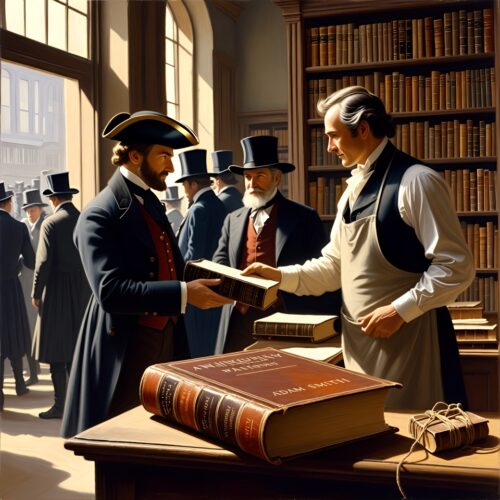 Book II explores capital accumulation. Stock splits into fixed and circulating. Productive labor (making things) beats unproductive labor (servants, entertainers—sorry, folks). Savings fuel growth. Interest rates reflect risk and opportunity.
Book III traces the “progress of opulence.” After Rome fell, Europe stagnated because agriculture was neglected. Towns and commerce eventually revived the countryside through trade.
Book IV is the takedown of mercantilism—the villain of the piece. Kings and ministers obsessed with gold hoards, tariffs, colonies, and monopolies. Smith skewers the East India Company, the Navigation Acts, and the absurd belief that trade is a zero-sum war. Colonies, he argues, cost more than they deliver. The famous “invisible hand” appears here: “By preferring the support of domestic to that of foreign industry, he intends only his own security; and… he is led by an invisible hand to promote an end which was no part of his intention.” Self-interest, guided by competition, creates public good better than any planner.
Book V handles government revenue. Defense, justice, and public works are legitimate. Taxes should be proportional, certain, convenient, and efficient—Smith’s four maxims still taught in every econ class. He even flirts with progressive taxation on land and luxuries.
The context of 1776 made the timing explosive. American colonists were drafting the Declaration of Independence four months later, railing against British trade restrictions—exactly the mercantilist follies Smith eviscerated. The Scottish Agricultural Revolution and early Industrial stirrings proved his points daily. France teetered toward revolution partly because its economy was strangled by the very regulations Smith mocked.
Immediate impact was electric. The book shaped debates in Parliament. Prime Minister William Pitt the Younger cited it. Across the Atlantic, Alexander Hamilton wrestled with Smith’s ideas in his Report on Manufactures. In the 19th century, free-trade movements from Britain to Japan quoted Smith chapter and verse. The Industrial Revolution accelerated because factories embraced division of labor on a scale Smith could scarcely imagine. Railroads, steam engines, and global shipping followed the logic of open markets.
Book II explores capital accumulation. Stock splits into fixed and circulating. Productive labor (making things) beats unproductive labor (servants, entertainers—sorry, folks). Savings fuel growth. Interest rates reflect risk and opportunity.
Book III traces the “progress of opulence.” After Rome fell, Europe stagnated because agriculture was neglected. Towns and commerce eventually revived the countryside through trade.
Book IV is the takedown of mercantilism—the villain of the piece. Kings and ministers obsessed with gold hoards, tariffs, colonies, and monopolies. Smith skewers the East India Company, the Navigation Acts, and the absurd belief that trade is a zero-sum war. Colonies, he argues, cost more than they deliver. The famous “invisible hand” appears here: “By preferring the support of domestic to that of foreign industry, he intends only his own security; and… he is led by an invisible hand to promote an end which was no part of his intention.” Self-interest, guided by competition, creates public good better than any planner.
Book V handles government revenue. Defense, justice, and public works are legitimate. Taxes should be proportional, certain, convenient, and efficient—Smith’s four maxims still taught in every econ class. He even flirts with progressive taxation on land and luxuries.
The context of 1776 made the timing explosive. American colonists were drafting the Declaration of Independence four months later, railing against British trade restrictions—exactly the mercantilist follies Smith eviscerated. The Scottish Agricultural Revolution and early Industrial stirrings proved his points daily. France teetered toward revolution partly because its economy was strangled by the very regulations Smith mocked.
Immediate impact was electric. The book shaped debates in Parliament. Prime Minister William Pitt the Younger cited it. Across the Atlantic, Alexander Hamilton wrestled with Smith’s ideas in his Report on Manufactures. In the 19th century, free-trade movements from Britain to Japan quoted Smith chapter and verse. The Industrial Revolution accelerated because factories embraced division of labor on a scale Smith could scarcely imagine. Railroads, steam engines, and global shipping followed the logic of open markets. Critics emerged—Karl Marx called Smith naïve about class conflict—but even Marx built on his labor theory of value. In the 20th century, Friedrich Hayek and Milton Friedman revived the invisible hand against central planning. Post-World War II, decolonization and GATT rounds echoed Smith’s anti-monopoly stance. Today, every free-trade agreement, every gig-economy platform, every smartphone assembled across continents owes a debt to the ideas unleashed on March 9, 1776.
Smith kept revising. Five lifetime editions appeared, with footnotes added in 1784 and index in 1789. He never claimed perfection. In later life, as Commissioner of Customs in Edinburgh from 1778, he enforced the very trade laws he criticized—proving even geniuses compromise. He never married, lived quietly with his mother until her death in 1784, and died July 17, 1790, asking friends to burn unfinished manuscripts. His legacy? The recognition that wealth isn’t zero-sum. It grows when people specialize, trade freely, and let self-interest align with the public good.
And that, friends, is the colossal outcome of one unassuming publication day: the intellectual foundation for the wealthiest, most innovative era in human history. Empires rose not on conquest but on pins, looms, ships, and the quiet genius of ordinary folk pursuing their own gain.
Now—how does a 250-year-old book help *you* today?
The outcome of March 9, 1776, was the proof that ordinary individuals, when freed from artificial restraints and encouraged to specialize and exchange, generate wealth beyond the dreams of kings. You don’t need a throne or a treasury. You need Smith’s three big levers: ruthless specialization, trust in the invisible hand of voluntary exchange, and smart boundaries on your personal “government” (your habits and schedule). Here’s how that plays out in your individual life with laser-specific application.
Critics emerged—Karl Marx called Smith naïve about class conflict—but even Marx built on his labor theory of value. In the 20th century, Friedrich Hayek and Milton Friedman revived the invisible hand against central planning. Post-World War II, decolonization and GATT rounds echoed Smith’s anti-monopoly stance. Today, every free-trade agreement, every gig-economy platform, every smartphone assembled across continents owes a debt to the ideas unleashed on March 9, 1776.
Smith kept revising. Five lifetime editions appeared, with footnotes added in 1784 and index in 1789. He never claimed perfection. In later life, as Commissioner of Customs in Edinburgh from 1778, he enforced the very trade laws he criticized—proving even geniuses compromise. He never married, lived quietly with his mother until her death in 1784, and died July 17, 1790, asking friends to burn unfinished manuscripts. His legacy? The recognition that wealth isn’t zero-sum. It grows when people specialize, trade freely, and let self-interest align with the public good.
And that, friends, is the colossal outcome of one unassuming publication day: the intellectual foundation for the wealthiest, most innovative era in human history. Empires rose not on conquest but on pins, looms, ships, and the quiet genius of ordinary folk pursuing their own gain.
Now—how does a 250-year-old book help *you* today?
The outcome of March 9, 1776, was the proof that ordinary individuals, when freed from artificial restraints and encouraged to specialize and exchange, generate wealth beyond the dreams of kings. You don’t need a throne or a treasury. You need Smith’s three big levers: ruthless specialization, trust in the invisible hand of voluntary exchange, and smart boundaries on your personal “government” (your habits and schedule). Here’s how that plays out in your individual life with laser-specific application. - **Specialize like the pin makers, not the jacks-of-all-trades.** Smith showed one worker doing eighteen tiny tasks outproduces ten generalists by orders of magnitude. Translate: stop scattering your energy across seventeen half-baked side hustles. Pick one core skill—copywriting, coding, plumbing, content creation, whatever—and drill it until you’re the person others pay premium rates to handle that exact operation. The market (clients, bosses, algorithms) will reward you with opportunities you never chased.
- **Let the invisible hand guide your career moves instead of forcing “passion” or “purpose” scripts.** Smith’s genius insight: when you pursue what genuinely benefits *you* (higher pay, better hours, meaningful work), you unintentionally create value for others. Stop agonizing over “what the world needs.” Ask: What can I do that I’m unusually good at and that enough people will voluntarily pay for? The hand will steer you toward collaborations, promotions, and networks you couldn’t plan.
- **Dismantle your personal mercantilism—those self-imposed tariffs and hoards that keep you poor.** Mercantilists hoarded gold and blocked imports. You hoard unused skills, binge-watch instead of building, or “protect” your time with perfectionism that prevents shipping. Drop the tariffs: trade your half-finished projects for feedback, outsource the parts you suck at, and let competition (other creators, colleagues) sharpen you.
- **Apply Smith’s four maxims of taxation to your own energy and attention.** Make every “tax” on your day proportional (don’t spend two hours on a task worth twenty minutes), certain (ruthless calendar blocking), convenient (do hard work when your brain is freshest), and efficient (eliminate the deadweight loss of doom-scrolling). The surplus revenue? That’s the extra hours, cash, and sanity that compound into freedom.
- **Embrace colonies of opportunity without the colonial cost.** Smith noted colonies enriched the mother country through voluntary exchange. In your life, treat every new network, platform, or side project as a colony: invest lightly, reap surplus produce (referrals, skills, income), but never let it drain your core productive labor.
These aren’t slogans. They’re mechanical advantages proven since 1776 to multiply output while reducing wasted effort.
Here’s the plan—unique against every self-help guru online. No vision boards. No 5 a.m. clubs. No gratitude journals. This is **The Smithian Pin-Factory Protocol**: a dead-simple, five-day reset that treats *your life* exactly like Smith treated a nation—divide labor, remove restraints, let the invisible hand do the heavy lifting. Do it once, then run it quarterly. It takes 15–30 minutes a day and requires zero apps beyond a notebook and your existing calendar.
**Day 1 – The Pin Audit (Division of Labor)**
List every recurring task in your life (work, home, health, learning) on paper. Draw lines dividing them into “core operations” you alone should own versus everything else. Outsource, automate, or delete three non-core tasks this week. Example: If you’re a writer who also edits, designs covers, and manages social media, hire a VA for the last two or use templates. Measure: by Sunday night, you should have reclaimed at least four hours.
**Day 2 – Invisible Hand Walk (Self-Interest Mapping)**
Take a 30-minute walk (Smith walked everywhere). Ask aloud: “What single action today serves my security and gain while likely helping someone else?” Write down the three answers that feel lightest and most exciting. Do the top one immediately. No forcing “shoulds.” The hand works when you stop steering.
**Day 3 – Mercantilism Purge (Remove Restraints)**
Identify one “tariff” you impose on yourself—perfectionism before posting, endless research before launching, comparing to others. Abolish it for 24 hours. Ship the imperfect thing. Post the messy draft. Book the gig without polishing the résumé to death. Feel the market (real feedback) respond.
**Day 4 – Revenue Maxims Check (Tax Your Day Efficiently)**
Review yesterday’s schedule like a sovereign auditing revenue. Which activities were proportional, certain, convenient, and efficient? Slash or reschedule the rest. Rule: any task taking longer than its value must be batched, delegated, or killed. Smith hated waste; you will too once you see the freed-up capital.
**Day 5 – Opulence Review & Trade Launch (Compound the Gains)**
Tally the extra time/money/energy created. Immediately “trade” one new surplus hour for something that multiplies it—skill practice, networking coffee, rest that prevents burnout. Schedule the next quarterly Pin-Factory Protocol on your calendar. Smith revised his book five times; you’ll refine this system naturally.
Run this protocol and you’re not “hustling harder.” You’re operating the same invisible machinery that turned 18th-century Scotland into the workshop of the world—except your workshop is your calendar, your pins are your skills, and your opulence is the life you actually want. The guy who once put toast in his teapot proved that absent-minded focus plus radical simplicity beats royal decrees every time.
March 9, 1776, didn’t just publish a book. It published permission: ordinary people, specializing and trading freely, can outproduce empires. That permission slip is still valid. Use it. Specialize, trade, purge the nonsense, and watch your personal wealth of nations expand faster than any king could tax.
The invisible hand is waiting. All it needs is your first honest move.
- **Specialize like the pin makers, not the jacks-of-all-trades.** Smith showed one worker doing eighteen tiny tasks outproduces ten generalists by orders of magnitude. Translate: stop scattering your energy across seventeen half-baked side hustles. Pick one core skill—copywriting, coding, plumbing, content creation, whatever—and drill it until you’re the person others pay premium rates to handle that exact operation. The market (clients, bosses, algorithms) will reward you with opportunities you never chased.
- **Let the invisible hand guide your career moves instead of forcing “passion” or “purpose” scripts.** Smith’s genius insight: when you pursue what genuinely benefits *you* (higher pay, better hours, meaningful work), you unintentionally create value for others. Stop agonizing over “what the world needs.” Ask: What can I do that I’m unusually good at and that enough people will voluntarily pay for? The hand will steer you toward collaborations, promotions, and networks you couldn’t plan.
- **Dismantle your personal mercantilism—those self-imposed tariffs and hoards that keep you poor.** Mercantilists hoarded gold and blocked imports. You hoard unused skills, binge-watch instead of building, or “protect” your time with perfectionism that prevents shipping. Drop the tariffs: trade your half-finished projects for feedback, outsource the parts you suck at, and let competition (other creators, colleagues) sharpen you.
- **Apply Smith’s four maxims of taxation to your own energy and attention.** Make every “tax” on your day proportional (don’t spend two hours on a task worth twenty minutes), certain (ruthless calendar blocking), convenient (do hard work when your brain is freshest), and efficient (eliminate the deadweight loss of doom-scrolling). The surplus revenue? That’s the extra hours, cash, and sanity that compound into freedom.
- **Embrace colonies of opportunity without the colonial cost.** Smith noted colonies enriched the mother country through voluntary exchange. In your life, treat every new network, platform, or side project as a colony: invest lightly, reap surplus produce (referrals, skills, income), but never let it drain your core productive labor.
These aren’t slogans. They’re mechanical advantages proven since 1776 to multiply output while reducing wasted effort.
Here’s the plan—unique against every self-help guru online. No vision boards. No 5 a.m. clubs. No gratitude journals. This is **The Smithian Pin-Factory Protocol**: a dead-simple, five-day reset that treats *your life* exactly like Smith treated a nation—divide labor, remove restraints, let the invisible hand do the heavy lifting. Do it once, then run it quarterly. It takes 15–30 minutes a day and requires zero apps beyond a notebook and your existing calendar.
**Day 1 – The Pin Audit (Division of Labor)**
List every recurring task in your life (work, home, health, learning) on paper. Draw lines dividing them into “core operations” you alone should own versus everything else. Outsource, automate, or delete three non-core tasks this week. Example: If you’re a writer who also edits, designs covers, and manages social media, hire a VA for the last two or use templates. Measure: by Sunday night, you should have reclaimed at least four hours.
**Day 2 – Invisible Hand Walk (Self-Interest Mapping)**
Take a 30-minute walk (Smith walked everywhere). Ask aloud: “What single action today serves my security and gain while likely helping someone else?” Write down the three answers that feel lightest and most exciting. Do the top one immediately. No forcing “shoulds.” The hand works when you stop steering.
**Day 3 – Mercantilism Purge (Remove Restraints)**
Identify one “tariff” you impose on yourself—perfectionism before posting, endless research before launching, comparing to others. Abolish it for 24 hours. Ship the imperfect thing. Post the messy draft. Book the gig without polishing the résumé to death. Feel the market (real feedback) respond.
**Day 4 – Revenue Maxims Check (Tax Your Day Efficiently)**
Review yesterday’s schedule like a sovereign auditing revenue. Which activities were proportional, certain, convenient, and efficient? Slash or reschedule the rest. Rule: any task taking longer than its value must be batched, delegated, or killed. Smith hated waste; you will too once you see the freed-up capital.
**Day 5 – Opulence Review & Trade Launch (Compound the Gains)**
Tally the extra time/money/energy created. Immediately “trade” one new surplus hour for something that multiplies it—skill practice, networking coffee, rest that prevents burnout. Schedule the next quarterly Pin-Factory Protocol on your calendar. Smith revised his book five times; you’ll refine this system naturally.
Run this protocol and you’re not “hustling harder.” You’re operating the same invisible machinery that turned 18th-century Scotland into the workshop of the world—except your workshop is your calendar, your pins are your skills, and your opulence is the life you actually want. The guy who once put toast in his teapot proved that absent-minded focus plus radical simplicity beats royal decrees every time.
March 9, 1776, didn’t just publish a book. It published permission: ordinary people, specializing and trading freely, can outproduce empires. That permission slip is still valid. Use it. Specialize, trade, purge the nonsense, and watch your personal wealth of nations expand faster than any king could tax.
The invisible hand is waiting. All it needs is your first honest move.