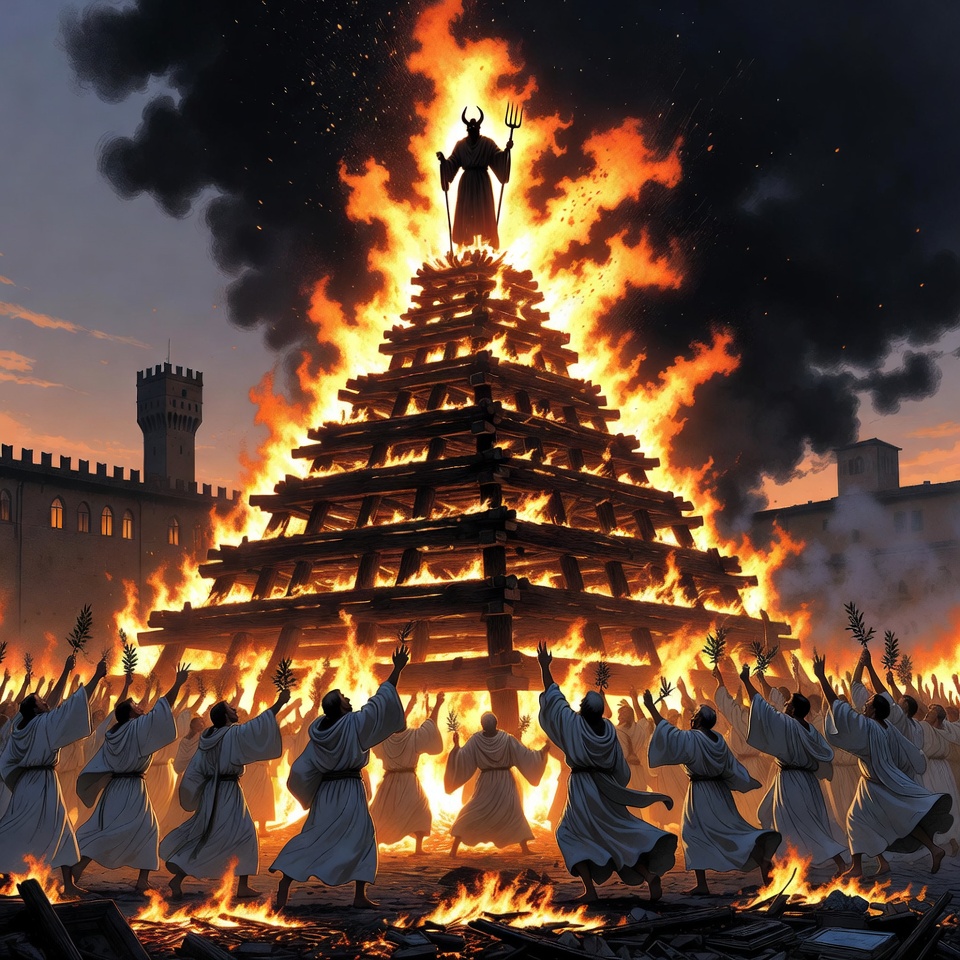
Ah, February 7, 1497 – a day when Florence, the glittering jewel of the Italian Renaissance, decided to play a game of "hot potato" with its most prized possessions. Picture this: a massive pyre in the heart of the city, piled high with everything from lipstick (or the 15th-century equivalent) to priceless paintings, all going up in smoke under the watchful eye of a fiery preacher who thought luxury was basically Satan's shopping list. This wasn't just a bonfire; it was the Bonfire of the Vanities, orchestrated by the Dominican friar Girolamo Savonarola. It was a spectacle of religious zeal, cultural clash, and enough drama to make modern reality TV look tame. But why did it happen? Who was this Savonarola guy, and how did he convince an entire city of art-loving Italians to torch their treasures? Buckle up, because we're diving deep into this scorching slice of history – with a dash of humor to keep things from getting too toasty. And stick around; we'll wrap up with how this medieval meltdown can actually fuel some positive changes in your life today.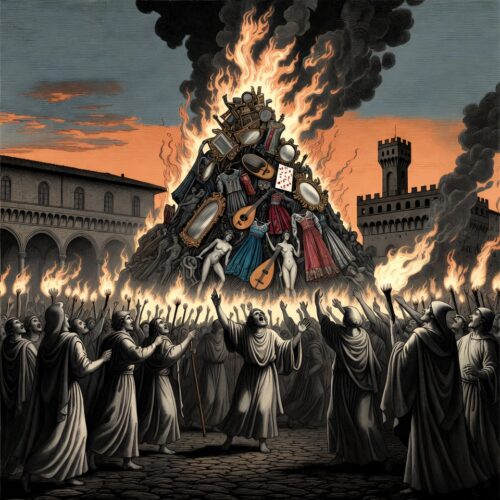 To understand the Bonfire of the Vanities, we have to rewind the clock to the late 15th century, when Florence was basically the Silicon Valley of art and ideas. The Renaissance was in full swing, a rebirth of classical learning, humanism, and all things beautiful. Think Leonardo da Vinci sketching flying machines, Michelangelo chiseling away at marble, and Botticelli painting ethereal goddesses. The city was ruled by the Medici family, a banking dynasty so wealthy they could buy popes (literally – they bankrolled a few). Lorenzo de' Medici, known as "the Magnificent," was the big cheese. He threw lavish parties, patronized artists, and turned Florence into a hub of opulence. But beneath the gilded surface, not everyone was thrilled. Economic inequality was rife, the Church was corrupt (hello, indulgences and simony), and plague outbreaks reminded people that life was short and sin was everywhere. Enter Girolamo Savonarola, the monk who saw all this excess and thought, "Nope, time for a divine intervention."
Savonarola wasn't born with a halo or a habit – he started life on September 21, 1452, in Ferrara, Italy, to a well-off family. His grandfather was a physician, and young Girolamo was educated in the classics, poetry, and philosophy. But he wasn't impressed by the worldly pursuits around him. As a teen, he wrote poems lamenting the corruption of society, like "On the Ruin of the World," where he railed against "the blind people who are without a guide." By 1475, at age 23, he ditched his comfy life and joined the Dominican Order in Bologna. The Dominicans were all about preaching and scholarship, and Savonarola dove in headfirst. He studied theology, mastered the Bible, and developed a style of sermonizing that was equal parts fire and brimstone. His early gigs as a preacher in places like Ferrara and Brescia weren't smash hits – he was awkward, with a high-pitched voice and a habit of mumbling. But he kept at it, honing his skills and building a reputation as a no-nonsense critic of moral decay.
Fast forward to 1482: Savonarola gets his big break when he's sent to preach in Florence at the convent of San Marco. At first, he's a flop – crowds were small, and his apocalyptic warnings about divine judgment fell flat in a city buzzing with humanism. But he didn't give up. He traveled around northern Italy, preaching in Lombardy and Piedmont, where he started gaining traction. His messages were simple yet terrifying: Repent, or face God's wrath. He predicted plagues, invasions, and the end of the world as we knew it. And guess what? Events seemed to back him up. In 1484, a comet appeared – Savonarola called it a sign of doom. Plagues hit, and political turmoil brewed. By 1490, Lorenzo de' Medici himself invited Savonarola back to Florence, perhaps thinking he could control the friar. Big mistake. Savonarola was assigned to San Marco again, and this time, his sermons exploded in popularity.
Imagine packing out a cathedral with standing-room-only crowds. That's what happened at the Duomo, where Savonarola preached. He attacked the Medici for their tyranny and luxury, calling Lorenzo a "usurper." He slammed the Church hierarchy, accusing priests of living like princes while the poor suffered. His prophecies were spot-on creepy: He foretold the death of Lorenzo (who kicked the bucket in 1492) and the invasion of Italy by a foreign king (enter Charles VIII of France in 1494, who marched through like a tourist with an army). Savonarola's secret weapon? Charisma mixed with fear. He claimed visions from God – angels whispering prophecies, the Virgin Mary appearing to guide him. One famous vision had him seeing a sword over Italy, inscribed with "Gladius Domini super terram" (The sword of the Lord over the earth). He wasn't just talking; he was performing, gesturing wildly, his voice booming with conviction. People wept, fainted, and converted on the spot. His followers, dubbed the Piagnoni ("Weepers" or "Snivelers" – a mocking nickname they wore like a badge), included everyone from peasants to intellectuals.
To understand the Bonfire of the Vanities, we have to rewind the clock to the late 15th century, when Florence was basically the Silicon Valley of art and ideas. The Renaissance was in full swing, a rebirth of classical learning, humanism, and all things beautiful. Think Leonardo da Vinci sketching flying machines, Michelangelo chiseling away at marble, and Botticelli painting ethereal goddesses. The city was ruled by the Medici family, a banking dynasty so wealthy they could buy popes (literally – they bankrolled a few). Lorenzo de' Medici, known as "the Magnificent," was the big cheese. He threw lavish parties, patronized artists, and turned Florence into a hub of opulence. But beneath the gilded surface, not everyone was thrilled. Economic inequality was rife, the Church was corrupt (hello, indulgences and simony), and plague outbreaks reminded people that life was short and sin was everywhere. Enter Girolamo Savonarola, the monk who saw all this excess and thought, "Nope, time for a divine intervention."
Savonarola wasn't born with a halo or a habit – he started life on September 21, 1452, in Ferrara, Italy, to a well-off family. His grandfather was a physician, and young Girolamo was educated in the classics, poetry, and philosophy. But he wasn't impressed by the worldly pursuits around him. As a teen, he wrote poems lamenting the corruption of society, like "On the Ruin of the World," where he railed against "the blind people who are without a guide." By 1475, at age 23, he ditched his comfy life and joined the Dominican Order in Bologna. The Dominicans were all about preaching and scholarship, and Savonarola dove in headfirst. He studied theology, mastered the Bible, and developed a style of sermonizing that was equal parts fire and brimstone. His early gigs as a preacher in places like Ferrara and Brescia weren't smash hits – he was awkward, with a high-pitched voice and a habit of mumbling. But he kept at it, honing his skills and building a reputation as a no-nonsense critic of moral decay.
Fast forward to 1482: Savonarola gets his big break when he's sent to preach in Florence at the convent of San Marco. At first, he's a flop – crowds were small, and his apocalyptic warnings about divine judgment fell flat in a city buzzing with humanism. But he didn't give up. He traveled around northern Italy, preaching in Lombardy and Piedmont, where he started gaining traction. His messages were simple yet terrifying: Repent, or face God's wrath. He predicted plagues, invasions, and the end of the world as we knew it. And guess what? Events seemed to back him up. In 1484, a comet appeared – Savonarola called it a sign of doom. Plagues hit, and political turmoil brewed. By 1490, Lorenzo de' Medici himself invited Savonarola back to Florence, perhaps thinking he could control the friar. Big mistake. Savonarola was assigned to San Marco again, and this time, his sermons exploded in popularity.
Imagine packing out a cathedral with standing-room-only crowds. That's what happened at the Duomo, where Savonarola preached. He attacked the Medici for their tyranny and luxury, calling Lorenzo a "usurper." He slammed the Church hierarchy, accusing priests of living like princes while the poor suffered. His prophecies were spot-on creepy: He foretold the death of Lorenzo (who kicked the bucket in 1492) and the invasion of Italy by a foreign king (enter Charles VIII of France in 1494, who marched through like a tourist with an army). Savonarola's secret weapon? Charisma mixed with fear. He claimed visions from God – angels whispering prophecies, the Virgin Mary appearing to guide him. One famous vision had him seeing a sword over Italy, inscribed with "Gladius Domini super terram" (The sword of the Lord over the earth). He wasn't just talking; he was performing, gesturing wildly, his voice booming with conviction. People wept, fainted, and converted on the spot. His followers, dubbed the Piagnoni ("Weepers" or "Snivelers" – a mocking nickname they wore like a badge), included everyone from peasants to intellectuals.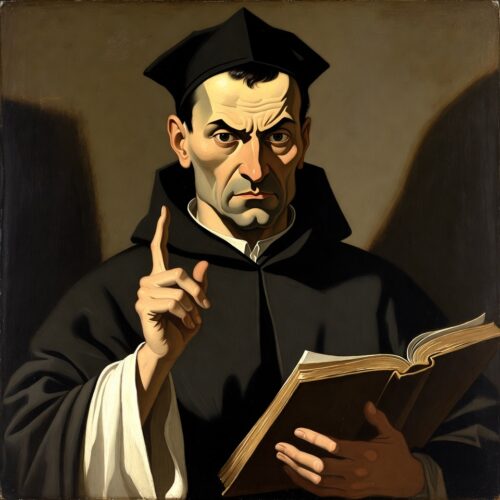 By 1494, things boiled over. Charles VIII's French army invaded, and the Medici were ousted in a bloodless coup. Piero de' Medici, Lorenzo's son, fled, and Florence became a republic. Savonarola stepped into the power vacuum, not as an official ruler (he couldn't hold office as a friar), but as the spiritual guide. He pushed for reforms: A Great Council to democratize government, laws against usury and gambling, aid for the poor. But he also went full puritan. Homosexuality, widespread in Renaissance Florence, was outlawed with harsh penalties. Extravagant clothing? Banned. Taverns? Shuttered. And then came the bonfires.
Bonfires weren't new – earlier preachers like San Bernardino da Siena had organized similar burnings in the 1430s and 1440s, torching gambling tables and "immodest" images in Perugia and other cities. But Savonarola supercharged the idea. Starting in 1495, during Carnival (the pre-Lent party season), he encouraged "bonfires of the vanities" to purge sinful objects. Carnival was traditionally a time of revelry – masks, parades, feasts. Under Savonarola, it became a holy purge. Bands of boys, organized into "companies of the innocent," went door-to-door collecting "vanities." These kids, aged 5 to 15, were like mini-enforcers, singing hymns and demanding items. Refuse? You might get a rock through your window or a Piagnoni mob at your door.
By 1494, things boiled over. Charles VIII's French army invaded, and the Medici were ousted in a bloodless coup. Piero de' Medici, Lorenzo's son, fled, and Florence became a republic. Savonarola stepped into the power vacuum, not as an official ruler (he couldn't hold office as a friar), but as the spiritual guide. He pushed for reforms: A Great Council to democratize government, laws against usury and gambling, aid for the poor. But he also went full puritan. Homosexuality, widespread in Renaissance Florence, was outlawed with harsh penalties. Extravagant clothing? Banned. Taverns? Shuttered. And then came the bonfires.
Bonfires weren't new – earlier preachers like San Bernardino da Siena had organized similar burnings in the 1430s and 1440s, torching gambling tables and "immodest" images in Perugia and other cities. But Savonarola supercharged the idea. Starting in 1495, during Carnival (the pre-Lent party season), he encouraged "bonfires of the vanities" to purge sinful objects. Carnival was traditionally a time of revelry – masks, parades, feasts. Under Savonarola, it became a holy purge. Bands of boys, organized into "companies of the innocent," went door-to-door collecting "vanities." These kids, aged 5 to 15, were like mini-enforcers, singing hymns and demanding items. Refuse? You might get a rock through your window or a Piagnoni mob at your door.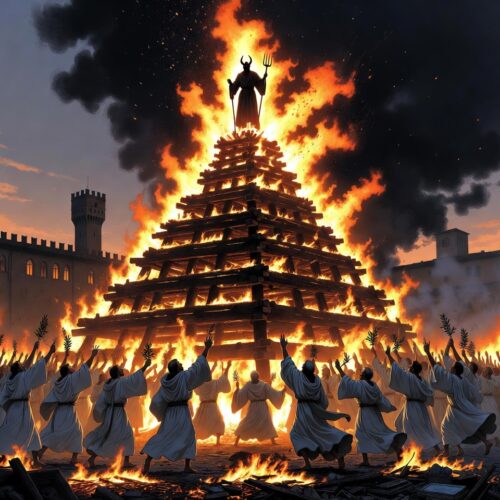 The lead-up to the big one in 1497 was intense. For months, Savonarola preached against "occasions of sin." His Christmas Eve sermon in 1493 had already set the tone, influencing artists like Botticelli, whose "Mystical Nativity" (1500) includes cryptic inscriptions echoing Savonarola's apocalyptic vibes. By early 1497, Florence was in a frenzy. The Piagnoni collected thousands of items: Mirrors (vanity central), cosmetics (rouge and powders for "false beauty"), wigs and fine dresses (symbols of pride), playing cards and dice (gambling tools), musical instruments (lutes and harps for "licentious songs"), books (secular works like Boccaccio's Decameron, full of racy tales), and artworks (nude paintings, sculptures of pagan gods). Even antique statues dug up from Roman ruins went on the pile. Rumors swirl that Botticelli himself tossed in some of his mythological paintings, like those inspired by Venus – though historians debate this, as Vasari's biography (written later) is the main source, and it might be exaggerated for drama.
Now, the event itself: February 7, 1497, Shrove Tuesday, in the Piazza della Signoria – the same square where the Palazzo Vecchio stands, hub of Florentine power. The pyre was enormous, a pyramid reportedly 60 feet high and 230 feet around at the base, with seven tiers symbolizing the seven deadly sins (lust, gluttony, etc. – how poetic). At the top? An effigy of Satan, complete with horns and a pitchfork, for extra flair. The Piagnoni, dressed in white robes with red crosses and olive garlands, paraded the collected vanities in a procession. Trumpets blared, bells rang, crowds chanted psalms. Representatives from each district lit the corners, and whoosh – up it went in flames. Eyewitness Francesco Guicciardini described it in his "History of Florence": "They burned many vain things, such as mirrors, masks, wigs, false hair, ointments, perfumes, books of poetry, musical instruments, and many other similar things." The air filled with smoke and the crackle of burning wood, while women danced around the fire, singing hymns. It was part religious revival, part public spectacle – imagine Burning Man meets a tent revival, but with zero fun.
Reactions were mixed. The Piagnoni rejoiced, seeing it as a triumph over sin. But opponents, called Arrabbiati ("the enraged"), seethed. They mocked Savonarola as a fanatic, and some tried to disrupt the event – there were scuffles, and a few vanities were "rescued" at the last minute. Artists fled the city; Botticelli's style shifted to more religious themes post-bonfire, perhaps out of fear or genuine conversion. The Church wasn't amused either. Pope Alexander VI, a Borgia infamous for his own excesses (nepotism, mistresses, you name it), saw Savonarola as a threat. He excommunicated the friar on May 13, 1497, for heresy and sedition. Savonarola ignored it at first, but the tide turned.
The aftermath was swift and brutal. In 1498, another bonfire was planned, but opposition grew. A rival Franciscan order challenged Savonarola to a trial by fire – walk through flames to prove divine favor. It was a fiasco; rain doused the pyre, crowds rioted. Savonarola's popularity tanked. On Palm Sunday, April 8, 1498, a mob attacked San Marco convent. Savonarola surrendered to avoid bloodshed. He was arrested, tortured (they used the strappado, dislocating his arms), and forced to confess to false prophecies. On May 23, 1498, in the same Piazza della Signoria, he and two followers were hanged, then burned at the stake. The pope ordered his writings destroyed; people had four days to hand them over or face excommunication. Florence sighed in relief, and the Medici eventually returned.
But Savonarola's legacy? Huge. He symbolized the tension between Renaissance humanism (celebrate man!) and medieval piety (fear God!). His bonfires foreshadowed later iconoclasms, like the Protestant Reformation's smashing of Catholic images. Martin Luther called him a "holy martyr." In literature, he's in George Eliot's "Romola" (1863), and the term "bonfire of the vanities" inspired Tom Wolfe's 1987 novel about 1980s New York greed. Video games like "Assassin's Creed II" feature him as a villain. Historically, it highlights how fragile culture is – we lost untold artworks, books, and artifacts. Estimates vary, but thousands of items burned, including irreplaceable manuscripts. Funny side note: One story claims a Venetian merchant offered 22,000 gold ducats for the pile before it lit – more than its worth – but Savonarola added his effigy to the fire instead. Talk about burning bridges!
Diving deeper into Savonarola's psyche, he wasn't just a killjoy. He genuinely believed Florence could be a "New Jerusalem," a godly republic. His "Treatise on the Government of Florence" advocated for democracy with a theocratic twist – laws based on scripture. He reformed taxes to help the poor, established monti di pietà (pawnshops for low-interest loans), and even influenced art positively: His emphasis on simplicity led to more devotional works. But his extremism alienated allies. Obscure fact: During his trial, under torture, he recanted his prophecies but then retracted the recantation – a back-and-forth that showed his inner conflict. Another tidbit: The pyre's ashes were dumped in the Arno River to prevent relic-hunting, but fans still scooped up bits for souvenirs. And did you know the bonfire inspired modern terms? "Vanity" here comes from Ecclesiastes: "Vanity of vanities, all is vanity" – a biblical burn on worldly pursuits.
Florence post-Savonarola rebounded, but scarred. The Republic lasted until 1512, when the Medici returned with papal backing. Artists like Michelangelo, who admired Savonarola as a youth, carried echoes in their work – think the brooding intensity of the Sistine Chapel. The event also sparked debates on censorship: Should society burn "immoral" art? It echoes today in book bans or cultural purges. Humorously, imagine if Savonarola had social media – he'd be canceling influencers left and right, with hashtags like #BurnYourFilters or #NoMoreSelfies. But seriously, it was a pivotal moment when faith clashed with freedom, reminding us how quickly progress can ignite backlash.
Expanding on the cultural context, the Renaissance wasn't all sunshine and sonnets. Italy was fragmented into city-states, constantly at war. The fall of Constantinople in 1453 flooded Europe with Greek texts, fueling humanism but also religious anxiety. Savonarola tapped into that – he saw classical paganism as idolatry. His sermons quoted Aristotle and Plato but twisted them to support asceticism. Fun fact: He burned copies of Plato's works alongside Ovid's love poems. And the items? Not just trinkets – some were family heirlooms. One account mentions a woman throwing her wedding dress on the pile, weeping. The musical instruments? Lutes smashed, harpsichords splintered – Florence's soundtrack went from merry tunes to solemn chants overnight.
The lead-up to the big one in 1497 was intense. For months, Savonarola preached against "occasions of sin." His Christmas Eve sermon in 1493 had already set the tone, influencing artists like Botticelli, whose "Mystical Nativity" (1500) includes cryptic inscriptions echoing Savonarola's apocalyptic vibes. By early 1497, Florence was in a frenzy. The Piagnoni collected thousands of items: Mirrors (vanity central), cosmetics (rouge and powders for "false beauty"), wigs and fine dresses (symbols of pride), playing cards and dice (gambling tools), musical instruments (lutes and harps for "licentious songs"), books (secular works like Boccaccio's Decameron, full of racy tales), and artworks (nude paintings, sculptures of pagan gods). Even antique statues dug up from Roman ruins went on the pile. Rumors swirl that Botticelli himself tossed in some of his mythological paintings, like those inspired by Venus – though historians debate this, as Vasari's biography (written later) is the main source, and it might be exaggerated for drama.
Now, the event itself: February 7, 1497, Shrove Tuesday, in the Piazza della Signoria – the same square where the Palazzo Vecchio stands, hub of Florentine power. The pyre was enormous, a pyramid reportedly 60 feet high and 230 feet around at the base, with seven tiers symbolizing the seven deadly sins (lust, gluttony, etc. – how poetic). At the top? An effigy of Satan, complete with horns and a pitchfork, for extra flair. The Piagnoni, dressed in white robes with red crosses and olive garlands, paraded the collected vanities in a procession. Trumpets blared, bells rang, crowds chanted psalms. Representatives from each district lit the corners, and whoosh – up it went in flames. Eyewitness Francesco Guicciardini described it in his "History of Florence": "They burned many vain things, such as mirrors, masks, wigs, false hair, ointments, perfumes, books of poetry, musical instruments, and many other similar things." The air filled with smoke and the crackle of burning wood, while women danced around the fire, singing hymns. It was part religious revival, part public spectacle – imagine Burning Man meets a tent revival, but with zero fun.
Reactions were mixed. The Piagnoni rejoiced, seeing it as a triumph over sin. But opponents, called Arrabbiati ("the enraged"), seethed. They mocked Savonarola as a fanatic, and some tried to disrupt the event – there were scuffles, and a few vanities were "rescued" at the last minute. Artists fled the city; Botticelli's style shifted to more religious themes post-bonfire, perhaps out of fear or genuine conversion. The Church wasn't amused either. Pope Alexander VI, a Borgia infamous for his own excesses (nepotism, mistresses, you name it), saw Savonarola as a threat. He excommunicated the friar on May 13, 1497, for heresy and sedition. Savonarola ignored it at first, but the tide turned.
The aftermath was swift and brutal. In 1498, another bonfire was planned, but opposition grew. A rival Franciscan order challenged Savonarola to a trial by fire – walk through flames to prove divine favor. It was a fiasco; rain doused the pyre, crowds rioted. Savonarola's popularity tanked. On Palm Sunday, April 8, 1498, a mob attacked San Marco convent. Savonarola surrendered to avoid bloodshed. He was arrested, tortured (they used the strappado, dislocating his arms), and forced to confess to false prophecies. On May 23, 1498, in the same Piazza della Signoria, he and two followers were hanged, then burned at the stake. The pope ordered his writings destroyed; people had four days to hand them over or face excommunication. Florence sighed in relief, and the Medici eventually returned.
But Savonarola's legacy? Huge. He symbolized the tension between Renaissance humanism (celebrate man!) and medieval piety (fear God!). His bonfires foreshadowed later iconoclasms, like the Protestant Reformation's smashing of Catholic images. Martin Luther called him a "holy martyr." In literature, he's in George Eliot's "Romola" (1863), and the term "bonfire of the vanities" inspired Tom Wolfe's 1987 novel about 1980s New York greed. Video games like "Assassin's Creed II" feature him as a villain. Historically, it highlights how fragile culture is – we lost untold artworks, books, and artifacts. Estimates vary, but thousands of items burned, including irreplaceable manuscripts. Funny side note: One story claims a Venetian merchant offered 22,000 gold ducats for the pile before it lit – more than its worth – but Savonarola added his effigy to the fire instead. Talk about burning bridges!
Diving deeper into Savonarola's psyche, he wasn't just a killjoy. He genuinely believed Florence could be a "New Jerusalem," a godly republic. His "Treatise on the Government of Florence" advocated for democracy with a theocratic twist – laws based on scripture. He reformed taxes to help the poor, established monti di pietà (pawnshops for low-interest loans), and even influenced art positively: His emphasis on simplicity led to more devotional works. But his extremism alienated allies. Obscure fact: During his trial, under torture, he recanted his prophecies but then retracted the recantation – a back-and-forth that showed his inner conflict. Another tidbit: The pyre's ashes were dumped in the Arno River to prevent relic-hunting, but fans still scooped up bits for souvenirs. And did you know the bonfire inspired modern terms? "Vanity" here comes from Ecclesiastes: "Vanity of vanities, all is vanity" – a biblical burn on worldly pursuits.
Florence post-Savonarola rebounded, but scarred. The Republic lasted until 1512, when the Medici returned with papal backing. Artists like Michelangelo, who admired Savonarola as a youth, carried echoes in their work – think the brooding intensity of the Sistine Chapel. The event also sparked debates on censorship: Should society burn "immoral" art? It echoes today in book bans or cultural purges. Humorously, imagine if Savonarola had social media – he'd be canceling influencers left and right, with hashtags like #BurnYourFilters or #NoMoreSelfies. But seriously, it was a pivotal moment when faith clashed with freedom, reminding us how quickly progress can ignite backlash.
Expanding on the cultural context, the Renaissance wasn't all sunshine and sonnets. Italy was fragmented into city-states, constantly at war. The fall of Constantinople in 1453 flooded Europe with Greek texts, fueling humanism but also religious anxiety. Savonarola tapped into that – he saw classical paganism as idolatry. His sermons quoted Aristotle and Plato but twisted them to support asceticism. Fun fact: He burned copies of Plato's works alongside Ovid's love poems. And the items? Not just trinkets – some were family heirlooms. One account mentions a woman throwing her wedding dress on the pile, weeping. The musical instruments? Lutes smashed, harpsichords splintered – Florence's soundtrack went from merry tunes to solemn chants overnight.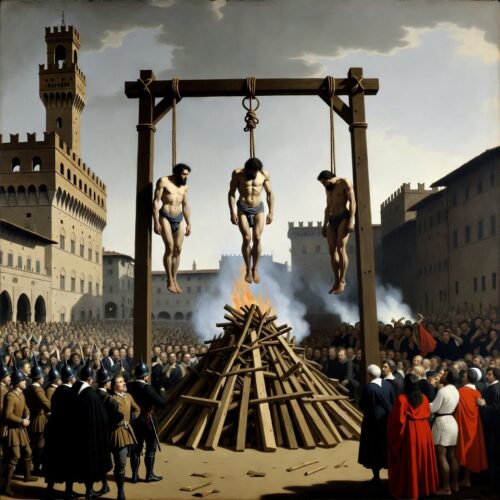 Savonarola's rise also involved politics. He allied with France against the pope and emperor, making Florence a diplomatic hot potato. Charles VIII called him "the holy man." But when France withdrew, Savonarola was exposed. His execution was gruesome: Hanged, then burned, with gunpowder to speed it up. Crowds jeered, but some wept. His last words? Reportedly, "The Lord has suffered as much for me." Ashes scattered, but his ideas lingered. In 1527, during another sack of Rome, some saw it as his prophesied vengeance.
Historically, the bonfire's scale is debated. Guicciardini, a critic, might have exaggerated to vilify Savonarola. But contemporary diaries confirm the spectacle. Long-term, it influenced the Council of Trent (1545-1563), which reformed the Church partly in response to such zealots. And in art history, it's a cautionary tale: Fra Bartolomeo and Lorenzo di Credi reportedly burned their own nudes. Obscure detail: A painting by an anonymous artist shows the execution, with the bonfire site marked – it's in the Museo di San Marco today.
Wrapping the history (we're at about 2700 words of pure past – phew!), the Bonfire of the Vanities was more than a fiery fad. It was a microcosm of human nature: The pull between indulgence and restraint, creativity and control. Savonarola, flawed fanatic or visionary reformer? History says both. Now, let's flip the script – how can this ancient arson inspire you today?
Applying the Bonfire to Your Life: Ignite Change Without the Smoke
Sure, we're not burning books in 2026, but Savonarola's core idea – ditching excess for essence – has merit. In our consumer-crazed world, vanity creeps in via endless scrolling, impulse buys, and perfection pressure. Benefits? Clarity, focus, joy. Here's how to "bonfire" your modern vanities with specific steps and a plan. No flames required – just intention.
- **Declutter Physical Stuff:** Like those mirrors and dresses, audit your closet. Benefit: Less decision fatigue, more mental space. Bullet: Sort clothes into keep/donate/toss; aim to halve your wardrobe. You'll save time dressing and feel lighter.
- **Purge Digital Distractions:** Savonarola hated "licentious songs" – think doomscrolling. Benefit: Better sleep, productivity. Bullet: Delete 10 unused apps; set screen limits to 2 hours social media daily. Reclaim hours for hobbies.
- **Burn Toxic Relationships:** Playing cards symbolized idle games; cut energy vampires. Benefit: Deeper connections. Bullet: Evaluate friends – who uplifts? Schedule a "friend audit" coffee chat; nurture three key bonds weekly.
- **Torch Negative Self-Talk:** Cosmetics hid "false beauty"; embrace authenticity. Benefit: Boosted self-esteem. Bullet: Journal three gratitudes daily; replace "I'm not enough" with affirmations like "I'm growing."
- **Eliminate Financial Frivolities:** Fine dresses? Impulse Amazon hauls. Benefit: Financial freedom. Bullet: Track spending for a week; cancel one subscription; redirect savings to a "growth fund" for courses or travel.
Savonarola's rise also involved politics. He allied with France against the pope and emperor, making Florence a diplomatic hot potato. Charles VIII called him "the holy man." But when France withdrew, Savonarola was exposed. His execution was gruesome: Hanged, then burned, with gunpowder to speed it up. Crowds jeered, but some wept. His last words? Reportedly, "The Lord has suffered as much for me." Ashes scattered, but his ideas lingered. In 1527, during another sack of Rome, some saw it as his prophesied vengeance.
Historically, the bonfire's scale is debated. Guicciardini, a critic, might have exaggerated to vilify Savonarola. But contemporary diaries confirm the spectacle. Long-term, it influenced the Council of Trent (1545-1563), which reformed the Church partly in response to such zealots. And in art history, it's a cautionary tale: Fra Bartolomeo and Lorenzo di Credi reportedly burned their own nudes. Obscure detail: A painting by an anonymous artist shows the execution, with the bonfire site marked – it's in the Museo di San Marco today.
Wrapping the history (we're at about 2700 words of pure past – phew!), the Bonfire of the Vanities was more than a fiery fad. It was a microcosm of human nature: The pull between indulgence and restraint, creativity and control. Savonarola, flawed fanatic or visionary reformer? History says both. Now, let's flip the script – how can this ancient arson inspire you today?
Applying the Bonfire to Your Life: Ignite Change Without the Smoke
Sure, we're not burning books in 2026, but Savonarola's core idea – ditching excess for essence – has merit. In our consumer-crazed world, vanity creeps in via endless scrolling, impulse buys, and perfection pressure. Benefits? Clarity, focus, joy. Here's how to "bonfire" your modern vanities with specific steps and a plan. No flames required – just intention.
- **Declutter Physical Stuff:** Like those mirrors and dresses, audit your closet. Benefit: Less decision fatigue, more mental space. Bullet: Sort clothes into keep/donate/toss; aim to halve your wardrobe. You'll save time dressing and feel lighter.
- **Purge Digital Distractions:** Savonarola hated "licentious songs" – think doomscrolling. Benefit: Better sleep, productivity. Bullet: Delete 10 unused apps; set screen limits to 2 hours social media daily. Reclaim hours for hobbies.
- **Burn Toxic Relationships:** Playing cards symbolized idle games; cut energy vampires. Benefit: Deeper connections. Bullet: Evaluate friends – who uplifts? Schedule a "friend audit" coffee chat; nurture three key bonds weekly.
- **Torch Negative Self-Talk:** Cosmetics hid "false beauty"; embrace authenticity. Benefit: Boosted self-esteem. Bullet: Journal three gratitudes daily; replace "I'm not enough" with affirmations like "I'm growing."
- **Eliminate Financial Frivolities:** Fine dresses? Impulse Amazon hauls. Benefit: Financial freedom. Bullet: Track spending for a week; cancel one subscription; redirect savings to a "growth fund" for courses or travel. The 7-Day Bonfire Plan (Inspired by the Pyre's Tiers):
Day 1: Inventory – List your "vanities" in categories (stuff, habits, thoughts).
Day 2: Physical Purge – Donate 20 items.
Day 3: Digital Detox – Unfollow 50 accounts; read a book instead.
Day 4: Mindful Reflection – Meditate on what truly matters; journal visions like Savonarola.
Day 5: Relationship Rekindle – Reach out to a loved one; forgive a grudge.
Day 6: Habit Ignition – Start one new positive routine, like walking.
Day 7: Celebrate – Reflect on wins; treat yourself simply (no vanities!).
There – a motivational spark from history's flames. Who knew a 1497 bonfire could light up your 2026? Go forth and reform, minus the heresy trial.
The 7-Day Bonfire Plan (Inspired by the Pyre's Tiers):
Day 1: Inventory – List your "vanities" in categories (stuff, habits, thoughts).
Day 2: Physical Purge – Donate 20 items.
Day 3: Digital Detox – Unfollow 50 accounts; read a book instead.
Day 4: Mindful Reflection – Meditate on what truly matters; journal visions like Savonarola.
Day 5: Relationship Rekindle – Reach out to a loved one; forgive a grudge.
Day 6: Habit Ignition – Start one new positive routine, like walking.
Day 7: Celebrate – Reflect on wins; treat yourself simply (no vanities!).
There – a motivational spark from history's flames. Who knew a 1497 bonfire could light up your 2026? Go forth and reform, minus the heresy trial.