Introduction: The Alchemy of January 18

On the morning of January 18, 1701, the world changed—not by the stroke of a sword, but by the placement of a hat. In the frozen, wind-swept city of Königsberg, nestled on the Baltic coast, a physically frail and often underestimated man named Frederick III performed an act of political alchemy so potent that its reverberations are still felt in the geopolitical architecture of the modern world. He walked into a church as an Elector and walked out as a King.

This was not merely a costume change. It was a calculated, high-stakes rebellion against the rigid hierarchy of European nobility. In the 18th century, titles were not vanity; they were the source code of power. To be a King was to possess sovereignty, to treat with empires as an equal, and to command a destiny distinct from the chaotic vassalage of the Holy Roman Empire. Frederick, ruling over a "sandbox" of scattered territories and recovering from the devastation of the Thirty Years' War, dared to elevate himself to the highest rank of human governance.

The event of January 18, 1701—the Coronation of Frederick I—is a masterclass in vision, logistics, and the sheer force of will. It serves as the ultimate historical case study in "Self-Coronation": the psychological and strategic process of asserting one’s value in a marketplace that refuses to acknowledge it.

This report will dissect that day and the years of maneuvering that led to it, reconstructing the freezing winter journey, the secret diplomatic treaties, the blinding Baroque pageantry, and the human moments of defiance that defined the birth of the Kingdom of Prussia. Following this exhaustive historical analysis, we will extract a rigorous, actionable protocol for modern application. Just as Frederick transformed the Margraviate of Brandenburg into the Kingdom of Prussia, the modern individual can utilize these same principles to transmute their own station, crowning themselves in their chosen field through a deliberate application of the "Prussian Protocol."

Part I: The Historical Crucible
The Geopolitical Vacuum: The Sandbox of the Holy Roman Empire
To understand the magnitude of what occurred on January 18, 1701, one must first descend into the precarious reality of the House of Hohenzollern at the turn of the 18th century. Frederick III was born into a legacy of survival, not splendor. His territories were a disjointed patchwork spread across northern Germany, famously described as the "sandbox of the Holy Roman Empire" due to the poor quality of the soil and the lack of natural resources.
1.1 The Shadow of the Thirty Years' War
The collective memory of Frederick’s subjects was scarred by the Thirty Years' War (1618–1648), a conflict that had decimated the population of Brandenburg. Cities had been burned, commerce halted, and the land depopulated. The Hohenzollern domains had been the marching grounds for foreign armies—Swedes, French, and Imperial troops—who took what they pleased. This trauma instilled a deep-seated lesson in the Prussian psyche: without sovereign power and a standing army, one is merely a victim of history.
Frederick’s father, Frederick William, known as the "Great Elector," had spent his life clawing back respectability through military discipline and shrewd diplomacy. He had built a formidable army, but he remained, in the eyes of the European elite, a vassal. He was an "Elector"—one of the select princes entitled to vote for the Holy Roman Emperor—but he was not a Monarch. He bowed to Vienna. He bowed to Paris. He bowed to Stockholm.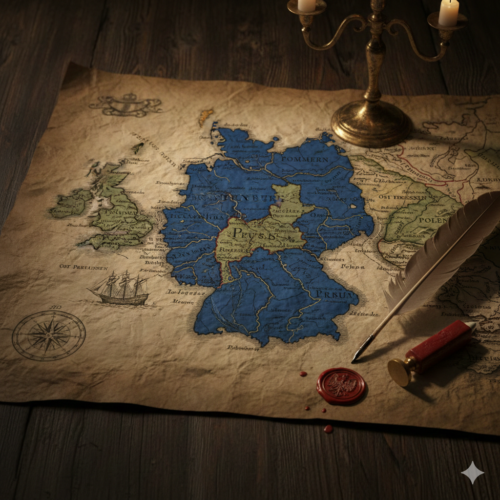 1.2 The Crisis of Rank
By the late 1690s, the "rank gap" had become an existential threat. Frederick III looked around Europe and saw his peers elevating themselves, leaving him behind.
1.2 The Crisis of Rank
By the late 1690s, the "rank gap" had become an existential threat. Frederick III looked around Europe and saw his peers elevating themselves, leaving him behind.
The Elector of Saxony, Augustus the Strong, had bought his way onto the throne of Poland, becoming King Augustus II.
The Elector of Hanover, George, was in the line of succession for the throne of Great Britain.
William of Orange, a cousin, had become King William III of England.
In the protocol-obsessed world of the Baroque era, this was disastrous. A King sat in a chair with arms; an Elector sat in a chair without arms. A King’s ambassadors were received with trumpets and open doors; an Elector’s ambassadors waited in the antechamber. These were not petty grievances—they translated directly into diplomatic leverage, marriage alliances, and the ability to secure loans. Frederick realized that if he did not secure a crown, his dynasty would sink into irrelevance, squeezed between the rising powers of the North and the West.

But there was a problem: The Holy Roman Empire, a thousand-year-old institution, strictly forbade the creation of new kingdoms within its borders. There was only one King in the Empire: the King of Bohemia (a title held by the Emperor himself). For Frederick to become a King, he would have to do the impossible—he would have to break the fundamental law of the Empire without inciting a war.
The Diplomatic Masterstroke: The Crown Treaty
The opportunity for elevation arrived in the form of a looming crisis: the death of the childless King Charles II of Spain. The Spanish Empire, which encompassed vast territories in the Americas, Italy, and the Netherlands, was up for grabs. The two superpowers of the day—Bourbon France under Louis XIV and Habsburg Austria under Emperor Leopold I—were poised to tear Europe apart to claim the inheritance. This was the War of the Spanish Succession.

Emperor Leopold I needed men. Specifically, he needed the disciplined, battle-hardened troops that the Great Elector and Frederick III had cultivated. Frederick saw the opening. He would trade blood for dignity.

2.1 The Negotiation

The negotiations were secretive, tense, and prolonged. Frederick’s ministers, led by the astute but controversial Johann Kasimir Kolbe von Wartenberg, engaged in a high-stakes poker game with Vienna. The Emperor was reluctant. Elevating a Protestant Elector to royal status was dangerous; it could upset the delicate religious balance of the Empire and encourage other princes to demand similar upgrades.

However, the threat of France was existential. Frederick played his hand perfectly: he offered 8,000 of his finest troops to the Emperor’s service for the coming war. In exchange, he demanded not land, not gold, but a word. He wanted recognition as King.

2.2 The Linguistic Loophole: "King in Prussia"

The legal hurdles were immense. As Elector of Brandenburg, Frederick was a subject of the Emperor. He could not be "King of Brandenburg." However, Frederick possessed another title: Duke of Prussia.

The Duchy of Prussia (East Prussia) lay outside the legal boundaries of the Holy Roman Empire. Historically a fief of the Polish Crown, it had achieved sovereignty in the mid-17th century. Frederick’s diplomats argued a brilliant legal fiction: Since the Emperor’s jurisdiction ended at the Imperial border, he had no right to stop Frederick from being a King in a territory that lay outside the Empire.

Leopold I capitulated, but with a strict condition designed to limit Frederick’s prestige. Frederick could not call himself "King of Prussia" (König von Preußen), as this might imply a territorial claim over Polish Prussia (West Prussia), which was still under the Polish Crown. Instead, he must style himself "King in Prussia" (König in Preußen).

To the modern ear, the difference between "of" and "in" sounds trivial. In 1700, it was the difference between a territorial claim and a mere title. But Frederick accepted. He knew that once the title was established, the preposition would eventually fall away. He was buying the concept of monarchy, knowing he could fill it with reality later.

On November 16, 1700, the "Crown Treaty" (Krontraktat) was signed. The transaction was complete: 8,000 Prussian lives for one golden circle.
The Winter Journey: Logistics of the Sublime
With the treaty signed, Frederick had to physically travel to the Duchy of Prussia to claim his crown. The coronation had to happen in Königsberg, the capital of the sovereign duchy, not in Berlin, which was still technically a vassal city.

This necessitated a winter journey of epic proportions. In December 1700, the entire Prussian court mobilized for a migration that would test the limits of 18th-century logistics.

3.1 The Scale of the Caravan

The numbers are staggering. Frederick did not travel lightly; he traveled with the full weight of the state to prove he was worthy of the crown. The procession consisted of:
1,800 carriages: Carrying the royal family, the ministers, the court musicians, the chefs, the wardrobe, and the regalia.
30,000 horses: Required for relay teams along the route.
The Crown Jewels: The newly commissioned regalia, hidden in secured coaches.
The route from Berlin to Königsberg covered approximately 600 kilometers (almost 400 miles) of brutal terrain. The roads of Pomerania and Prussia were notoriously poor—deep ruts in summer, frozen iron-hard tracks in winter.

3.2 The Weather of 1700/1701

This journey took place during the climatic period known as the Little Ice Age. While the catastrophic "Great Frost" of 1709 was still a few years away, the winter of 1700/1701 was severe. Contemporary accounts describe biting winds, deep snowdrifts, and temperatures that froze wine in the barrel.

Traveling in such conditions was a calculated risk. A blizzard could have stranded the court, killing horses and embarrassing the prospective King. Yet, Frederick pushed forward. He stopped at every major town to receive accolades, turning the grueling march into a victory lap. The sight of 1,800 carriages snaking through the snow-covered pine forests was a visual assertion of power that the local peasantry had never seen. It signaled that the center of gravity was shifting.

The logistical cost was immense. It is estimated that the coronation and the journey cost the state 6 million thalers—roughly twice the annual revenue of the government. Frederick was mortgaging the state’s future on a single event, betting that the return on investment in terms of status and alliances would outweigh the debt.
The Institution of Merit: The Order of the Black Eagle
Frederick arrived in Königsberg in late December, and the preparations for the ceremony began. But before he crowned himself, he did something strategically profound. On January 17, 1701—the day before the coronation—he founded a new order of chivalry: The Order of the Black Eagle (Hoher Orden vom Schwarzen Adler).
This was not merely a vanity project. It was a tool of statecraft. By creating a new, exclusive hierarchy, Frederick ensured that the most powerful men in his realm would owe their prestige directly to him, the new King.
4.1 The Symbolism
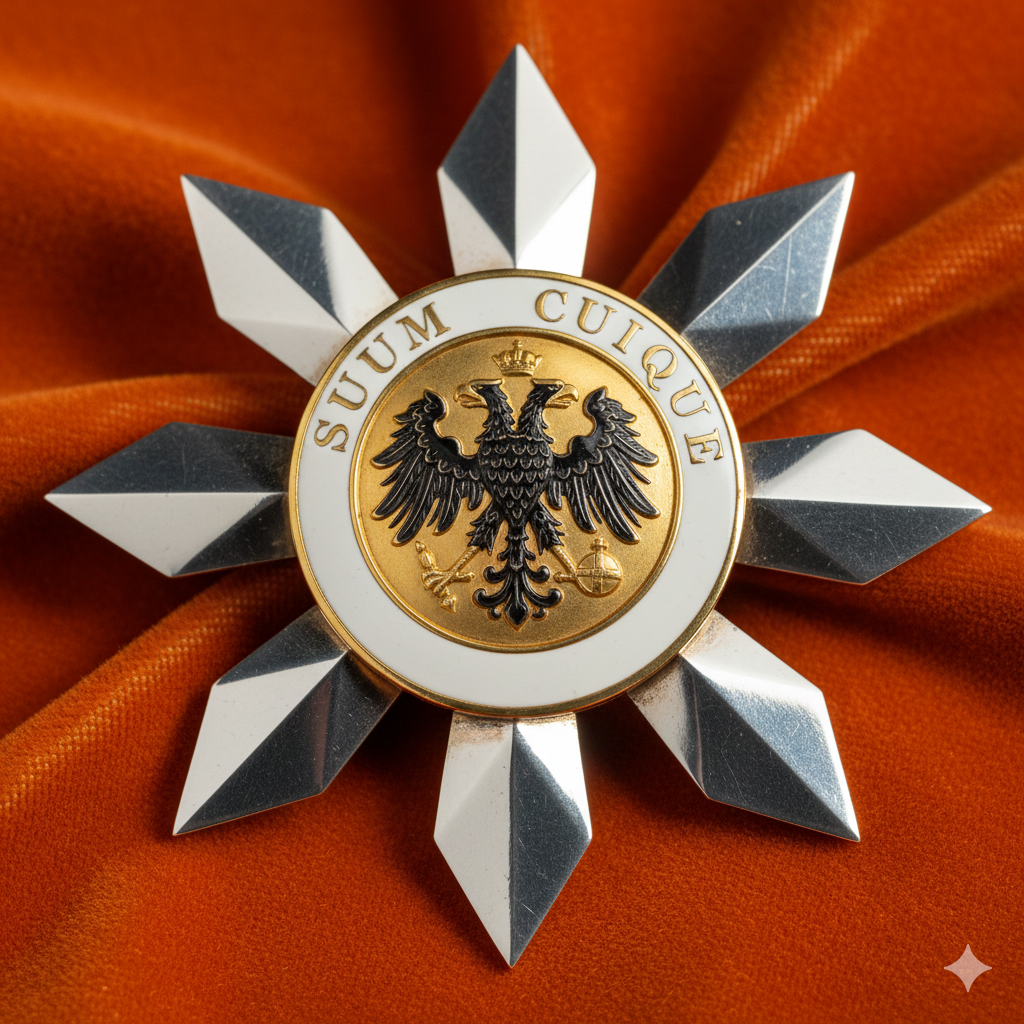
The badge of the order was a blue enameled Maltese cross with black eagles between the arms. The ribbon was orange, honoring his mother, Louise Henriette of Orange-Nassau. But the most important element was the motto inscribed on the star: Suum Cuique.
4.2 "Suum Cuique" – To Each His Own
This Latin phrase, derived from Cicero, translates to "To each his own" or "To each according to his merit." In the context of 1701, it was a radical statement. It suggested a kingdom built not just on blood, but on justice and merit. It signaled that in this new Kingdom of Prussia, service to the state would be the highest virtue.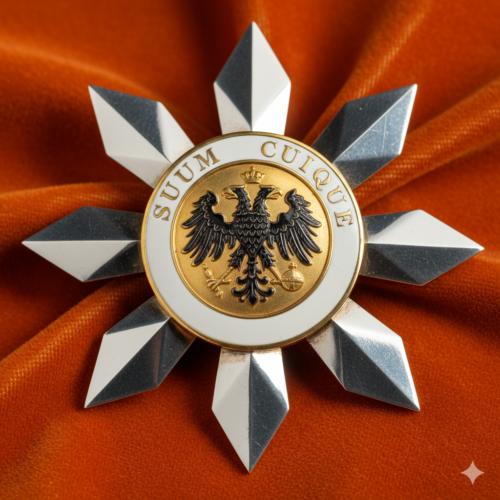 The first knights invested included the Crown Prince (the future Frederick William I) and the King’s half-brothers. By binding the royal family and the top generals to this order, Frederick created a "Circle of Excellence" that reinforced his new majesty. The investiture ceremony on January 17th served as the prelude, the spiritual purification before the political apotheosis of the next day.
January 18, 1701: The Day of the Crown
The morning of January 18 dawned cold and gray over the Pregel River. Inside the great Königsberg Castle (Schloss Königsberg), the air was thick with incense, perfume, and the tension of history in the making.
5.1 The Attire of Ambition
Frederick knew that to be a King, he had to look like a god. He wore a coat of scarlet velvet, so heavily embroidered with gold that it was stiff to the touch. But the centerpiece of his attire was the buttons. He wore diamond buttons, each one a fortune, worth a reported total of thousands of thalers. His mantle was of crimson velvet, lined with ermine, the fur of kings.
5.2 The Act of Self-Coronation
The ceremony began in the Audience Chamber of the castle, not in the church. This location was chosen for a specific, symbolic reason.
In traditional coronations, the King knelt before a Bishop or the Pope, who placed the crown upon his head. This ritual symbolized that the King’s power came from God, mediated through the Church. Frederick, however, was a Calvinist ruling a Lutheran populace, and more importantly, he was a sovereign who owed his title to his own negotiation, not to the Pope or the Emperor.
At approximately 10:00 AM, Frederick III stood before the table bearing the regalia. He reached out, took the crown—a magnificent piece of open-work gold featuring a single arch (a style usually reserved for Emperors)—and placed it upon his own head.
There was no hesitation. In that moment, he declared that his power was direct. He was autocrown. He answered only to God.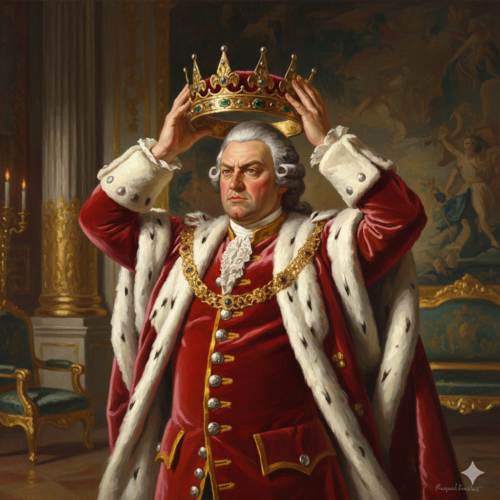 After crowning himself, he turned to his wife, Sophie Charlotte. She knelt before him, and he placed a smaller queen’s crown upon her head. This gesture cemented the hierarchy of the new state: The King is the source of all honor; the Queen receives her status from the King.
5.3 The Ecumenical Anointing
Only after he was already crowned did Frederick proceed to the Castle Church (Schlosskirche) for the religious service. This reversal of the usual order (Crowning, then Anointing) was deliberate. The church service was not to make him King, but to bless the King who already existed.
The service itself was a marvel of diplomatic engineering. Prussia was a bi-confessional state. The Hohenzollerns were Calvinists (Reformed), while the vast majority of their subjects were Lutherans. To unite his people, Frederick appointed two bishops specifically for this day:
After crowning himself, he turned to his wife, Sophie Charlotte. She knelt before him, and he placed a smaller queen’s crown upon her head. This gesture cemented the hierarchy of the new state: The King is the source of all honor; the Queen receives her status from the King.
5.3 The Ecumenical Anointing
Only after he was already crowned did Frederick proceed to the Castle Church (Schlosskirche) for the religious service. This reversal of the usual order (Crowning, then Anointing) was deliberate. The church service was not to make him King, but to bless the King who already existed.
The service itself was a marvel of diplomatic engineering. Prussia was a bi-confessional state. The Hohenzollerns were Calvinists (Reformed), while the vast majority of their subjects were Lutherans. To unite his people, Frederick appointed two bishops specifically for this day:
Bishop Benjamin Ursinus von Bär, representing the Calvinist court.
Bishop Bernhard von Sanden, representing the Lutheran populace.
The two bishops, standing side by side, anointed the King’s forehead and wrists with holy oil. This act of ecumenism was rare in an era of religious strife and signaled that the Prussian King was the protector of all Protestants. Notably, after the anointing, the King wiped the oil off, a subtle indication that he did not consider the clerical blessing to be an indelible mark of authority superior to his own will.
The Human Element: The Queen’s Pinch of Snuff
Amidst the suffocating pomp—the four-hour service, the endless sermons, the heavy velvet—there occurred a moment of delightful human rebellion.

Queen Sophie Charlotte was not a typical consort. She was the sister of the future King George I of Great Britain, and a brilliant intellectual in her own right. She was the correspondent and patron of Gottfried Wilhelm Leibniz, the great philosopher and mathematician. Together, they had founded the Berlin Academy of Sciences in 1700. Sophie Charlotte preferred debates on metaphysics to court etiquette. She famously teased Leibniz, asking him to explain the "why" of the "why."

To her, the coronation was a necessary political theater, but a tedious one. During the endless droning of the coronation sermon, while the court stood in frozen reverence, Sophie Charlotte was observed taking her snuff box from her robes. With a casual elegance, she took a pinch of snuff—a habit considered somewhat "rakish" for a woman, let alone a Queen in the middle of her consecration.

Frederick, seeing this from his throne, was reportedly furious. He sent a glare that could have melted the Baltic ice. But Sophie Charlotte finished her snuff. This small gesture of independence—a "pinch of reality" amidst the constructed majesty—remains one of the most endearing anecdotes of the day. It reminds us that even inside the heavy machinery of statecraft, the individual personality persists.
The Celebration: Fountains of Wine and Fire in the Sky
Once the religious service concluded, the new Kingdom of Prussia erupted in a celebration designed to overwhelm the senses of every observer.

7.1 The Coronation Banquet

The royal banquet was held in the Great Hall of the castle. The menu was a testament to the King’s reach and the culinary sophistication of the era. While exact menus are reconstructed from court records of the time, we know the feast included:
Whole Roasted Oxen: Stuffed with other meats, symbolizing abundance.
Pyramids of Confectionery: Sugar sculptures depicting the Black Eagle and the Goddess of Fame.
The Wines: The finest French Burgundies and Rhine wines flowed freely.
7.2 The Public Feast
Frederick understood that a King must be loved (or at least appreciated) by his people. In the castle courtyard, the scene was even more chaotic and joyous. Two fountains had been constructed for the day. At a signal, they began to spout wine instead of water—one fountain flowing with red wine, the other with white. The citizens of Königsberg drank from the King’s bounty. Commemorative silver and gold medals, struck with the King’s profile and the new royal title, were thrown by the handful from the castle balconies into the scrambling crowd below.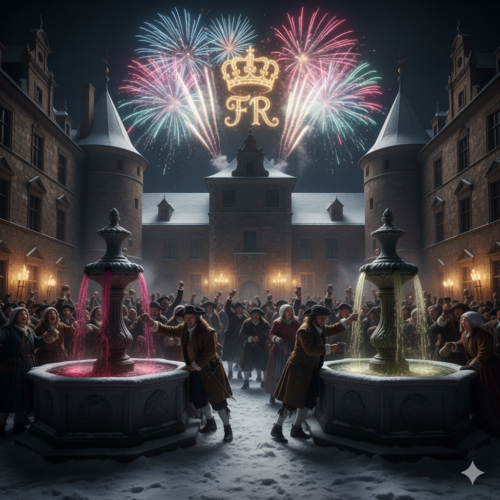 7.3 The Illuminations
As night fell early in the northern winter, the sky was set ablaze. Baroque fireworks were high art. Elaborate set-pieces were constructed on the frozen river and the castle grounds.
7.3 The Illuminations
As night fell early in the northern winter, the sky was set ablaze. Baroque fireworks were high art. Elaborate set-pieces were constructed on the frozen river and the castle grounds.
Allegories in Fire: Rockets exploded to reveal burning outlines of crowns, eagles, and the initials "FR" (Fridericus Rex).
The Message: The night sky itself was commandeered to proclaim the new reality. To a pre-industrial populace, the control of fire and light was a demonstration of near-supernatural power.
The Legacy: The Birth of a Superpower
When the hangover of the festivities cleared, Europe woke up to a new map. The "King in Prussia" was no longer just an Elector.
The Psychological Shift: The title unified the disparate lands of the Hohenzollerns. A subject in Cleves (in the west) and a subject in Königsberg (in the east) now served the same King, not just a Duke or Margrave. This created a nascent national identity.
The Military Rise: The title gave Prussia the status to punch above its weight. Frederick I’s son, Frederick William I (the "Soldier King"), would strip away the diamond buttons and expensive pageantry to focus entirely on the army, filling the royal shell his father built with military steel.
The Empire: Frederick I’s grandson, Frederick the Great, would use that army to invade Silesia and drop the "in" from his title, forcing Europe to acknowledge him as King of Prussia.
On January 18, 1871—exactly 170 years later—King William I of Prussia stood in the Hall of Mirrors at Versailles and was proclaimed German Emperor. He chose that date deliberately. The coronation of 1701 was the seed; the German Empire was the tree.

Part II: The Sovereignty Protocol – Applied Motivation

"Suum Cuique" – To Each According to His Merit.

The history of January 18, 1701, is more than a chronicle of dead kings and velvet robes. It is a playbook for Radical Agency. Frederick III was a man with a "deformed spine" and a "sandbox" territory, sandwiched between empires. He had every reason to remain a second-tier vassal. Instead, he engineered a reality where he became a King.

He did not wait for the "right time." He did not wait for permission. He negotiated, he traveled through the ice, and he placed the crown on his own head.

How does a person benefit today from this historical fact? By applying the Prussian Protocol to their own life. Whether you are seeking a promotion, launching a business, or redefining your identity, the steps Frederick took are the universal steps of elevation.

Phase 1: The Crown Treaty (The Art of Value Negotiation)

Frederick did not beg the Emperor for a crown. He traded for it. He knew the Emperor needed troops, so he built an army (his asset) and leveraged it for the one thing he couldn't build: status.

Actionable Insight:

Most people negotiate from a place of need ("I want this raise," "I want this opportunity"). Sovereigns negotiate from a place of asset exchange.

The Plan:
Identify Your "Emperor": Who holds the keys to the next level of your life? Is it a boss, an investor, a publisher, or a specific market?
Audit Your "8,000 Troops": What is the one tangible asset you possess that the "Emperor" is desperate for? Is it your ability to solve a specific crisis? Your network? Your specialized coding skill? Your time?
The "King in Prussia" Maneuver: If they refuse to give you the ultimate title you want (e.g., Partner, CEO), find the linguistic loophole. Negotiate for a title or role that sounds lesser but grants you sovereignty over a specific domain.
Phase 2: The Winter Journey (The Logistics of Resilience)

Frederick moved 1,800 carriages through the Little Ice Age. He didn't wait for spring. He understood that the friction of the journey validated the worth of the destination.

Actionable Insight:

We live in an era of "convenience." We wait for the "right conditions" to start. But the roads to sovereignty are always frozen. The waiting is the failure.

The Plan:
Embrace the "Bad Weather": Look at your current obstacles (lack of money, lack of time, fatigue). Reframe them. These are not reasons to stop; they are the terrain. Frederick traveled because it was winter, to ensure he was King by January.
Logistical Overkill: Do not attempt a "King" level objective with "Elector" level resources. If you are launching a massive project, do not skimp on sleep, nutrition, or support.
The "30,000 Horses" Audit: What support systems do you need to reach your goal?
Do you need a relay team (assistants, mentors)?
Do you need better "carriages" (technology, software)?
Stop trying to white-knuckle your way to grandeur. Build the infrastructure that makes the journey inevitable.
Phase 3: The Order of the Black Eagle (Constructing Your Court)

The day before he became King, Frederick created a new hierarchy. He minted a new coin of social currency—membership in his Order. He defined who was "in" and who was "out," based on merit.

Actionable Insight:

You cannot rise if you are surrounded by people who view you as your "old self." You must create a new "Order" that reinforces your new identity.

The Plan:
Adopt the Motto: Suum Cuique (To Each His Merit). Make this the rule of your inner circle. No free rides for old friends who drag you down.
The Investiture: Identify the 3-5 people in your life who represent the "King" standard you aspire to.
Formalize the Bond: Don't just "hang out." Create a structure. Start a monthly dinner, a mastermind group, or a weekly accountability call. Call it your "Chapter." Give it a name.
The Standard: Use this group to enforce your new standards. When you act like a "Duke" instead of a "King," this group’s job is to correct you.
Phase 4: The Self-Coronation (The Principle of Autocrown)

This is the most critical lesson of January 18. Frederick did not let the Bishop crown him. He did it himself.

Actionable Insight:

Impostor syndrome is the waiting room for a Bishop who is never coming. No one is going to walk into your office, tap you on the shoulder, and say, "You are now ready to be great." You must sanction your own authority.

The Plan:
Identify the Wait: Where are you waiting for permission?
Waiting to call yourself a "Writer"?
Waiting to call yourself a "Founder"?
Waiting to call yourself an "Artist"?
The Act: Perform a physical act of Self-Coronation.
The Mindset: When you walk into a room, do not look for validation. Enter with the assumption of authority. Frederick wore diamond buttons so no one would question his bill. "Dress" your part—whatever that means in your industry—so undeniably that the question of your legitimacy never arises.
Phase 5: The Pinch of Snuff (The Human Tether)

Queen Sophie Charlotte took snuff during the coronation. She refused to lose her humanity to the role.

Actionable Insight:

As you rise, the pressure to become a "persona" will be immense. You risk becoming a stiff, velvet-clad statue of yourself. You must maintain a connection to your authentic core—your "pinch of snuff."

The Plan:
Find Your Tether: What is the one small, perhaps "rakish," habit or hobby that is just for you? Is it bad reality TV? Is it heavy metal music? Is it gardening?
Use It Strategically: When the "pomp" of your career becomes suffocating—when you are in the high-stakes meeting or the public performance—mentally (or physically) take your pinch of snuff. Remind yourself that you are playing a role, but you are not the role.
The Philosophical Court: Like Sophie Charlotte, keep a "Leibniz" nearby. Keep learning. Keep questioning the "why." Don't let the rituals of success blind you to the curiosity of life.
Conclusion: The Invitation of January 18

The distance between Frederick the Elector and Frederick the King was not a matter of blood; it was a matter of decision.

On this day, January 18, realize that your current limitations—your "sandbox," your "deformed spine," your "winter"—are not barriers. They are the raw materials of your coronation. The world is full of Electors waiting for the Emperor to give them a nod. Be the one who negotiates the treaty, braves the ice, and picks up the crown with your own hands.

Suum Cuique. To each, his merit. To you, your crown.