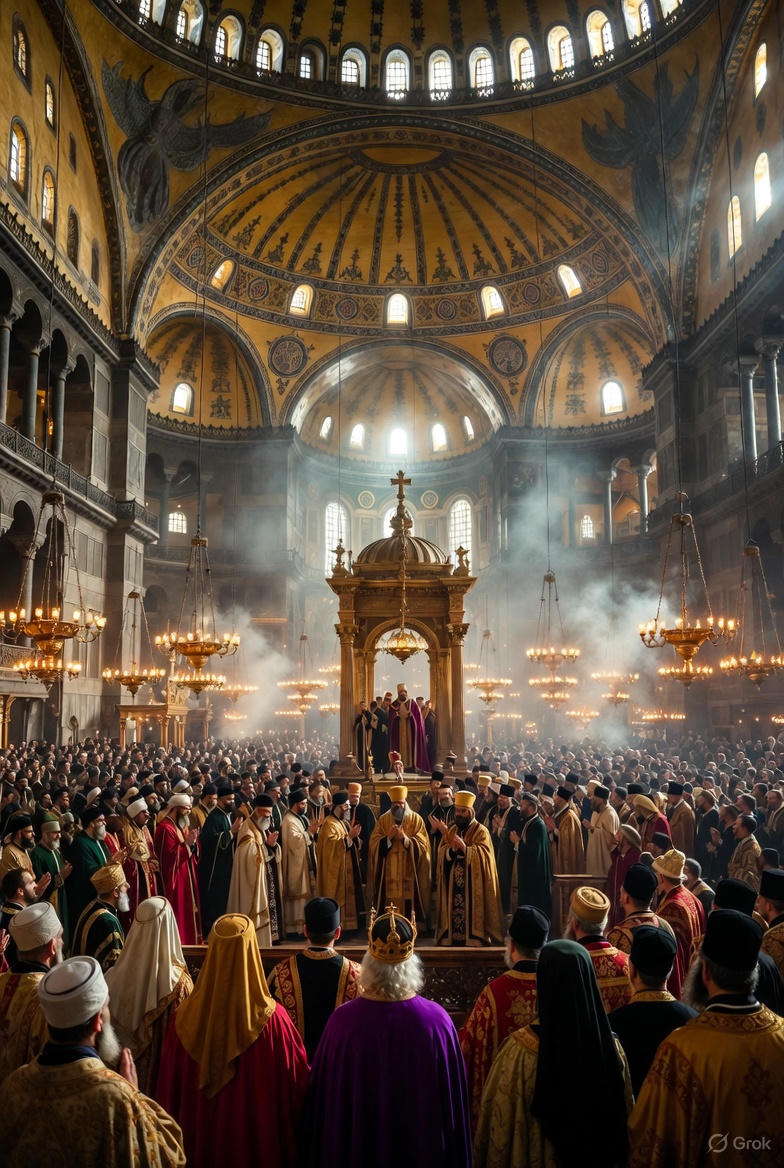
Imagine a colossal dome, once shattered by the fury of the earth itself, rising anew like a phoenix from the rubble—taller, stronger, and more awe-inspiring than before. On December 24, 562 AD, in the heart of Constantinople, the Byzantine Empire witnessed one of its most profound moments of renewal: the rededication of the Hagia Sophia after a catastrophic earthquake. This wasn't just a repair job; it was a symphony of human ambition, engineering genius, and unyielding faith that transformed disaster into an eternal masterpiece. As we dive into this captivating chapter of distant history, we'll uncover the intricate details of how Emperor Justinian I and his brilliant minds turned calamity into glory. And while the bulk of our journey will traverse the dusty annals of the Byzantine world—filled with seismic shocks, architectural marvels, and imperial drama—we'll cap it off with a spark of motivation, showing how this ancient feat can fuel your modern life with practical strategies for bouncing back bigger and better.
Let's set the stage in the bustling metropolis of Constantinople, the glittering jewel of the Eastern Roman Empire, often called Byzantium. Founded by Constantine the Great in 330 AD as the "New Rome," the city was a melting pot of Greek intellect, Roman law, and Christian fervor. By the 6th century, under Justinian I, it had become a powerhouse of culture and power, with grand boulevards, aqueducts snaking through hills, and forums echoing with debates on theology and philosophy. But amid this splendor lurked a relentless foe: earthquakes. The region sat atop volatile fault lines, where the earth's plates ground against each other like titans in eternal combat. These tremors weren't rare; they were a fact of life, shaping the city's skyline as much as its emperors did.
The story of Hagia Sophia begins long before 562, rooted in a lineage of sacred structures on the same hallowed ground. The first church on the site, known as the Megale Ekklesia or "Great Church," was consecrated on February 15, 360 AD, during the reign of Emperor Constantius II, son of Constantine. This basilica was a modest affair by later standards—a timber-roofed edifice with columns pilfered from pagan temples, curtains draping its interiors, and a west-facing entrance flanked by a narthex. Built adjacent to the emerging Great Palace, it symbolized the shift from Rome's pagan past to Christianity's ascendant future. Archaeological digs have unearthed remnants of its banded masonry walls and a propylaeum, hinting at a U-shaped plan inspired by Roman basilicas like St. Peter's in Rome. It even featured an atrium for gatherings, a baptistery for rituals, and a skeuophylakion—a treasury for relics, possibly serving funerary purposes in its early days.
But fate was unkind. In 404 AD, riots erupted over the exile of the fiery Patriarch John Chrysostom, whose sermons against imperial excess had ruffled feathers. The mob set the church ablaze, reducing much of it to ashes, though side buildings survived. Undeterred, Emperor Theodosius II commissioned a second church in 415 AD, designed by architect Rufinus. This iteration was grander: a five-aisled basilica with a monumental propylaeum, vaulted porticos, and an atrium paved in marble. Its facade boasted polychrome mosaics and carved friezes depicting 12 lambs representing the apostles. External sculptures adorned its walls, and the skeuophylakion was rebuilt as a rotunda with niches for storage and a spiral staircase for access. Chroniclers like Socrates Scholasticus described it as a beacon of imperial piety, sharing clergy with the nearby Hagia Eirene (Holy Peace) and enclosed within a shared wall.
Alas, this too fell victim to chaos. In January 532 AD, the Nika Riots—named after the chant "Nika!" (Conquer!) of rival chariot-racing factions—engulfed the city. What started as sports rivalry escalated into a full-blown rebellion against Justinian's taxes and policies. Rioters torched the Theodosian church, along with much of the palace district. Procopius, Justinian's court historian, vividly recounted in his "De Aedificiis" how the flames consumed the temple, viewing it as divine judgment yet foreseeing a greater rebirth. Justinian, ever the opportunist, saw this as a chance to etch his name in eternity.
Mere weeks after quelling the riots—with 30,000 rebels slaughtered in the Hippodrome—Justinian launched the third and most ambitious Hagia Sophia on February 23, 532 AD. He appointed Anthemius of Tralles, a geometer versed in mathematics and physics, and Isidore of Miletus, an engineer with mechanical expertise, as lead architects. Both hailed from the intellectual hotbed of Asia Minor, influenced by the Neoplatonist school of Ammonius in Alexandria, blending pagan philosophy with Christian symbolism. Funding came from imperial coffers, reportedly 4,000 pounds of gold initially, though critics whispered of seized fortunes from the riot's instigators.
Construction was a whirlwind: over 10,000 workers labored day and night, importing materials from across the empire. Porphyry columns from Egypt's temples, verd antique marble from Thessaly, white Proconnesian slabs from the Sea of Marmara—the building became a mosaic of the Mediterranean world. The exterior was veneered in shimmering marble, while interiors gleamed with polychrome stones and gold tesserae. At its core was a revolutionary design: a central dome, 31-33 meters in diameter, hoisted 55 meters high on pendentives—those ingenious curved triangles that bridged square piers to a circular base. This was the first full pendentive dome in history, allowing a vast, unobstructed nave that dwarfed anything before it. The structure spanned 82 meters long and 73 meters wide, with semi-domes cascading light through 40 arched windows, creating an ethereal glow that Procopius likened to heaven on earth.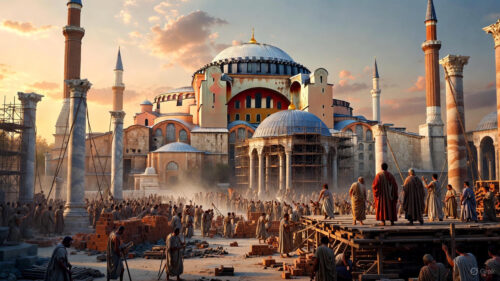 Justinian spared no extravagance. The ambon (pulpit) was a marble island in the nave, the ciborium (altar canopy) silver-plated, and the solea (raised walkway) banded in green marble like rivers flowing to the sea. Capitals bore monograms of Justinian and his empress, Theodora, whose influence loomed large despite her scandalous past as an actress. Upon completion, Justinian entered on December 27, 537 AD, exclaiming, "Solomon, I have surpassed thee!"—a nod to outshining the Temple of Jerusalem. The church, dedicated to Holy Wisdom (Sophia), became the patriarchal seat, hosting coronations, councils, and asylum for fugitives. It embodied Byzantine theocracy, where emperor and patriarch intertwined in rituals that reinforced divine right.
Yet, nature struck back. Earthquakes in 553 and 557 cracked the dome and semi-domes, exposing design flaws: the flat dome exerted excessive lateral thrust on piers deformed by hasty construction. Then, on May 7, 558 AD, a massive tremor—part of a swarm plaguing the region—collapsed the eastern semi-dome entirely, crushing the ambon, altar, and ciborium beneath tons of rubble. John Malalas chronicled the horror: the dome "fell like a thunderbolt," shaking the city as if the world ended. Justinian, grief-stricken, ordered the debris cleared and vowed a superior rebuild.
Justinian spared no extravagance. The ambon (pulpit) was a marble island in the nave, the ciborium (altar canopy) silver-plated, and the solea (raised walkway) banded in green marble like rivers flowing to the sea. Capitals bore monograms of Justinian and his empress, Theodora, whose influence loomed large despite her scandalous past as an actress. Upon completion, Justinian entered on December 27, 537 AD, exclaiming, "Solomon, I have surpassed thee!"—a nod to outshining the Temple of Jerusalem. The church, dedicated to Holy Wisdom (Sophia), became the patriarchal seat, hosting coronations, councils, and asylum for fugitives. It embodied Byzantine theocracy, where emperor and patriarch intertwined in rituals that reinforced divine right.
Yet, nature struck back. Earthquakes in 553 and 557 cracked the dome and semi-domes, exposing design flaws: the flat dome exerted excessive lateral thrust on piers deformed by hasty construction. Then, on May 7, 558 AD, a massive tremor—part of a swarm plaguing the region—collapsed the eastern semi-dome entirely, crushing the ambon, altar, and ciborium beneath tons of rubble. John Malalas chronicled the horror: the dome "fell like a thunderbolt," shaking the city as if the world ended. Justinian, grief-stricken, ordered the debris cleared and vowed a superior rebuild.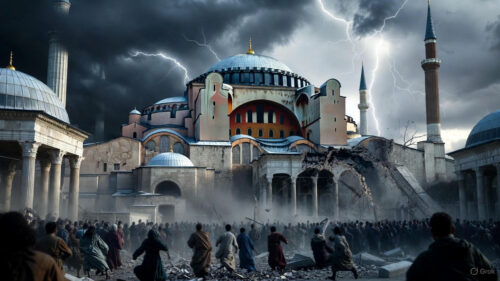 Enter Isidore the Younger, nephew (or possibly son) of the original Isidore, tasked with the restoration. He lightened materials, using pumice-infused bricks for the dome, and raised it by 6.25 meters to reduce stress on walls. Forty ribs were added for reinforcement, creating a scalloped shell effect that distributed weight more evenly. Eight massive Corinthian columns from Baalbek in Lebanon were shipped in, their transport a logistical feat involving fleets navigating stormy seas. Iron chains encircled the base to counter outward push, a technique echoing Roman precedents but refined here. Workers buttressed piers, realigned arches, and restored mosaics, all while preserving the core vision.
By late 562, the work was done. The rededication ceremonies commenced on December 24, Christmas Eve, presided over by Patriarch Eutychius in Justinian's presence. This wasn't a mere ribbon-cutting; it was a liturgical extravaganza blending Christmas joy with triumphant resurrection themes. Paul the Silentiary, a court poet and official, composed an ekphrasis—a vivid descriptive poem—recited during the festivities, which extended to Epiphany on January 6, 563. His verses painted the dome as a "celestial vault," the marbles as "meadows blooming with unwithering flowers," and the light as divine radiance piercing the soul. The event drew crowds from across the empire, with incense wafting, choirs chanting, and processions circling the nave. Justinian, now in his twilight years, saw it as his legacy sealed—proof that human will could defy the gods' wrath.
But Hagia Sophia's trials didn't end there. In the centuries following, it weathered more quakes: one in 740 AD damaged supports, another in 869 toppled a half-dome, repaired by Emperor Basil I. The 989 tremor collapsed the western arch, fixed over six years by Armenian architect Trdat, who added cherubim mosaics and a grand Christ Pantocrator in the dome. Iconoclasm under Leo III in 726 AD stripped figural art, only for it to return post-843 with stunning mosaics like the Virgin in the apse. The church hosted pivotal moments: the 1054 schism when Cardinal Humbert excommunicated the patriarch, igniting East-West divide; sieges by Avars in 626, where hymns to the Virgin reportedly repelled invaders.
Enter Isidore the Younger, nephew (or possibly son) of the original Isidore, tasked with the restoration. He lightened materials, using pumice-infused bricks for the dome, and raised it by 6.25 meters to reduce stress on walls. Forty ribs were added for reinforcement, creating a scalloped shell effect that distributed weight more evenly. Eight massive Corinthian columns from Baalbek in Lebanon were shipped in, their transport a logistical feat involving fleets navigating stormy seas. Iron chains encircled the base to counter outward push, a technique echoing Roman precedents but refined here. Workers buttressed piers, realigned arches, and restored mosaics, all while preserving the core vision.
By late 562, the work was done. The rededication ceremonies commenced on December 24, Christmas Eve, presided over by Patriarch Eutychius in Justinian's presence. This wasn't a mere ribbon-cutting; it was a liturgical extravaganza blending Christmas joy with triumphant resurrection themes. Paul the Silentiary, a court poet and official, composed an ekphrasis—a vivid descriptive poem—recited during the festivities, which extended to Epiphany on January 6, 563. His verses painted the dome as a "celestial vault," the marbles as "meadows blooming with unwithering flowers," and the light as divine radiance piercing the soul. The event drew crowds from across the empire, with incense wafting, choirs chanting, and processions circling the nave. Justinian, now in his twilight years, saw it as his legacy sealed—proof that human will could defy the gods' wrath.
But Hagia Sophia's trials didn't end there. In the centuries following, it weathered more quakes: one in 740 AD damaged supports, another in 869 toppled a half-dome, repaired by Emperor Basil I. The 989 tremor collapsed the western arch, fixed over six years by Armenian architect Trdat, who added cherubim mosaics and a grand Christ Pantocrator in the dome. Iconoclasm under Leo III in 726 AD stripped figural art, only for it to return post-843 with stunning mosaics like the Virgin in the apse. The church hosted pivotal moments: the 1054 schism when Cardinal Humbert excommunicated the patriarch, igniting East-West divide; sieges by Avars in 626, where hymns to the Virgin reportedly repelled invaders.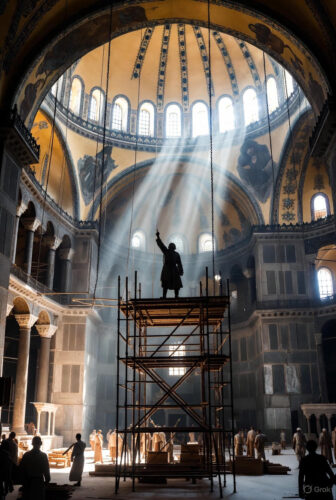 Architecturally, Hagia Sophia revolutionized design. Its pendentives inspired countless churches, from Thessaloniki's Hagia Sophia to Venice's San Marco. The floor's cosmic layout—marbles evoking seas and islands—symbolized the universe under God's wisdom. Galleries for the empress, imperial doors from legendary woods (rumored Noah's Ark), and a weeping column said to cure ailments added mystique. Even in daily life, it was a hub: markets in its atrium, refugees in its narthex, scholars debating in its shadows.
Fast-forward through Byzantine decline: the Fourth Crusade in 1204 sacked it, installing Latin emperors who looted treasures. Reclaimed in 1261, it limped on until 1453, when Ottoman Sultan Mehmed II conquered Constantinople. Awed, he converted it to a mosque, adding minarets and plastering mosaics, yet preserving its form. As Aya Sofya, it influenced Ottoman architecture, like Sinan's Suleymaniye. In 1935, Atatürk secularized it as a museum; in 2020, it reverted to a mosque. Through it all, the 562 rededication stands as a pivot—when ruin birthed resilience.
Now, shifting gears to the motivational spark: the rededication teaches that setbacks aren't endpoints; they're setups for comebacks. Justinian's team didn't just patch—they innovated, raising the dome higher and fortifying it smarter. Today, apply this to your life: when "earthquakes" like job loss, health scares, or relationship rifts hit, rebuild with vision. Here's how, in specific bullet points and a step-by-step plan to harness this historical wisdom for personal growth.
Architecturally, Hagia Sophia revolutionized design. Its pendentives inspired countless churches, from Thessaloniki's Hagia Sophia to Venice's San Marco. The floor's cosmic layout—marbles evoking seas and islands—symbolized the universe under God's wisdom. Galleries for the empress, imperial doors from legendary woods (rumored Noah's Ark), and a weeping column said to cure ailments added mystique. Even in daily life, it was a hub: markets in its atrium, refugees in its narthex, scholars debating in its shadows.
Fast-forward through Byzantine decline: the Fourth Crusade in 1204 sacked it, installing Latin emperors who looted treasures. Reclaimed in 1261, it limped on until 1453, when Ottoman Sultan Mehmed II conquered Constantinople. Awed, he converted it to a mosque, adding minarets and plastering mosaics, yet preserving its form. As Aya Sofya, it influenced Ottoman architecture, like Sinan's Suleymaniye. In 1935, Atatürk secularized it as a museum; in 2020, it reverted to a mosque. Through it all, the 562 rededication stands as a pivot—when ruin birthed resilience.
Now, shifting gears to the motivational spark: the rededication teaches that setbacks aren't endpoints; they're setups for comebacks. Justinian's team didn't just patch—they innovated, raising the dome higher and fortifying it smarter. Today, apply this to your life: when "earthquakes" like job loss, health scares, or relationship rifts hit, rebuild with vision. Here's how, in specific bullet points and a step-by-step plan to harness this historical wisdom for personal growth.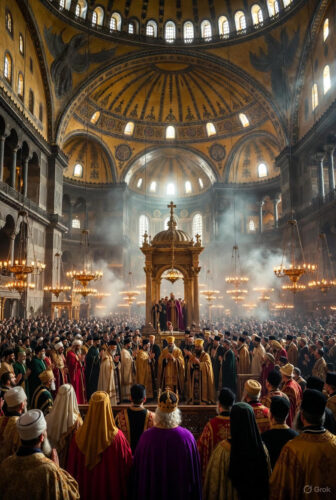 - **Embrace Innovation in Crisis**: Like Isidore the Younger's ribbed dome, upgrade your skills post-setback—enroll in an online course on a new career tool within a week of a layoff to emerge more versatile.
- **Leverage Community Resources**: Justinian imported columns from afar; similarly, network aggressively—join three professional groups or reach out to five mentors monthly to build a support "fleet" for your goals.
- **Heighten Your Ambitions**: The dome rose 20 feet taller; after a failure, set bolder targets—like aiming for a promotion with double the responsibility instead of settling for stability.
- **Document Your Journey**: Paul the Silentiary's poem immortalized the event; keep a daily journal of progress, noting one win per entry to fuel motivation and track growth.
- **Celebrate Milestones Ritually**: The rededication was a festival; mark your rebounds with personal ceremonies, like a solo dinner after completing a fitness milestone, to reinforce positive habits.
Your 30-Day Rebuild Plan:
- **Embrace Innovation in Crisis**: Like Isidore the Younger's ribbed dome, upgrade your skills post-setback—enroll in an online course on a new career tool within a week of a layoff to emerge more versatile.
- **Leverage Community Resources**: Justinian imported columns from afar; similarly, network aggressively—join three professional groups or reach out to five mentors monthly to build a support "fleet" for your goals.
- **Heighten Your Ambitions**: The dome rose 20 feet taller; after a failure, set bolder targets—like aiming for a promotion with double the responsibility instead of settling for stability.
- **Document Your Journey**: Paul the Silentiary's poem immortalized the event; keep a daily journal of progress, noting one win per entry to fuel motivation and track growth.
- **Celebrate Milestones Ritually**: The rededication was a festival; mark your rebounds with personal ceremonies, like a solo dinner after completing a fitness milestone, to reinforce positive habits.
Your 30-Day Rebuild Plan:
**Days 1-5: Assess the Rubble**—Identify your "earthquake" (e.g., a stalled project). List three core damages and three strengths that survived, mirroring Justinian's post-quake survey.
**Days 6-10: Gather Materials**—Research solutions: read two books or articles on resilience, and collect "imports" like advice from experts or new tools/apps to fortify your approach.
**Days 11-20: Construct Anew**—Implement changes: dedicate two hours daily to rebuilding, such as practicing a skill or networking, raising your "dome" higher with measurable goals like increasing productivity by 20%.
**Days 21-25: Reinforce and Test**—Add "ribs" for stability: incorporate habits like weekly reviews or accountability buddies to prevent future collapses.
**Days 26-30: Rededicate with Fanfare**—Celebrate completion: host a small gathering or treat yourself, reciting a personal "ekphrasis"—a written reflection on your transformation—to solidify the victory.
This ancient tale isn't dusty lore; it's a blueprint for your epic revival. Channel Justinian's grit, and watch your life soar like that timeless dome.