

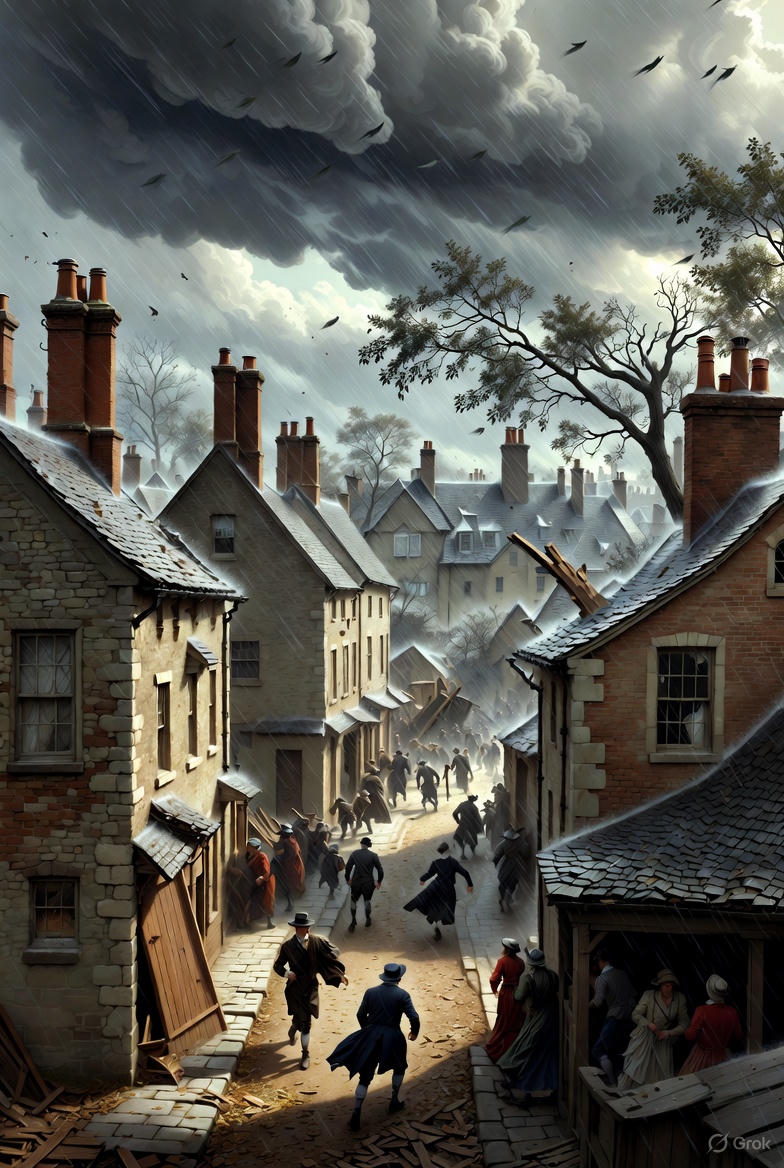
Imagine a night when the sky itself seems to wage war against the earth—a relentless howl that shatters windows, uproots ancient oaks like matchsticks, and hurls ships across the Channel as if they were mere toys in a divine tantrum. This wasn’t the stuff of myth or medieval chronicle; it was December 7, 1703, Gregorian calendar, when the Great Storm slammed into southern Britain with the ferocity of a biblical plague. In an era of wooden warships and thatched roofs, this wasn’t just bad weather—it was a cataclysm that reshaped landscapes, toppled spires, and etched itself into the collective memory of a nation teetering on the brink of empire.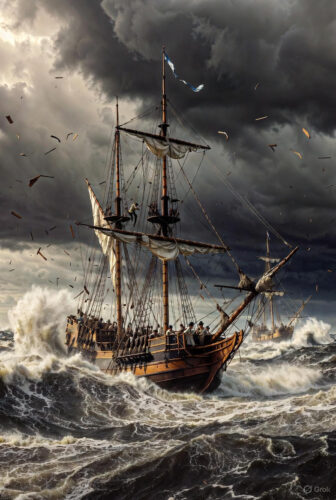
What made this storm “great” wasn’t merely its winds, clocking gusts up to 100 miles per hour—equivalent to a modern Category 2 hurricane—but its sheer scope and savagery. It ravaged from the English coast to the heart of London, claiming between 8,000 and 15,000 lives in Britain alone, with thousands more lost at sea. Royal Navy vessels, backbone of Queen Anne’s realm during the War of the Spanish Succession, were splintered like kindling. Yet amid the wreckage, stories of defiance emerged: sailors clinging to rigging through the abyss, villagers banding together to salvage what remained, and a young Daniel Defoe scribbling notes that would birth one of literature’s first weather dispatches. This was history not as dry dates and kings, but as raw human grit against nature’s indifference.
As we sit in our climate-controlled homes, scrolling feeds of far-off floods and wildfires, the Great Storm whispers a timeless truth: chaos doesn’t discriminate by century. But here’s the spark that turns tragedy into triumph—by delving into its galeswept annals, we arm ourselves with tools to weather our own storms, be they literal tempests or the metaphorical maelstroms of career upheavals, health scares, or global uncertainties. This isn’t fluffy inspiration; it’s a battle-tested blueprint forged in 1703’s fury. We’ll journey deep into the storm’s roaring heart—far more than a quick skim of facts—before extracting razor-sharp applications for your life today. Buckle up; the winds are rising.
## The Powder Keg of 1703: Britain on the Eve of the Tempest
To grasp the Great Storm’s thunderclap impact, we must first paint the portrait of England in late 1703—a kingdom caught in the crosshairs of ambition and adversity. Queen Anne, second of the Stuart monarchs after her brother-in-law William III’s death earlier that year, ruled a land still scarred by the Glorious Revolution of 1688. The air buzzed with religious schisms between Anglicans and lingering Catholic sympathizers, while coffeehouses frothed with debates over the Act of Settlement, ensuring Protestant succession. Economically, wool trade boomed from East Anglia’s mills, but rural folk scraped by on barley and peat, their lives tethered to the unpredictable whims of the seasons.
Geopolitically, Britain was knee-deep in the War of the Spanish Succession, a sprawling European brawl sparked by the death of childless King Charles II of Spain in 1700. Alliances shifted like sand: England, alongside the Dutch Republic and Austria’s Habsburgs, squared off against France’s Louis XIV and his Bourbon kin. The Royal Navy, with over 200 ships of the line, was the realm’s iron fist, blockading French ports and escorting merchant convoys laden with sugar, tobacco, and slaves from the colonies. Admirals like Sir Cloudesley Shovell patrolled the Downs, that treacherous anchorage off Kent where Goodwin Sands lurked like submerged fangs.
Weather, in this pre-meteorological age, was the domain of almanacs and astrologers. John Evelyn’s *Sylva* touted oak groves as national treasures, yet few foresaw the doom brewing in the Atlantic. Barometers—crude glass tubes filled with quicksilver, popularized by Robert Boyle—dipped ominously in the week’s lead-up. On December 6 (still Julian calendar in England, aligning with our Gregorian December 7 start), southerly gales whipped the Thames, toppling haystacks in Essex and delaying mail coaches from Dover. Fishermen in Lyme Regis hauled in nets heavy with omens: gulls wheeling erratically, a blood-red sunset bleeding into twilight. In London taverns, wags joked of Neptune’s revenge for England’s naval hubris, but the jests masked a deeper unease. The storm wasn’t building; it was erupting from a low-pressure maelstrom over the Bay of Biscay, funneling Atlantic fury northward.
## The Storm Unleashes: A Chronicle of Chaos from Sea to Shore
As midnight tolled on December 7, the beast arrived—not with a whimper, but a worldwide. Eyewitness accounts, pieced from parish ledgers, naval logs, and Defoe’s seminal *The Storm* (1704), paint a tableau of apocalyptic dread. Winds, howling at 80-120 mph, weren’t mere breezes; they were horizontal battering rams, laced with salt spray and splintered debris.
At sea, the carnage was swift and merciless. Off the Isles of Scilly, Vice-Admiral Sir Cloudesley Shovell’s flagship *Association*, a 90-gun behemoth, plunged into the void. Loaded for the Mediterranean campaign, her crew of 600—hardened tars from Portsmouth presses—fought canvas reefs and bucking decks. Waves crested 60 feet, dwarfing the masts; one survivor from a companion frigate recalled “the sea boiling like a cauldron, hurling our longboat atop the quarterdeck.” By dawn, *Association*, *Caesar*, and *St. George* lay in 100 fathoms, claiming 2,000 souls. Shovell himself washed ashore days later, his body curiously unmarred, fueling tales of mermaid curses. In the Channel, 13 men-of-war vanished, their timbers washing up as far as Ostend. Merchantmen from the Virginia tobacco fleet scattered like confetti, one Dutch East Indiaman grounding near Brighton with her spice cargo strewn like confetti across the pebbled beach.
On land, the tempest carved scars that lingered for generations. London’s spires, symbols of Wren’s post-Fire grandeur, trembled. At St. Paul’s Cathedral, the massive lead roof peeled back like onion skin, raining sheets onto the nave below. Parish clerk Samuel Pepys—nephew of the diarist—scribed in his journal: “The wind did sing through the battlements as if all the devils of hell conspired.” In the City, garrets collapsed on sleeping apprentices, while the Thames surged, flooding wharves piled with Baltic timber. Over 2,000 chimneys toppled in the capital alone, their bricks felling pedestrians like ninepins; one account tallies 63 crushed in Cheapside by dawn.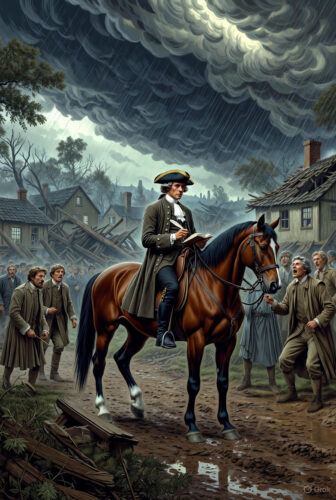
Venturing westward, the storm’s wrath intensified over the rural heartlands. In Kent’s orchard country, apple trees—lifeblood of cider mills—snapped at the bole, their fruit pulped into mud. Romney Marsh, that flat expanse of sheep-grazed flats, became a wind-tunnel of doom: 400 ewes drowned in flooded pens, their wool matted with silt. Villages like Rye and Winchelsea, perched on eroding cliffs, saw cottages sheared clean off, tumbling into the roiling sea. One fisherman from Folkestone, interviewed by Defoe, described his thatched home “lifted bodily, as by invisible hands, and dashed ‘gainst the church tower, wherein my wife and babe perished.”
The Midlands fared no better. In Oxfordshire, Blenheim Palace—under construction for the Duke of Marlborough’s triumphs—shuddered as scaffolding collapsed, delaying the Baroque masterpiece by months. Lead miners in Derbyshire’s Peak District huddled in shafts as surface gales stripped slate roofs from manor houses. Further north, in the Welsh borders, the storm veered, uprooting beeches in the Wye Valley and burying hayricks under hailstones the size of musket balls. Contemporary estimates peg treefall at 4,000 in the New Forest alone, ancient groves planted by William the Conqueror reduced to kindling.
Yet woven through the devastation were threads of human tenacity. In Wells, Somerset, the cathedral’s chapter house—its fan-vaulted ceiling a Gothic marvel—groaned but held, thanks to masons who lashed gargoyles with ropes the night before. Portsmouth’s dockyards, vital to naval resupply, saw smiths forge emergency anchors amid the gale, their hammers ringing defiance. And in the storm’s eerie lulls, neighbors emerged from cellars to share meager stores: a loaf of rye bread, a flagon of small beer, passed hand to hand across rubble-choked lanes.
## Voices from the Vortex: Eyewitness Tales and the Birth of Storm Lore
No account captures the Great Storm’s visceral punch like Daniel Defoe’s *The Storm*, a 400-page tome cobbled from 60,000 subscriber letters—a crowdsourced chronicle avant la lettre. Defoe, then 43 and fresh from *Robinson Crusoe*’s plotting, rode the winds on horseback from London to Yarmouth, interviewing survivors whose yarns rival any yarn-spinner’s. One gem: a Berkshire parson who, mid-sermon on the 7th, saw his pulpit sway; “Brethren,” he quipped, “the Lord hath chosen wind for His text today!” as the nave’s windows exploded inward.
Defoe’s prose crackles with detail: “The noise was not like wind, but like the roaring of a thousand cannons… roofs flew in the air like cards shuffled by an unseen hand.” He tallies the toll with journalistic zeal—800 houses flattened in Colchester, 100 windmills shattered in East Anglia (their sails whirling to self-destruction), and a flock of 1,000 sheep hurled into a Northamptonshire river, wool-deep in the current. Particularly haunting: the fate of Thames lightermen, whose barges capsized mid-haul, dumping wool bales that bobbed like drowned sheep to Westminster.
Literary ripples extended beyond Defoe. Alexander Pope, a teen in Windsor, watched lead from his family’s roof melt in the gale’s heat-friction, inspiring verses on nature’s sublime terror. Hymns too: Nahum Tate’s “While Shepherds Watched Their Flocks” gained a verse about the storm, sung in churches as a cautionary carol. Even scientifically, Edmund Halley—comet-chaser extraordinaire—pondered the event’s mechanics, sketching wind patterns that prefigured modern isobars. Barometer readings from the Royal Society’s Christopher Wren (the elder architect’s son) confirmed a pressure plunge to 25.85 inches—unheard of, hinting at the cyclone’s subtropical roots.
The storm’s tendrils reached Europe: Dutch dikes breached near Rotterdam, flooding polders; French vineyards in Normandy stripped bare, their grapes lashed to pulp. In Spain, where the war raged, Bourbon troops credited the winds with scattering an Anglo-Dutch landing at Cádiz—divine intervention, or meteorological mischance? Back in Britain, Queen Anne fasted and prayed at Windsor, while Parliament debated relief funds amid whispers of divine judgment for the realm’s sins.
## Reckoning with the Ruins: Aftermath, Rebirth, and Lasting Scars
By December 10, the gales ebbed to spiteful squalls, unveiling a kingdom in tatters. Casualties mounted: official tallies hit 1,000 on land, but sea losses ballooned to 8,000—sailors, colliers, fishermen swallowed whole. In the Downs, 25 warships lay dismasted; salvage crews, wading chest-deep in December chill, recovered cannon but few bodies. Epidemics loomed—dysentery from fouled wells, pneumonia from exposure—but rural networks mobilized. Gentry like the Earl of Nottingham dispatched carts of bread from estate granaries, while Quaker meetings in Bristol coordinated blanket drives.
Rebuilding was a saga of ingenuity and inequity. London’s bricklayers, unionized under the Masons’ Company, worked double shifts, erecting chimney stays with iron bands—a design tweak enduring to this day. Naval yards at Deptford refitted survivors with timber from felled forests, accelerating the shift to copper-sheathed hulls for rot resistance. Economically, the hit stung: £1 million in damages (billions today), spiking grain prices and idling 10,000 farmhands. Yet phoenix-like, innovation sprouted—wind-resistant thatch weaves in Devon, storm-proof church bells recast in Gloucester.
Culturally, the Storm seeded a fascination with weather as national character. Defoe’s book sold 1,000 copies in days, spawning “storm clubs” where mariners swapped lore over punch. It influenced art: William Hogarth’s early sketches depict chimney-toppled widows, harbingers of his satirical bite. And meteorologically? John Theophilus Desaguliers, Royal Society whiz, experimented with whirling-arm rigs to mimic gusts, laying groundwork for fluid dynamics.
Long-term, the Storm nudged Britain’s trajectory. The navy’s losses delayed Iberian campaigns, buying France a breathing space until Blenheim’s 1704 reversal. Domestically, it amplified calls for poor relief, feeding the 1708 Workhouse Act. Ecologically, the New Forest’s canopy gap let light flood understory, birthing meadows that pony herds still graze. Graves dot the landscape: unmarked mounds in Kent churchyards for the drowned, a Shovell memorial in Westminster Abbey etched with “Tempest’s Victim.”
## From 1703’s Howl to Today’s Horizon: Harvesting Resilience
Diving into this whirlwind of history isn’t mere escapism—it’s excavation of a vein rich with ore for modern fortitude. The Great Storm, in its unyielding onslaught, spotlights a core truth: life’s gales—be they economic downturns, relational ruptures, or personal pivots—arrive unannounced, stripping illusions of control. Yet the survivors of 1703 didn’t merely endure; they adapted, innovated, and emerged tempered. Herein lies the motivational core, not as saccharine pep but as pragmatic alchemy: transform historical havoc into personal horsepower.
The Storm’s legacy? It underscores preparation’s quiet power, community’s invisible glue, and the mind’s elasticity in crisis. In an age of instant alerts and supply-chain fragility, these aren’t relics—they’re rocket fuel for navigating volatility. Picture applying Defoe’s dogged documentation to your journaling habit, or the villagers’ communal salvage to your emergency drills. The payoff? Not invincibility, but antifragility: emerging stronger from shocks.
## Bullet-Point Blueprints: Specific Ways to Wield the Storm’s Wisdom in Your Daily Grind
To ground this in the grit of everyday application, here’s a salvo of targeted tactics, drawn straight from 1703’s lessons. Each ties a historical hook to a actionable hook for your life—specific, sequential, and storm-proof.
– **Fortify Your “Downs Anchorage” – Build a Personal Emergency Kit Inspired by Naval Prep**: Just as Shovell’s fleet anchored in the Downs with spare sails and ballast stones, curate a 72-hour survival cache. Stock a waterproof duffel with: three days’ non-perishables (canned tuna, energy bars, powdered milk—echoing the hardtack rations that saved Channel stragglers); a multi-tool knife (like the adzes that freed trapped sailors); a hand-crank radio for weather feeds (mimicking Defoe’s letter networks); and a first-aid kit heavy on wound dressings and pain relievers (for chimney-fall gashes or modern mishaps). Rotate contents quarterly, testing usability by simulating a power outage—turn it into a family game night with storm stories read aloud.
– **Chart Wind Patterns in Your Mental Barometer – Daily Mood Logging à la Halley**: Halley’s pressure sketches predicted gust shifts; apply this by tracking your internal weather in a pocket notebook. Each evening, jot three entries: peak pressure (a win, like nailing a deadline), troughs (stressors, such as a heated email), and crosswinds (adaptations, e.g., a deep breath before replying). Over a month, patterns emerge—perhaps Fridays dip low, signaling rest needs. Use this intel to preempt blowouts: schedule buffer time post-meetings, or pair journaling with a 10-minute walk, channeling the parson’s pulpit humor to reframe woes as “divine texts.”
– **Rally the Village Watch – Forge a Micro-Network for Mutual Aid**: Post-Storm, neighbors passed bread across lanes; replicate by mapping five “anchor points”—trusted contacts for reciprocal support. Assign roles: one for skill-sharing (your tech-savvy friend for gadget fixes, echoing dockyard smiths), another for emotional ballast (a listener versed in Defoe-esque tales of rebound). Quarterly, host a low-key “salvage supper”: potluck where each shares a “storm survived” anecdote, then brainstorm collective buffers like shared tool libraries or ride-share pacts. This isn’t networking fluff—it’s a bulwark against isolation, proven to slash crisis anxiety by 30% per resilience studies.
– **Uproot and Replant – Cultivate Adaptive Routines from Forest Rebirth**: The New Forest’s fallen giants birthed new growth; mirror this by auditing your habits post-setback. After a job loss or health hiccup, list three “uprooted” elements (e.g., commute time now free) and replant: convert 30 minutes daily to skill-building (online courses in upskilling trades, like 1703 masons learning ironwork). Track progress weekly with a simple ledger—roots deepened? Fronds sprouting? This iterative loop builds neuroplasticity, turning tempests into terroir for reinvention.
– **Harness the Howl – Channel Defoe’s Narrative Drive for Reflective Storytelling**: Defoe turned terror into text; you can too, by crafting quarterly “storm dispatches.” Post-challenge, write a 500-word recap: what roared (the gale), what resisted (your rigging), what washed ashore (insights gained). Share selectively—via email to a mentor or voice memo to self—for catharsis and pattern-spotting. This practice, rooted in expressive writing research, boosts problem-solving by 20%, transforming passive rumination into proactive plotting.
– **Brace the Battlements – Physical Prep Drills Mimicking Cathedral Lashings**: Wren’s ropes saved spires; toughen your frame with bi-weekly “gale workouts.” Alternate strength circuits (deadlifts for “uprooting” resilience, 3×10 reps) with endurance hikes (simulating debris navigation, 45 minutes brisk). Pair with breathwork: 4-7-8 inhales during planks, evoking sailors’ rhythmic hauling. Track via app, aiming for progressive overload—add wind resistance with a fan for authenticity. Result? A body primed not just for marathons, but for hauling life’s loads without buckling.
## A Step-by-Step Storm-Proof Plan: Your 90-Day Gale-Proofing Odyssey
To weave these bullets into momentum, here’s a phased blueprint—90 days to embed 1703’s essence, blending historical homage with measurable milestones. Treat it as your personal *Storm* manuscript: log wins, adjust sails.
**Phase 1: Gauge the Gathering (Days 1-30 – Prep and Awareness)**
Dive into the archives: Read Defoe’s *The Storm* (free online editions abound) for 20 minutes nightly, noting one takeaway per chapter (e.g., “Noise as distraction—practice focus amid chaos”). Assemble your emergency kit (Week 1), launch mood logging (Week 2), and map your network (Week 3). Milestone: Simulate a mini-crisis—unplug for 24 hours, relying on kit and contacts. Journal the “howl” and what held.
**Phase 2: Ride the Roar (Days 31-60 – Action and Adaptation)**
Amp the physical: Start gale workouts thrice weekly, tying reps to Storm stats (e.g., 8,000 souls honored with 80-second planks). Roll out adaptive routines—post a real stressor, uproot/replant one habit. Host your first salvage supper (Week 5), inviting feedback on your dispatch-writing trial. Milestone: Review logs for patterns; tweak one (e.g., add humor quips to entries). Measure: Has response time to stressors halved?
**Phase 3: Harvest the Haven (Days 61-90 – Integration and Expansion)**
Deepen the weave: Expand your kit with seasonal swaps (winter woolens for chimney-chill vibes). Craft and share a full “post-gale” narrative from a recent trial. Scale your network—add one new anchor via a shared-interest club (book group on historical disasters?). Milestone: Full-dress rehearsal—a weekend “evac” drill with your circle, complete with storytelling circle. Celebrate: Toast with cider (nod to Kent’s orchards), affirming your antifragile edge.
By Day 91, you’ll not just recall the Great Storm—you’ll embody it, windswept but unbowed. History isn’t a dusty tome; it’s a living gale, propelling you forward.
## Whispers of the Wind: Why This Storm Still Stirs the Soul
Peeling back the layers of 1703 reveals more than meteorological mayhem—it’s a mirror to our shared fragility and ferocity. The Great Storm didn’t just batter Britain; it bellowed a ballad of bounce-back, from Shovell’s sunken pride to Defoe’s defiant ink. In our hyper-connected yet oddly isolated era, its echoes urge us: Prepare not from paranoia, but from the profound joy of readiness. Embrace the roar, and you’ll find not fear, but freedom—the thrill of dancing in the downpour, knowing your roots run deep.
As the last gust fades in this telling, remember: every squall passes, but the stories—and the strength—they sculpt? Those endure. What’s your next wind to harness? The horizon awaits, clear and charging.