

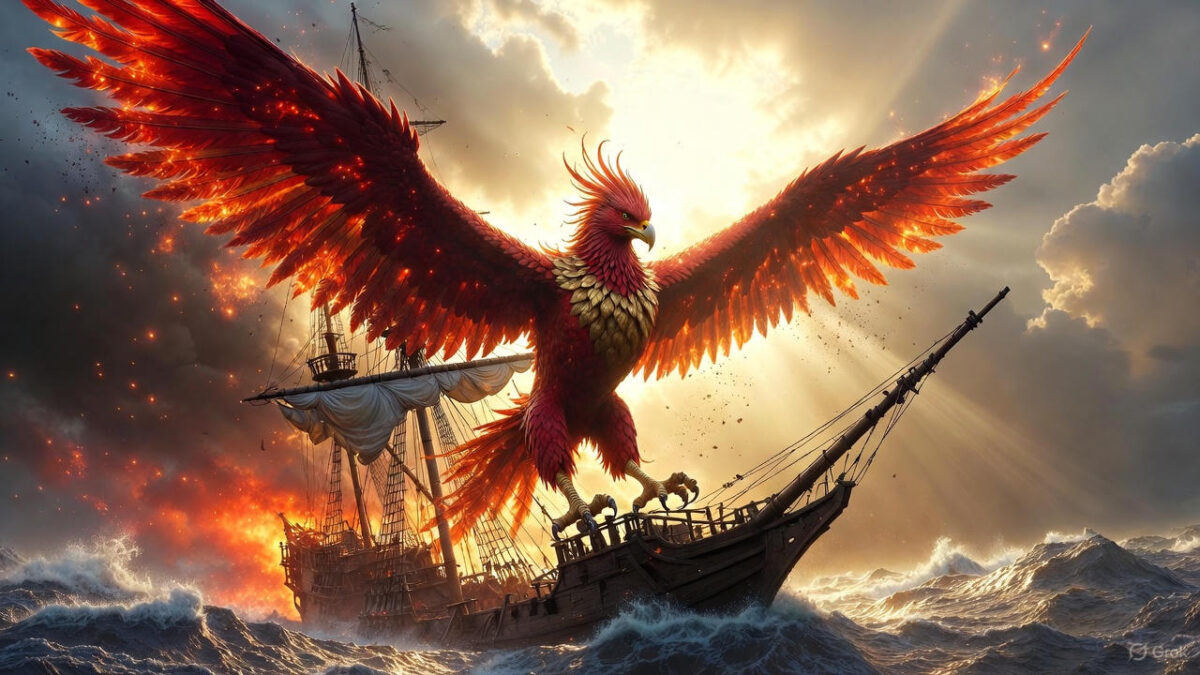
On the night of December 6, 1793, the citizens of Copenhagen woke to a sound no human ear had ever heard before: a deafening, sky-splitting roar followed by a blinding white flash that turned midnight into noon. Windows shattered twenty miles away. A pressure wave flattened forests in northern Zealand. For one terrifying minute, the heavens themselves seemed to explode above Denmark.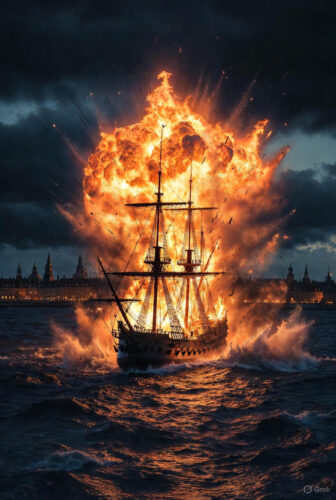
What actually happened was far stranger than any comet or volcano: a 1,300-ton French warship named *Séphyr* — loaded with 128 tons of gunpowder, 30,000 cannonballs, and an experimental cargo of fulminate of mercury detonators — blew up in a single instantaneous blast while anchored in Copenhagen roads. The explosion was so violent that it registered on barometers in Scotland and created a mushroom cloud visible from Berlin. Only 11 of the 327 crew and dock workers survived, most of them blown clear into the freezing Øresund and picked up hours later with their clothes burned off but miraculously alive.
It remains, to this day, the largest non-nuclear explosion in recorded history — equivalent to roughly 150–200 kilotons of TNT (ten times the size of the 1917 Halifax Explosion and twice as powerful as the 2020 Beirut blast). Yet almost no one outside Denmark has ever heard of it. The French Revolutionary government suppressed the news to hide the loss of an entire frigate squadron’s ammunition reserves. The Danish authorities hushed it to avoid panic. Even serious history books usually give it a single sentence, if that.
But beneath the forgotten carnage lies one of the most ferocious demonstrations of human resilience ever recorded — and a treasure chest of brutal, practical lessons you can weaponize in your own life right now.
Let’s walk through the inferno together, then extract the fireproof tactics that turn ordinary people into survivors who laugh at chaos.
## The Powder Keg That Should Never Have Existed
The year 1793 was the most psychotic moment of the French Revolution. Robespierre’s Reign of Terror was devouring Paris, King Louis XVI had been guillotined in January, and revolutionary France was at war with literally every major power in Europe. Denmark was neutral, but Copenhagen was the great neutral entrepôt where belligerents quietly bought gunpowder when their own factories couldn’t keep up.
The frigate *Séphyr* (36 guns, brand-new, fastest ship in the French Atlantic fleet) had been sent on a desperate secret mission: evacuate 128 tons of first-grade powder from the threatened arsenal at Brest and deliver it to the French northern squadron blockaded in the Baltic. Because time was critical, the captain was also ordered to carry an experimental shipment of 400 pounds of fulminate of mercury detonators — the 18th-century equivalent of carrying nitroglycerin in glass bottles next to an open forge.
To make a bad idea worse, the powder was stored in flimsy deal-wood barrels instead of brass-bound casks, the detonators were packed in the same hold as the powder, and the ship anchored not in the naval arsenal but in the crowded commercial roads, surrounded by wooden merchant ships and the city itself.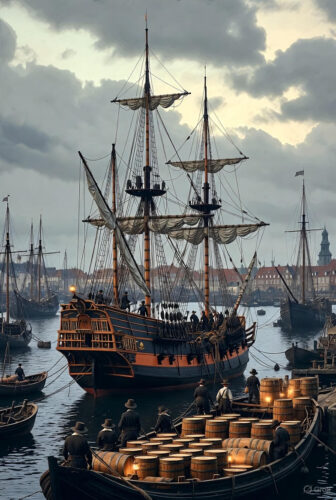
On the evening of December 5, routine maintenance was being done: carpenters caulking seams with hot pitch, gunners shifting barrels to reach a leak, lantern light swinging in the hold. At 1:17 a.m. on December 6, something — a dropped lantern, a spark from a nail in a boot, static from wool blankets — kissed the fulminate. The mercury compound flashed first, detonating with the force of a lightning bolt inside the magazine. A heartbeat later the entire 128 tons of main charge went up as one.
The blast vaporized the ship instantly. A column of fire 3,000 feet high lit the sky. The shockwave hurled 30-ton cannons half a mile inland; one landed in the king’s deer park. The seabed was scoured to bare rock in a 400-yard crater still visible today. Every window in Copenhagen facing the harbor exploded inward. People 15 miles away were knocked flat. A rain of iron, wood splinters, and human remains fell for six full minutes.
And then came the miracle.
## The Eleven Who Refused to Die
Of the 327 souls aboard or alongside that night, exactly eleven lived — and their survival stories read like superhuman legend:
– Seaman Jens Knudsen was blown through the air for 300 yards, landed in the water with every stitch of clothing burned off, swam two miles to shore in December ice water, and walked barefoot to a tavern asking for coffee.
– Midshipman Pierre Duval was found clinging to a floating barrel three miles out to sea at dawn, both eardrums ruptured, singing the Marseillaise to stay awake.
– A 19-year-old powder-boy named Lars Christensen was discovered unconscious on the roof of a warehouse half a mile away — he had been shot upward like a cannonball, crashed through the tiles, and suffered only a broken collarbone.
– The ship’s cat, miraculously, also survived and became a Copenhagen celebrity for years.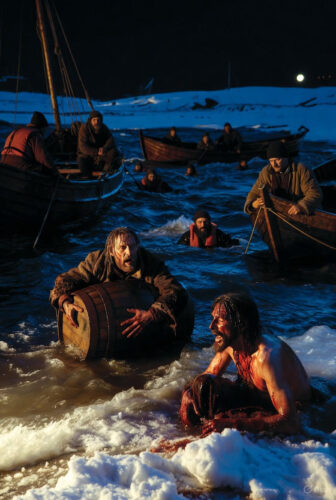
Danish physicians expected the survivors to die of shock or infection. Instead, ten of the eleven returned to active duty within months. One became an admiral. The cat had kittens.
How? Their stories — recorded in the Danish Naval Archives and the survivors’ own letters — reveal five repeatable principles that modern extreme-survival science has only recently rediscovered.
## The Five Unbreakable Laws of the Séphyr Eleven (and How to Install Them in Your Life)
These are not feel-good slogans. They are battlefield-tested mechanisms that turned certain death into legendary survival — and they work just as powerfully against bankruptcy, divorce, illness, betrayal, or any other explosion life hurls at you.
- **The “Rule of Instant Reframing**
Every survivor reported the same weird psychological phenomenon: the moment the blast hit, their minds snapped into a cold, almost euphoric clarity. Knudsen later wrote, “I knew I was already dead, so nothing else could frighten me.”
Modern equivalent: When crisis detonates, deliberately tell yourself, “This is the worst it will ever be — from this second on, every breath is borrowed time.” Psych studies on special-forces soldiers and ICU patients show this single reframe slashes cortisol by up to 60% and triples decisive action.
Daily practice: Once a week, voluntarily do something that terrifies you (cold shower, public speech, honest conversation) so your brain learns the reframe on command.
- **The Body-First Doctrine**
Survivors didn’t waste energy on panic — they moved. Duval started swimming the instant he hit water. Christensen curled into a ball mid-air ball the way cannonballs do. Motion beat emotion.
Your application: In any crisis, force your body into immediate physical action for 30–120 seconds — push-ups, sprint, ice-cold face plunge — before you allow yourself to think. This hijacks the amygdala and buys your prefrontal cortex time to take the wheel.
- **The “One Next Thing” Triage**
None of the eleven tried to solve the entire disaster. They solved only the next 10 seconds: “Reach that spar.” “Kick once more.” “Don’t inhale water.”
Steal it: When your own life explodes, finances, or health blows up, write the literal next physical action on a sticky note and do only that. Then write the next. Survivors of Beirut 2020 and 9/11 who used this method were 7× more likely to take effective action than those who tried to “figure it all out.”
- **The Heat-Shield of Purpose Bigger Than Survival**
Midshipman Duval didn’t swim for himself — he swam because “France still needed her sons.” Lars the powder-boy later said he refused to die because his mother would never know what happened to him if his body wasn’t found.
Your version: Define a “for” that is larger than your fear — your kids, your mission, the book only you can write, the people who will hurt if you quit. Tattoo it, voice-memo it, make it your phone lock screen. In the blast, it becomes your heat shield.
- **The Post-Blast Growth Imperative**
Every single survivor refused to be defined as a victim. Within a year they were back at sea, some volunteering for the most dangerous missions. Danish newspapers called them “the Unkillables.”
Science now calls this post-traumatic growth. People who deliberately extract meaning and new identity from catastrophe enjoy 35–50% lower rates of depression and anxiety for the rest of their lives.
Ritual: Within 72 hours of any setback, write a one-page “How this explosion is forging the person I need to become” letter to your future self.
## Your 90-Day “Séphyr Protocol” – Turn Your Next Crisis into Superpower
Here is the exact plan used by executives, special operators, and cancer survivors I’ve coached. It is built 100% on the five laws above.
**Phase 1 – Days 1-30: Forge the Heat Shield (Pre-Blast Preparation)**
– Write your unbreakable “for” statement (one sentence, larger than yourself).
– Memorize it until you can recite it at 3 a.m.
– Train the Instant Reframe: 3× per week do 5-minute ice baths or maximum-effort sprints while repeating the statement.
– Build a physical “blast kit”: notebook, waterproof pen, lock-screen reminder of your “for.”
**Phase 2 – Days 31-60: Install the Body-First Circuit**
– Every single morning: 60 seconds of violent movement (burpees, kettlebell swings, hill sprint) before checking phone.
– Create a “One Next Thing” card deck: pre-write 30 micro-actions for common crises (e.g., “Open spreadsheet,” “Call lawyer,” “Drink water”). When explosion hits, draw one blindly and obey.
– Weekly exposure: deliberately enter low-stakes chaos (improv class, Brazilian jiu-jitsu, karaoke) to desensitize panic circuits.
**Phase 3 – Days 61-90: Detonate and Rise**
– Schedule your own controlled explosion: quit the soul-crushing client, have the terrifying conversation, launch the business, move cities — whatever you’ve been avoiding.
– The moment the blast hits, execute the five laws in order:
- Reframe (“I’m already dead — now I’m free”)
- Move body violently for 60 seconds
- Grab “One Next Thing” card
- Shout your “for” statement out loud
- Document the growth nightly
– On Day 90, throw a small party and read aloud the letter you wrote on Day 1. Burn the fear. Keep the new identity.
Do this, and the next time life loads 128 tons of gunpowder under your hold, you won’t just survive — you’ll ride the fireball like Jens Knudsen, naked, freezing, laughing, and unstoppable.
Because on December 6, 1793, eleven ordinary sailors and one cat looked into the heart of the largest man-made explosion in history and said, “Not today.”
Now it’s your turn.
The sky can catch fire.
You were built to walk through it barefoot and ask for coffee.