On May 24, 1487, in the echoing stone heart of Christ Church Cathedral in Dublin, Ireland, a bewildered ten-year-old boy named Lambert Simnel was dressed in fine robes, paraded before cheering Irish nobles, and solemnly crowned as "King Edward VI" of England. Trumpets blared, prayers rose to the rafters, and for one glittering, absurd moment, a carpenter's son from Oxford held the symbolic scepter of the Plantagenet claim. This wasn't some children's pageant or school play gone rogue. This was a full-throated Yorkist rebellion against the freshly minted Tudor king, Henry VII, engineered by battle-hardened nobles, foreign mercenaries, and scheming priests who saw in the boy's innocent face a weapon to reclaim a fractured kingdom. The event on that distant May 24 stands as one of the most audacious, hilarious, and ultimately poignant footnotes in the bloody transition from the Wars of the Roses to Tudor stability. It wasn't a grand battle or a legendary coronation of a destined ruler. It was a desperate, improvised puppet show in the dying embers of medieval dynastic warfare. And yet, buried in its details—90% of this tale—is a masterclass in resilience, adaptability, and the sheer randomness of power that can transform how any modern person navigates their own daily battles.
### The Fractured World Before the Fake King
To understand why a kid ended up with a crown on May 24, 1487, we must rewind to the meat grinder of 15th-century England. The Wars of the Roses had torn the nobility apart for decades. Houses of Lancaster and York clashed in a series of bloody conflicts over the throne, fueled by weak kings, ambitious dukes, and opportunistic barons. Edward IV of York had stabilized things somewhat after taking the crown in 1461, but his sudden death in 1483 left his young sons— the famous "Princes in the Tower"—as heirs. Their uncle, Richard III, seized power amid rumors (and likely realities) of foul play. Richard's reign ended brutally at Bosworth Field in 1485 when Henry Tudor, a Lancastrian with a tenuous claim, defeated him with a ragtag army bolstered by French and Scottish support.
Henry VII's victory was far from secure. He was a cautious, paranoid administrator who married Elizabeth of York to unite the houses, founded the Tudor dynasty, and spent his reign stamping out Yorkist remnants. But the old Yorkist network—exiles in Burgundy, loyalists in Ireland, and disgruntled English nobles—refused to fade quietly. Ireland, in particular, was a hotbed of Yorkist sympathy. The Fitzgerald family (Earls of Kildare) effectively ruled the Pale and had deep ties to the Yorkists. Rumors swirled that Henry had quietly eliminated the real Edward, Earl of Warwick (son of George, Duke of Clarence, and a legitimate Yorkist claimant held in the Tower of London).
Enter Richard Simon (or Symonds), an ambitious Oxford priest with a sharp eye for opportunity and zero scruples. Around 1486, he spotted young Lambert Simnel—son of a joiner or organ-builder, depending on the source—whose features bore a passing resemblance to the Plantagenet line. Contemporary accounts describe Simnel as handsome, quick-witted, and malleable. Simon began tutoring him rigorously: courtly manners, royal genealogy, the right posture for a king, even the cadence of noble speech. Initially, the plan was to pass him off as Richard, Duke of York (one of the missing princes). But when rumors of the Earl of Warwick's death gained traction, the script flipped. Simnel would impersonate Warwick himself.
This wasn't amateur hour. Simon had backing from heavy hitters. John de la Pole, Earl of Lincoln—Richard III's designated heir and a survivor who had initially sworn loyalty to Henry VII—saw his chance for power. Francis Lovell, another Yorkist loyalist, joined the plot. Most crucially, Margaret of Burgundy (Edward IV's sister) provided cold, hard cash and 2,000 battle-hardened German mercenaries under the command of the fearsome Martin Schwartz. These weren't weekend warriors; they were pike-wielding professionals from the Holy Roman Empire's conflicts.
The event on that distant May 24 stands as one of the most audacious, hilarious, and ultimately poignant footnotes in the bloody transition from the Wars of the Roses to Tudor stability. It wasn't a grand battle or a legendary coronation of a destined ruler. It was a desperate, improvised puppet show in the dying embers of medieval dynastic warfare. And yet, buried in its details—90% of this tale—is a masterclass in resilience, adaptability, and the sheer randomness of power that can transform how any modern person navigates their own daily battles.
### The Fractured World Before the Fake King
To understand why a kid ended up with a crown on May 24, 1487, we must rewind to the meat grinder of 15th-century England. The Wars of the Roses had torn the nobility apart for decades. Houses of Lancaster and York clashed in a series of bloody conflicts over the throne, fueled by weak kings, ambitious dukes, and opportunistic barons. Edward IV of York had stabilized things somewhat after taking the crown in 1461, but his sudden death in 1483 left his young sons— the famous "Princes in the Tower"—as heirs. Their uncle, Richard III, seized power amid rumors (and likely realities) of foul play. Richard's reign ended brutally at Bosworth Field in 1485 when Henry Tudor, a Lancastrian with a tenuous claim, defeated him with a ragtag army bolstered by French and Scottish support.
Henry VII's victory was far from secure. He was a cautious, paranoid administrator who married Elizabeth of York to unite the houses, founded the Tudor dynasty, and spent his reign stamping out Yorkist remnants. But the old Yorkist network—exiles in Burgundy, loyalists in Ireland, and disgruntled English nobles—refused to fade quietly. Ireland, in particular, was a hotbed of Yorkist sympathy. The Fitzgerald family (Earls of Kildare) effectively ruled the Pale and had deep ties to the Yorkists. Rumors swirled that Henry had quietly eliminated the real Edward, Earl of Warwick (son of George, Duke of Clarence, and a legitimate Yorkist claimant held in the Tower of London).
Enter Richard Simon (or Symonds), an ambitious Oxford priest with a sharp eye for opportunity and zero scruples. Around 1486, he spotted young Lambert Simnel—son of a joiner or organ-builder, depending on the source—whose features bore a passing resemblance to the Plantagenet line. Contemporary accounts describe Simnel as handsome, quick-witted, and malleable. Simon began tutoring him rigorously: courtly manners, royal genealogy, the right posture for a king, even the cadence of noble speech. Initially, the plan was to pass him off as Richard, Duke of York (one of the missing princes). But when rumors of the Earl of Warwick's death gained traction, the script flipped. Simnel would impersonate Warwick himself.
This wasn't amateur hour. Simon had backing from heavy hitters. John de la Pole, Earl of Lincoln—Richard III's designated heir and a survivor who had initially sworn loyalty to Henry VII—saw his chance for power. Francis Lovell, another Yorkist loyalist, joined the plot. Most crucially, Margaret of Burgundy (Edward IV's sister) provided cold, hard cash and 2,000 battle-hardened German mercenaries under the command of the fearsome Martin Schwartz. These weren't weekend warriors; they were pike-wielding professionals from the Holy Roman Empire's conflicts.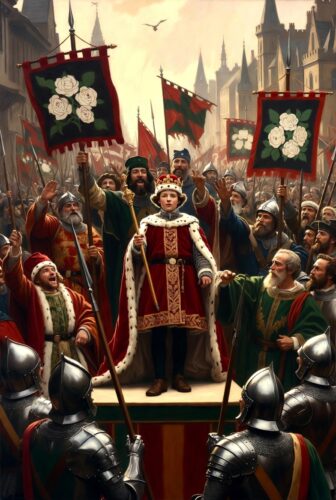 By early 1487, the conspiracy had legs. Simnel was smuggled to Ireland, where the Yorkist cause burned hot. On May 24, amid the splendor of Dublin's Christ Church Cathedral, the farce reached its zenith. The boy was anointed and crowned with all the pomp the Irish lords could muster. A parliament was convened at Drogheda. Coins were minted in his name. For a brief window, "King Edward VI" had a shadow court, an army in the making, and the backing of foreign gold. The plan: Land in England, rally Yorkist sympathizers, topple Henry VII, and install the puppet king (with Lincoln and others pulling the strings, of course).
### The March, the Battle, and the Farce's End
The invasion launched in June 1487. Simnel's forces—Irish kerns (light infantry), German landsknechts, and a smattering of English recruits—sailed from Ireland and landed near Piel Island in Lancashire. They marched inland, hoping for a groundswell of support. It never came in the numbers expected. Henry VII, ever the meticulous spider, had been tracking the plot. He paraded the *real* Earl of Warwick through London streets to prove the imposture, undermining the rebels' propaganda.
The decisive clash came on June 16, 1487, at the Battle of Stoke Field in Nottinghamshire—the last major battle of the Wars of the Roses. Henry's army of around 12,000 professional troops faced the rebel force of perhaps 8,000. It was brutal but one-sided. The German mercenaries fought with desperate ferocity, but the Irish levies broke under arrow fire and cavalry charges. John de la Pole was killed. Martin Schwartz died alongside many of his men. Lovell fled and vanished into legend (possibly drowning or hiding in a secret chamber). Simnel and Simon were captured.
Here comes the twist that makes this story deliciously human and motivational gold: Henry VII's response. Most medieval kings would have executed the pretender publicly to deter future threats. Henry, displaying the calculating mercy that defined his reign, recognized Simnel for what he was—a child pawn. The boy was pardoned. Richard Simon, the priest, got life in prison. And Lambert? He was given a job in the royal kitchens as a spit-turner, turning meat over open fires. Later, he advanced to falconer. He lived quietly, possibly married, and faded into obscurity, dying sometime after 1534. One account even suggests he fathered a canon in Essex. From fake king to kitchen servant to bird handler—talk about a career downgrade that saved his life.
By early 1487, the conspiracy had legs. Simnel was smuggled to Ireland, where the Yorkist cause burned hot. On May 24, amid the splendor of Dublin's Christ Church Cathedral, the farce reached its zenith. The boy was anointed and crowned with all the pomp the Irish lords could muster. A parliament was convened at Drogheda. Coins were minted in his name. For a brief window, "King Edward VI" had a shadow court, an army in the making, and the backing of foreign gold. The plan: Land in England, rally Yorkist sympathizers, topple Henry VII, and install the puppet king (with Lincoln and others pulling the strings, of course).
### The March, the Battle, and the Farce's End
The invasion launched in June 1487. Simnel's forces—Irish kerns (light infantry), German landsknechts, and a smattering of English recruits—sailed from Ireland and landed near Piel Island in Lancashire. They marched inland, hoping for a groundswell of support. It never came in the numbers expected. Henry VII, ever the meticulous spider, had been tracking the plot. He paraded the *real* Earl of Warwick through London streets to prove the imposture, undermining the rebels' propaganda.
The decisive clash came on June 16, 1487, at the Battle of Stoke Field in Nottinghamshire—the last major battle of the Wars of the Roses. Henry's army of around 12,000 professional troops faced the rebel force of perhaps 8,000. It was brutal but one-sided. The German mercenaries fought with desperate ferocity, but the Irish levies broke under arrow fire and cavalry charges. John de la Pole was killed. Martin Schwartz died alongside many of his men. Lovell fled and vanished into legend (possibly drowning or hiding in a secret chamber). Simnel and Simon were captured.
Here comes the twist that makes this story deliciously human and motivational gold: Henry VII's response. Most medieval kings would have executed the pretender publicly to deter future threats. Henry, displaying the calculating mercy that defined his reign, recognized Simnel for what he was—a child pawn. The boy was pardoned. Richard Simon, the priest, got life in prison. And Lambert? He was given a job in the royal kitchens as a spit-turner, turning meat over open fires. Later, he advanced to falconer. He lived quietly, possibly married, and faded into obscurity, dying sometime after 1534. One account even suggests he fathered a canon in Essex. From fake king to kitchen servant to bird handler—talk about a career downgrade that saved his life. The rebellion's failure solidified Henry's grip. It taught him (and future Tudors) the value of intelligence networks, propaganda, and selective clemency. Stoke Field marked the effective end of serious Yorkist military challenges, though pretenders like Perkin Warbeck would pop up later. For Lambert Simnel, the crown lasted mere weeks. The lesson for history? Power is theater, origins matter less than timing and adaptability, and humility can be the ultimate survival strategy.
### Echoes Across Centuries: Why This Obscure Farce Matters in 2026
Fast-forward half a millennium. The world has changed—smartphones instead of pikes, LinkedIn instead of coronations—but human nature hasn't. We still chase "thrones": promotions, influence, validation, financial security. We still face imposters—our own self-doubt, societal expectations, or external manipulators who try to define our worth. Lambert Simnel's saga, with its blend of absurdity, ambition, betrayal, and redemption, offers raw material for forging a better personal path. Not the fluffy, generic self-help mantras of "believe in yourself" or "hustle harder" that flood the internet. This is grounded in the gritty reality of a boy who wore a crown one day and turned spits the next, emerging intact.
The outcome of May 24, 1487, and its aftermath reveals that legitimacy isn't bestowed by external pomp—it's earned through endurance, quiet competence, and refusing to let one role (even a kingly one) define you forever. Simnel didn't rage against his demotion; he adapted and outlived the plotters who used him. That's the edge.
### Specific Ways This Historical Fact Benefits Your Individual Life Today
- **Embrace "Spit-Turner Resilience" in Career Setbacks**: When a big project flops or a "promotion" turns out to be a lateral move into grunt work, channel Simnel. He went from cathedral pageantry to kitchen smoke without crumbling. Today, if your startup pitch gets rejected or your job title shrinks, treat it as temporary kitchen duty. Use the time to master fundamentals—network quietly, observe power dynamics from below, and prepare for your next ascent. This beats burnout from entitlement; it's strategic humility that builds unbreakable skills.
- **Detect and Defuse Modern "Priest Simons" in Your Circle**: Simon spotted potential in Simnel and molded him for his own gain. In 2026, these are the influencers, "mentors," or colleagues who hype you up for *their* schemes—pyramid gigs, toxic side hustles, or drama that elevates them. Bullet-point audit: Does this person benefit more than you? Are promises vague on details but heavy on flattery? Walk away early, like Henry parading the real Warwick. Protect your agency.
- **Weaponize Adaptability Over Rigid Identity**: Simnel's "royal" training was fake, but the skills transferred. Apply this by treating every role as training. Switched from tech to trades? From corporate to creator economy? Your past "crown" (old expertise) equips you for the kitchen (new basics). List transferable traits: discipline from past routines, charm from presentations, endurance from deadlines. This creates a personal moat against obsolescence in AI-disrupted jobs.
- **Master Selective Mercy for Your Inner Critic and Relationships**: Henry spared Simnel not out of weakness but calculation—it neutralized the threat without creating a martyr. In your life, apply to self-talk: Forgive minor past "pretender" failures (that gym resolution, that failed course) without self-flagellation. Extend to others—confront betrayal calmly but don't burn bridges unnecessarily. It conserves energy for real battles.
- **Build Alliances Like Irish Yorkists but Vet Them Ruthlessly**: The Dublin coronation succeeded temporarily because of local loyalty networks. Today, cultivate your "Irish lords"—trusted friends, online communities, mentors—but verify their motives. Ask: Would they march with you at Stoke, or flee at the first arrow? Test with small collaborations before big commitments. This creates a resilient personal "army" without blind loyalty.
- **Turn Public "Defeat" into Private Legacy**: After Stoke, Simnel vanished from headlines but lived long. In the social media age, a viral failure (bad review, canceled project) feels eternal. Reframe: Document lessons privately, pivot publicly with humor. Your "kitchen years" become the foundation for a falconer phase—elevated, specialized expertise others envy.
- **Recognize Power as Theater and Focus on Substance**: The May 24 coronation was all spectacle. Henry's real strength was administration and intelligence. Today, ignore shiny metrics (followers, titles) and invest in systems: daily habits, financial buffers, knowledge compounding. A fake crown impresses for a day; consistent output rules decades.
The rebellion's failure solidified Henry's grip. It taught him (and future Tudors) the value of intelligence networks, propaganda, and selective clemency. Stoke Field marked the effective end of serious Yorkist military challenges, though pretenders like Perkin Warbeck would pop up later. For Lambert Simnel, the crown lasted mere weeks. The lesson for history? Power is theater, origins matter less than timing and adaptability, and humility can be the ultimate survival strategy.
### Echoes Across Centuries: Why This Obscure Farce Matters in 2026
Fast-forward half a millennium. The world has changed—smartphones instead of pikes, LinkedIn instead of coronations—but human nature hasn't. We still chase "thrones": promotions, influence, validation, financial security. We still face imposters—our own self-doubt, societal expectations, or external manipulators who try to define our worth. Lambert Simnel's saga, with its blend of absurdity, ambition, betrayal, and redemption, offers raw material for forging a better personal path. Not the fluffy, generic self-help mantras of "believe in yourself" or "hustle harder" that flood the internet. This is grounded in the gritty reality of a boy who wore a crown one day and turned spits the next, emerging intact.
The outcome of May 24, 1487, and its aftermath reveals that legitimacy isn't bestowed by external pomp—it's earned through endurance, quiet competence, and refusing to let one role (even a kingly one) define you forever. Simnel didn't rage against his demotion; he adapted and outlived the plotters who used him. That's the edge.
### Specific Ways This Historical Fact Benefits Your Individual Life Today
- **Embrace "Spit-Turner Resilience" in Career Setbacks**: When a big project flops or a "promotion" turns out to be a lateral move into grunt work, channel Simnel. He went from cathedral pageantry to kitchen smoke without crumbling. Today, if your startup pitch gets rejected or your job title shrinks, treat it as temporary kitchen duty. Use the time to master fundamentals—network quietly, observe power dynamics from below, and prepare for your next ascent. This beats burnout from entitlement; it's strategic humility that builds unbreakable skills.
- **Detect and Defuse Modern "Priest Simons" in Your Circle**: Simon spotted potential in Simnel and molded him for his own gain. In 2026, these are the influencers, "mentors," or colleagues who hype you up for *their* schemes—pyramid gigs, toxic side hustles, or drama that elevates them. Bullet-point audit: Does this person benefit more than you? Are promises vague on details but heavy on flattery? Walk away early, like Henry parading the real Warwick. Protect your agency.
- **Weaponize Adaptability Over Rigid Identity**: Simnel's "royal" training was fake, but the skills transferred. Apply this by treating every role as training. Switched from tech to trades? From corporate to creator economy? Your past "crown" (old expertise) equips you for the kitchen (new basics). List transferable traits: discipline from past routines, charm from presentations, endurance from deadlines. This creates a personal moat against obsolescence in AI-disrupted jobs.
- **Master Selective Mercy for Your Inner Critic and Relationships**: Henry spared Simnel not out of weakness but calculation—it neutralized the threat without creating a martyr. In your life, apply to self-talk: Forgive minor past "pretender" failures (that gym resolution, that failed course) without self-flagellation. Extend to others—confront betrayal calmly but don't burn bridges unnecessarily. It conserves energy for real battles.
- **Build Alliances Like Irish Yorkists but Vet Them Ruthlessly**: The Dublin coronation succeeded temporarily because of local loyalty networks. Today, cultivate your "Irish lords"—trusted friends, online communities, mentors—but verify their motives. Ask: Would they march with you at Stoke, or flee at the first arrow? Test with small collaborations before big commitments. This creates a resilient personal "army" without blind loyalty.
- **Turn Public "Defeat" into Private Legacy**: After Stoke, Simnel vanished from headlines but lived long. In the social media age, a viral failure (bad review, canceled project) feels eternal. Reframe: Document lessons privately, pivot publicly with humor. Your "kitchen years" become the foundation for a falconer phase—elevated, specialized expertise others envy.
- **Recognize Power as Theater and Focus on Substance**: The May 24 coronation was all spectacle. Henry's real strength was administration and intelligence. Today, ignore shiny metrics (followers, titles) and invest in systems: daily habits, financial buffers, knowledge compounding. A fake crown impresses for a day; consistent output rules decades. ### Your Detailed, Quick, Unique "Spit-Turner Protocol" – A 30-Day Rebellion-Proof Life Reset
This isn't another vision-board journal or 5 a.m. club clone. It's a battlefield-derived protocol inspired directly by Simnel's arc: rapid demotion, kitchen survival, quiet mastery. It's anti-fragile, integrates historical absurdity for motivation, and emphasizes "crown-to-spit" transitions as strength, not shame. Do this once, adapt forever. Takes 15-20 minutes daily.
**Week 1: The Dublin Coronation Audit (Claim Your Fake Throne Honestly)**
Morning (5 mins): Write one "crown" you're chasing this year (e.g., specific promotion, fitness milestone, side income). Detail the "robes"—what external validation looks like. Evening (10 mins): List three "Simon" influences pushing you there. Score them 1-10 on self-interest. Burn or delete the most manipulative one. Laugh at the absurdity, like a kid in ermine. This kills impostor syndrome by naming the theater.
**Week 2: The March to Lancashire (Gather Mercenaries Wisely)**
Identify 2-3 real allies. Schedule one low-stakes "landing" (coffee chat or shared task). Share a minor vulnerability from your past "rebellion" (failed goal) and note their response. Cut anyone who weaponizes it. Parallel: Build one micro-skill daily (10 mins) tied to your crown—e.g., if career, learn one industry term deeply. This creates momentum without over-reliance on hype.
**Week 3: Stoke Field Simulation (Face the Arrows)**
Simulate defeat: Intentionally tackle one hard task likely to partially fail (cold outreach, tough workout set). Journal the "battle" facts only—no drama. Then, assign yourself one "kitchen task" immediately after: a humble, repeatable action (filing receipts, meal prep, reading 10 pages). Reward with falconry time—something joyful and skill-building, like a hobby walk. Repeat to desensitize failure.
**Week 4: The Royal Kitchens Integration (Master the Spit, Eye the Falcons)**
Daily core: Morning spit-turn (non-negotiable habit in your weak area, 20 mins). Midday audit: One act of calculated mercy—for yourself or a contact. Evening legacy note: One lesson transferred from "crown" training to current role. End with visualization: See yourself as future falconer—elevated, free, handling "birds" (opportunities) with expertise. Track in a single running document titled "From Dublin to Kitchens."
Post-30 days: Review. Your "rebellion" is now internalized. The uniqueness? It uses historical irony as humor fuel (imagine explaining your spreadsheet as "my personal Stoke Field report"), forces tangible demotions as training, and prioritizes quiet competence over performative wins. No apps, no gurus—just you, the spit, and the long game. Simnel outlived his users because he adapted without ego. You will too.
### Your Detailed, Quick, Unique "Spit-Turner Protocol" – A 30-Day Rebellion-Proof Life Reset
This isn't another vision-board journal or 5 a.m. club clone. It's a battlefield-derived protocol inspired directly by Simnel's arc: rapid demotion, kitchen survival, quiet mastery. It's anti-fragile, integrates historical absurdity for motivation, and emphasizes "crown-to-spit" transitions as strength, not shame. Do this once, adapt forever. Takes 15-20 minutes daily.
**Week 1: The Dublin Coronation Audit (Claim Your Fake Throne Honestly)**
Morning (5 mins): Write one "crown" you're chasing this year (e.g., specific promotion, fitness milestone, side income). Detail the "robes"—what external validation looks like. Evening (10 mins): List three "Simon" influences pushing you there. Score them 1-10 on self-interest. Burn or delete the most manipulative one. Laugh at the absurdity, like a kid in ermine. This kills impostor syndrome by naming the theater.
**Week 2: The March to Lancashire (Gather Mercenaries Wisely)**
Identify 2-3 real allies. Schedule one low-stakes "landing" (coffee chat or shared task). Share a minor vulnerability from your past "rebellion" (failed goal) and note their response. Cut anyone who weaponizes it. Parallel: Build one micro-skill daily (10 mins) tied to your crown—e.g., if career, learn one industry term deeply. This creates momentum without over-reliance on hype.
**Week 3: Stoke Field Simulation (Face the Arrows)**
Simulate defeat: Intentionally tackle one hard task likely to partially fail (cold outreach, tough workout set). Journal the "battle" facts only—no drama. Then, assign yourself one "kitchen task" immediately after: a humble, repeatable action (filing receipts, meal prep, reading 10 pages). Reward with falconry time—something joyful and skill-building, like a hobby walk. Repeat to desensitize failure.
**Week 4: The Royal Kitchens Integration (Master the Spit, Eye the Falcons)**
Daily core: Morning spit-turn (non-negotiable habit in your weak area, 20 mins). Midday audit: One act of calculated mercy—for yourself or a contact. Evening legacy note: One lesson transferred from "crown" training to current role. End with visualization: See yourself as future falconer—elevated, free, handling "birds" (opportunities) with expertise. Track in a single running document titled "From Dublin to Kitchens."
Post-30 days: Review. Your "rebellion" is now internalized. The uniqueness? It uses historical irony as humor fuel (imagine explaining your spreadsheet as "my personal Stoke Field report"), forces tangible demotions as training, and prioritizes quiet competence over performative wins. No apps, no gurus—just you, the spit, and the long game. Simnel outlived his users because he adapted without ego. You will too. This May 24 story, rich with the dust of cathedrals, the clash of pikes, and the sizzle of kitchen fires, reminds us that history's also-rans often teach the best survival hacks. Lambert didn't conquer England, but he conquered obscurity on his terms. Apply these truths, and neither will you. Your throne awaits—not in some Dublin rite, but in the steady turn of your own daily spit, leading to heights no pretender could imagine. Get to the kitchens. The falcons are calling.